Why it is written this way
Writing effective bug reports is challenging not because of writing skills, but because of information structure. When a ticket simply says "checkout isn't working," developers fail to reproduce it, wasting hours in back-and-forth messaging while the user forgets key details.
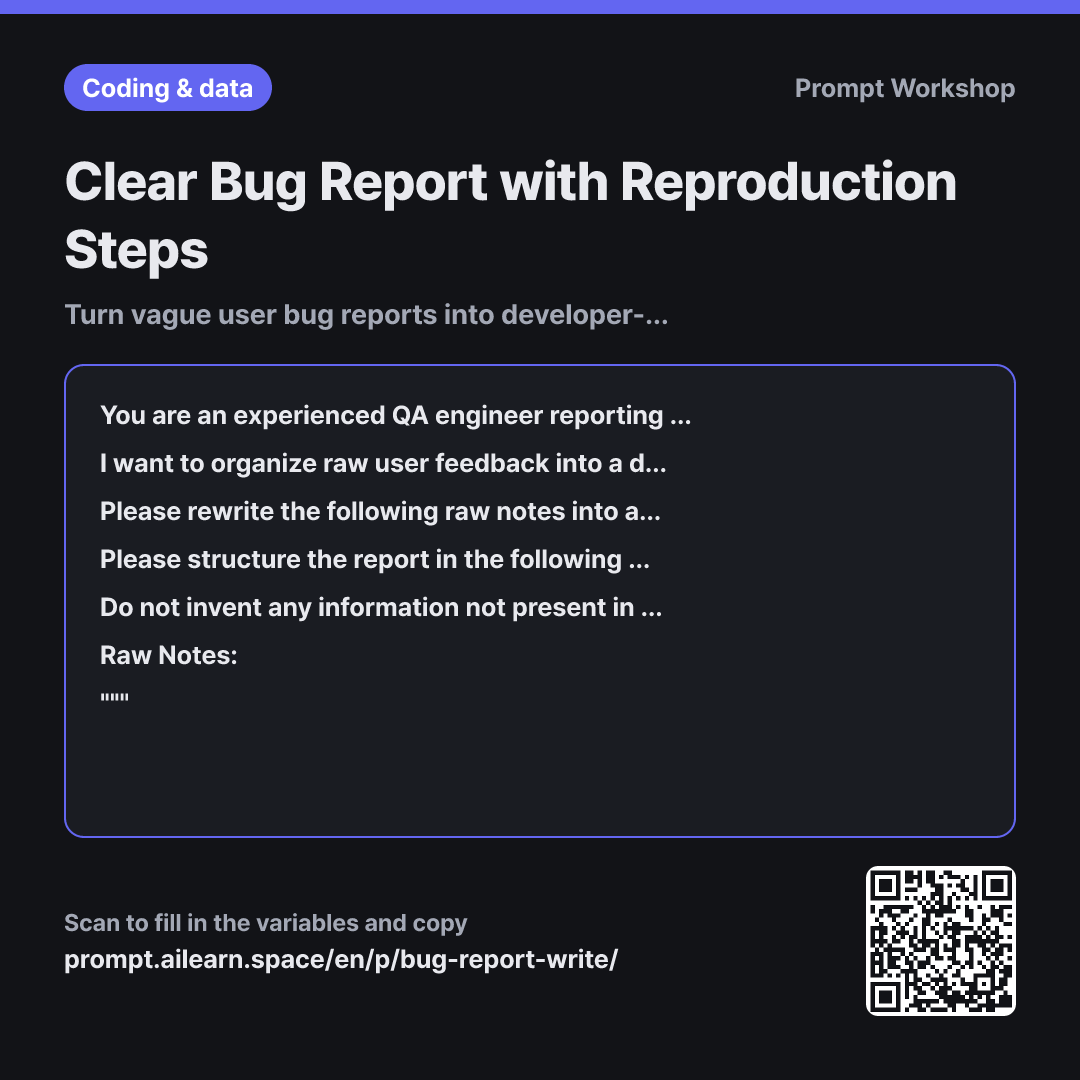
Enforcing a strict output format is the core of this prompt. In particular, separating "Expected Result" from "Actual Result" turns "it doesn't work" into "the checkout button should open the payment modal, but nothing happens on click"—instantly narrowing down where to look. Restricting reproduction steps to one atomic action per line ensures developers can pinpoint the exact moment of failure.
The three constraints filter out common noise. "Do not invent info; mark as Not provided" prevents the hallucination of plausible browser versions or fictional error messages. "Do not speculate on root causes" keeps the report objective rather than misguiding developers toward false assumptions, while generating follow-up questions ensures you can gather missing info from the reporter in a single reach-out.
Wrapping the raw notes in """ prevents user notes from colliding with the main system instructions (e.g., notes saying "Please fix this ASAP" won't confuse the model). Anonymizing user details ensures sensitive customer PII is not leaked into public or internal issue trackers.
Unfamiliar terms? See Aha AI: output-format, prompt-injection
Compared with a bad example
A customer said checkout isn't working. Please write a bug report. They said it worked yesterday but failed today.
The AI will hallucinate missing details. It may invent plausible error codes or unconfirmed browser versions, wasting developers' time investigating false leads. The reproduction steps will likely end up as a single vague line like "Attempt checkout," requiring someone to follow up anyway to ask which button was clicked.
Variations
For internally experienced bugs
I want to file a bug report for an issue I personally encountered. The environment is {{usage environment}}, and the expected behavior is {{expected behavior}}. Please format the notes below into an issue ticket, clearly separating what I have already tested from what I have not yet tested. Before filing, list 3 quick sanity checks I should run first.
""" {{symptom note memo}} """
Useful for internal testing where you have direct access to reproduce. Generating a checklist of pre-filing checks helps prevent issues from being closed as "Works on my machine."
For aggregating multiple user reports
Below is a collection of user reports submitted over the past few days. Group them by likely shared issues, and provide a single-line representative title along with key similarities and differences for each group. Isolate single, hard-to-categorize reports into a separate section. Do not guess; justify your groupings by quoting phrases directly from the reports.
""" {{symptom note memo}} """
Ideal when user feedback piles up. Grouping related reports helps you create consolidated tickets rather than spamming the backlog with duplicates.
Model notes
Attach screenshots or error screen recordings if available. Multimodal models can extract exact error messages and UI screen names that are often omitted in written notes.
Related prompts
Last updated 2026-09-02 · Found a mistake? Let us know