Why it is written this way
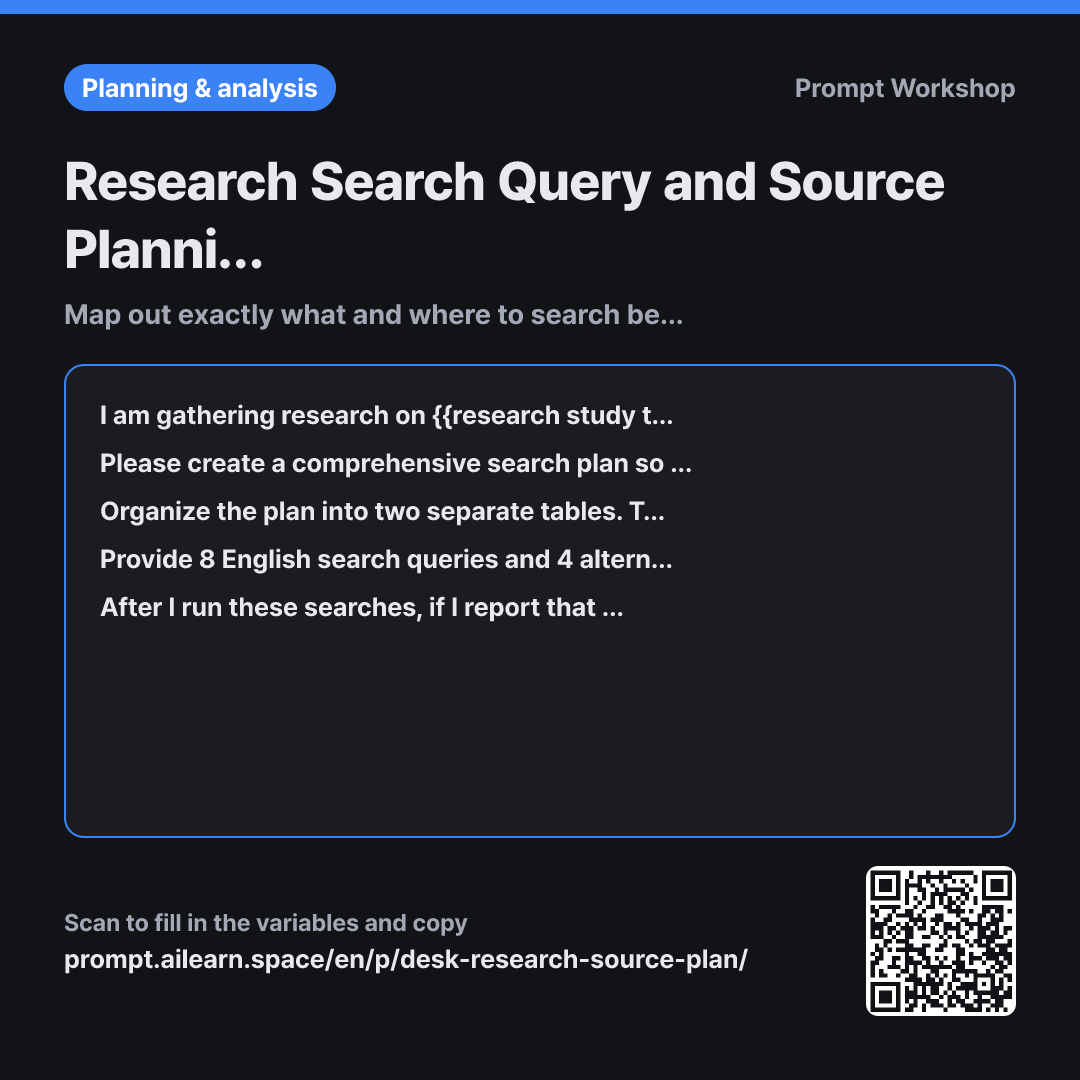
The most common issue when delegating desk research to ChatGPT is receiving hallucinated URLs. Asking for direct source links often generates plausible-looking addresses that lead to 404 pages or completely irrelevant content. Fictional report titles and paper names are often fabricated just as easily. This prompt solves that problem by requesting a search plan rather than direct answers.
This is why the task explicitly specifies: "Do not include URLs or links, and do not summarize actual findings or data." Restricting only one leads the AI to fabricate the other. Instead, this leverages what AI does best: brainstorming multidimensional search phrases and identifying the exact types of institutions likely to publish relevant data.
The format uses two distinct tables because search queries and institutional sources serve different purposes. Search queries are quick tools to test and discard, whereas credible sources become recurring references. The "Source Reliability" column is crucial for research planning, ensuring community discussions and government statistics are clearly categorized so you know what can be formally cited later.
The constraint specifying the number of search queries prevents the model from generating dozens of repetitive variations. The final instruction ensures continuous iteration: you can report dead-end searches and have the AI refine individual queries on demand.
Unfamiliar terms? See Aha AI: hallucination, output-format
Compared with a bad example
Find me sources and links showing that users over 40 are increasing on secondhand marketplace apps.
This prompt generates a list of fabricated links that lead to nonexistent or unrelated articles. Worse, it often invents quotes along with them. Using those uncVerifyable quotes in a formal deck or report creates significant compliance and credibility risks when sources are requested.
Variations
For Academic Papers and Coursework
I am preparing a {{usage destination}} on {{research study topic}}. I need to find prior literature addressing "{{required supporting evidence}}".
Please provide 12 academic search queries using established terminology in the field. Do not invent paper titles or author names. Following the queries, outline a 3-step search workflow specifying which academic databases to query and in what order.
Academic indexing depends heavily on specific terminology. This variant instructs the AI to pull standard domain keywords while preventing fabricated author citations.
Evaluating Source Reliability
I found a resource while researching {{research study topic}}. Please evaluate whether it legitimately supports the claim: "{{required supporting evidence}}".
Break your assessment into three sections: ① What this material actually supports ② Common misinterpretations that it does not actually prove ③ Key caveats or verification checks needed before citing it.
The post-research phase carries its own risks. This variant prevents confirmation bias—assuming a source validates a thesis when it only mentions adjacent topics.
Model notes
Models with live web browsing enabled may still attempt to run live searches and summarize results even when asked for a plan. Treat any summarized results as general context, and execute the generated search queries yourself for verification. Non-browsing models strictly follow the prompt to construct an optimal search blueprint.
Related prompts
Last updated 2026-09-02 · Found a mistake? Let us know