Why it is written this way
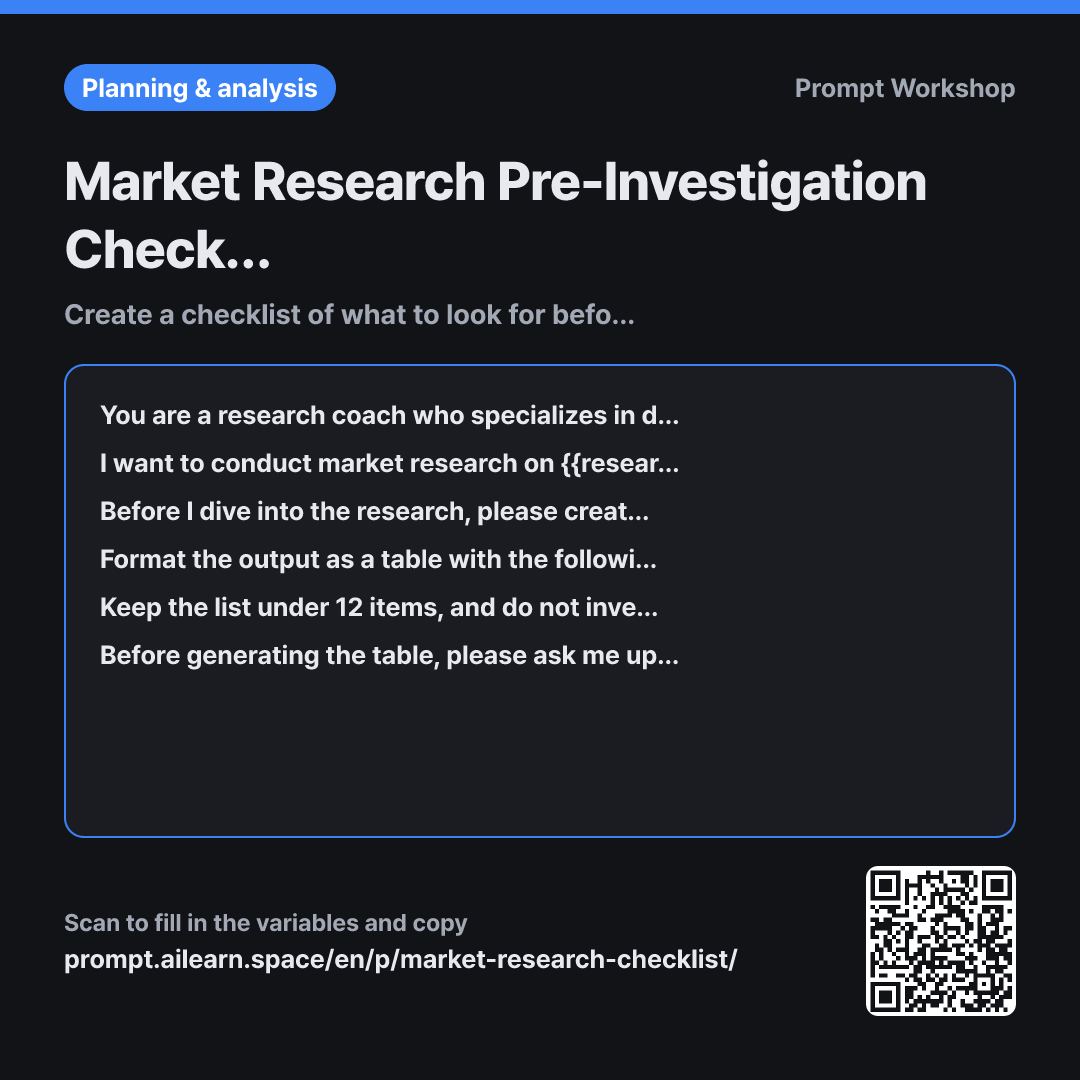
When you simply ask AI to "do market research," it immediately generates estimated market sizes and CAGR figures. The major problem is that these numbers lack verifiable sources. If you copy them into a pitch deck and an investor asks for proof, you won't be able to provide it—and often, the referenced reports don't even exist. This prompt prevents AI from giving unverified answers and instead guides it to build an actionable discovery checklist for you to verify yourself.
This is why the Role explicitly frames the AI as "a research coach who points out what to look for rather than answering directly." Stating a persona alone is not enough, so explicit negative constraints are added. The Context paragraph specifying the business stage and deadline sets the appropriate scope and length for the checklist. What you need during idea validation overlaps less than half with what you need right before launch.
In the Task paragraph, the instruction "do not provide numbers, only specify where to check" fundamentally shifts the output's purpose. This single line eliminates the most common hallucination traps during research preparation. Adding a "Why It Matters" column serves the same purpose: if you cannot justify why an item is necessary, it is usually not worth researching.
The final Clarification prompt acts as a filter to narrow the scope. If you just mention a meal prep service, the AI might cover the entire global food delivery sector. A quick exchange clarifying your target geography or known competitors cuts irrelevant items in half and drastically increases practical utility. If you are in a rush, you can simply append: "Skip questions and build the table immediately."
Unfamiliar terms? See Aha AI: role-prompting, hallucination
Compared with a bad example
Do market research on the meal prep delivery market for single people. Tell me the market size and competitors.
Asking like this produces a plausible-looking summary with market sizes and company names. However, the market figures lack verifiable sources, and the competitor list often includes defunct or non-existent companies. Worst of all, receiving these answers gives a false sense of completion, preventing you from conducting the essential primary validation yourself.
Variations
Focusing solely on competitors
I want to analyze the competitive landscape for {{research study topic}}. I am currently at the {{business stage}}.
Please create the structural framework for a competitor comparison matrix. Do not fill in actual data such as company names, pricing, or market share; leave those cells blank. Only provide the column headers and specific instructions on where to verify each data point.
This variant leaves data values blank and provides only the comparison framework. Populating the data yourself ensures verified sources and helps validate whether the comparison criteria make sense.
Finding blind spots in existing research
Below is the summary of the research I completed on {{research study topic}} ahead of {{deadline time}}.
[Insert completed research notes here]
After reviewing this, please identify 5 critical questions that this research still cannot answer. For each question, add a one-line explanation of the risks involved if left unanswered. Do not summarize or praise my research notes.
This variant shifts focus toward stress-testing for blind spots. Explicitly forbidding summaries or praise ensures the AI critiques the gaps instead of just rephrasing your existing findings.
Model notes
Models with web browsing enabled may still attempt to populate the table with online data. If this happens, ask for direct source links and click to verify that the pages are active and accurate.
Related prompts
Last updated 2026-09-02 · Found a mistake? Let us know