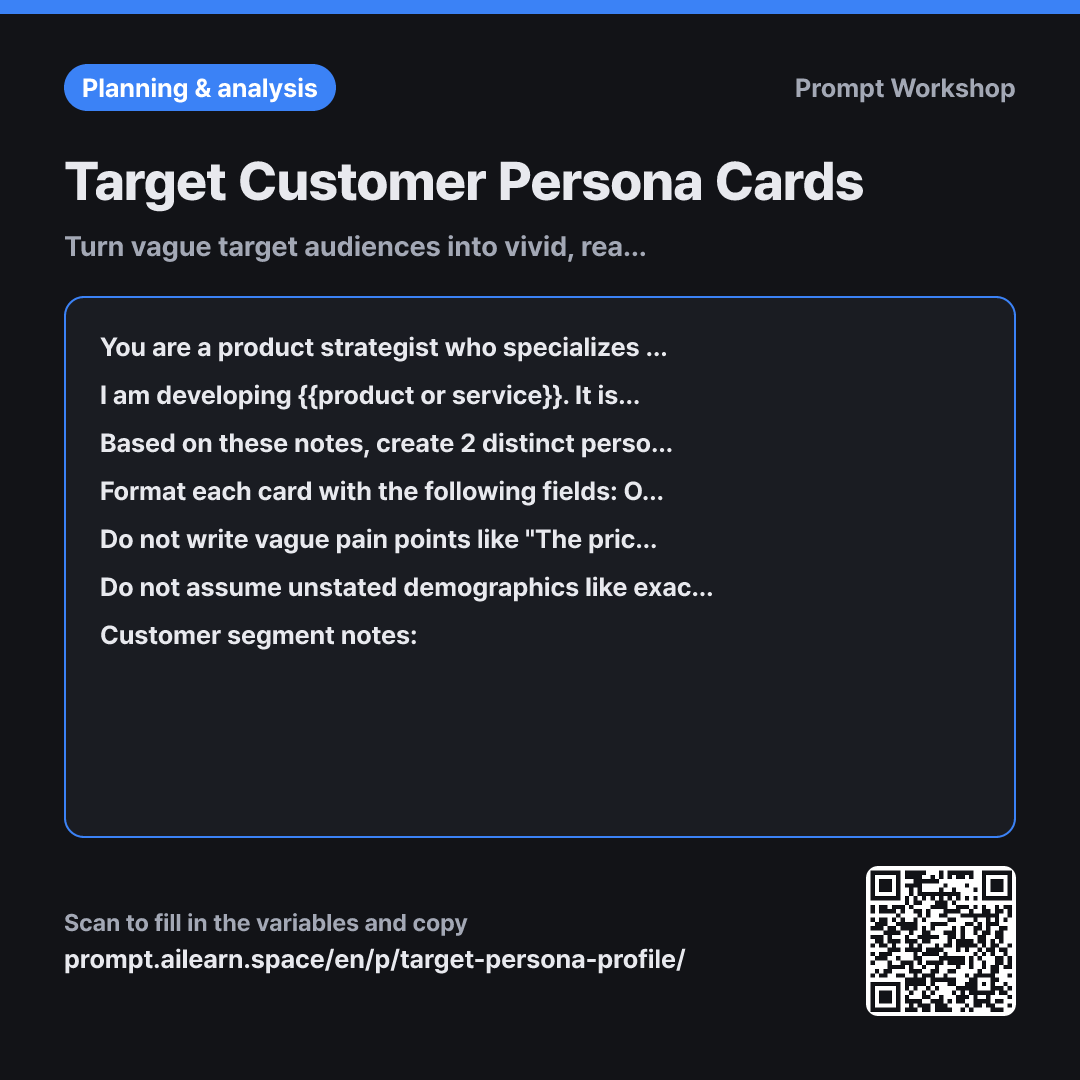
Why it is written this way
Most persona generators stop at generic profiles like "Working professional in her 30s, cares about wellness." While these fit neatly into slide decks, they are useless for actual product planning because they provide zero filter for what features to build or which copy to write. This prompt focuses on extracting concrete scenes rather than broad demographics.
Setting the Role as a strategist who "pictures a single person's daily routine rather than statistics" sets the tone. A market analyst persona returns percentages and market segments, while a copywriter persona creates overly emotional fluff. The same logic applies to asking for the usage context in the Context paragraph—weekday evenings and weekend mornings attract entirely different people even for the exact same Pilates studio.
Listing specific fields in the Format section forms the backbone of this prompt. Crucial fields like "How they currently cope" and "The single reason they might churn" are often omitted, yet the former reveals true competitors (including workarounds) and the latter uncovers early churn risks. A persona card filled only with positive traits merely serves to flatter your assumptions.
Paragraph 5 uses an Example to calibrate the required level of detail. Contrasting "The price feels expensive" with "Arrived at 8 PM... so I just went home" sets the expectation for specificity without long explanations. Finally, the (Inferred) tag in the Constraints prevents you from taking AI assumptions as absolute fact. A high number of inferred tags does not mean the persona is flawed; it highlights exactly what you still need to validate directly with customers.
Compared with a bad example
Create a target customer persona for a Pilates studio. Working women in their 30s and 40s.
This produces a generic character bio listing a name, age, job title, and hobbies. It sounds plausible, but it incorporates none of your real studio notes, nor does it address core issues like members churning after 3 months. You cannot use such cards to decide whether to adjust your class schedule or revamp your onboarding consultations.
Variations
Validating with Existing Customer Data
Here are customer notes for {{product or service}}. I originally assumed my core target audience was people coming in for {{usage context}}.
Read the notes and highlight 3 clear signals that contradict my assumption. For each signal, cite the exact sentence from the notes that led to your conclusion. Do not generate persona cards.
""" {{customer segment notes}} """
Use this approach to test your assumptions against raw data before building full personas. Forcing the AI to cite specific source sentences prevents it from inventing plausible-sounding objections.
Translating Personas into Ad Copy
Choose one customer profile from the notes below who comes in for {{usage context}}, and write ad copy that would stop them in their tracks when they see {{product or service}}.
Generate 3 copy variations. Each variation must include one short headline and one line of explanation. In parentheses after each variation, state which specific pain point it addresses. Avoid exaggerated claims or unverified metrics.
""" {{customer segment notes}} """
A persona's real-world usefulness is immediately tested when turning it into messaging. Requiring the AI to specify the exact pain point being targeted filters out empty marketing fluff.
Related prompts
Last updated 2026-09-02 · Found a mistake? Let us know