Why it is written this way
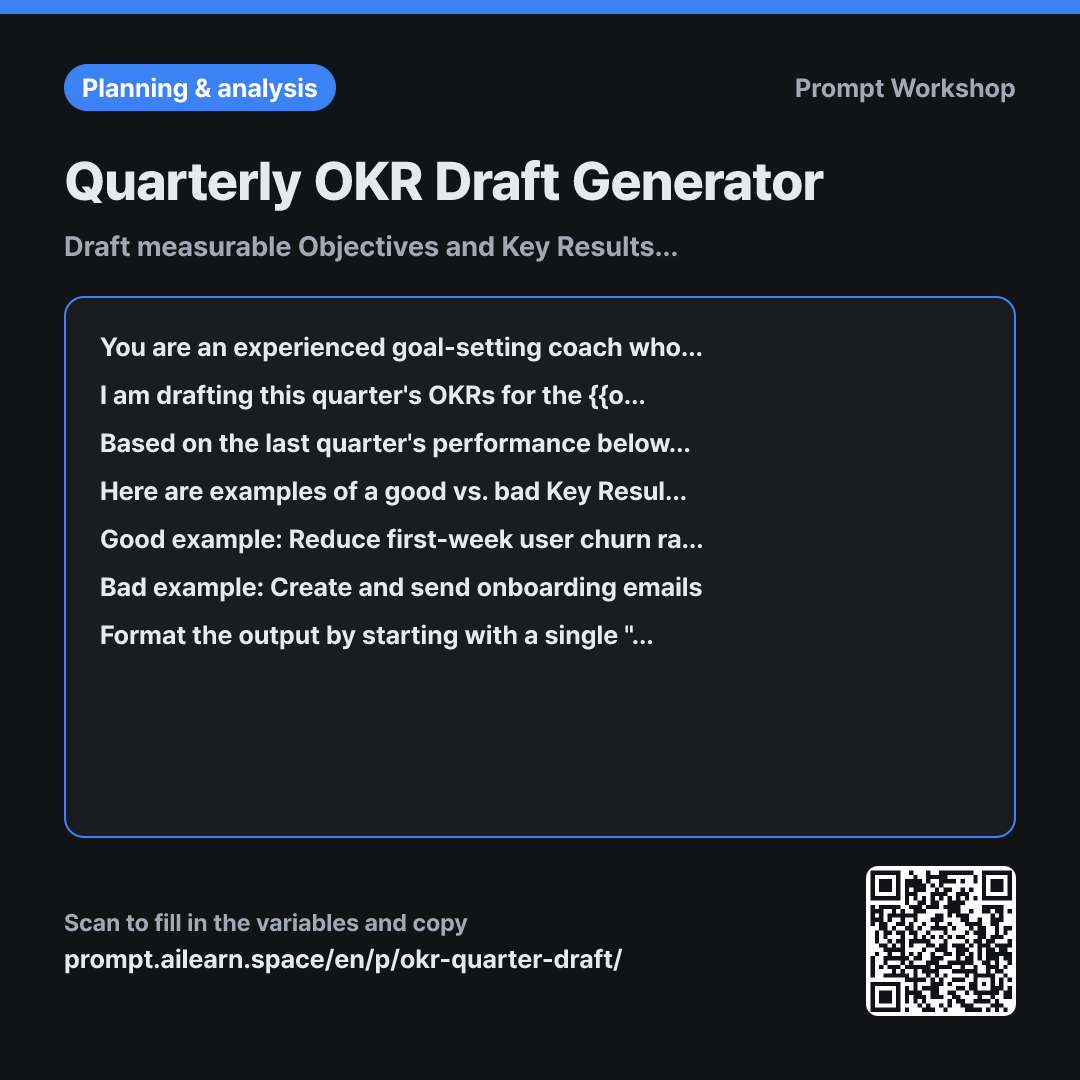
When asking ChatGPT to draft OKRs, nine times out of ten it returns a generic to-do list in place of Key Results. If entries like "Send onboarding emails" or "Write 10 blog posts" take the Key Result spots, you only measure effort, not outcome. Most instructions in this prompt are intentionally designed to prevent that failure mode.
The Role in the opening paragraph defines not just a "consultant," but specifically someone vigilant against task lists. Giving the AI a specific bias to guard against encourages it to filter items rather than pad them. Stating in the Context that you will refine the draft with your team prevents the AI from fabricating plausible data just to look complete.
The two-line Examples in the middle serve as the core of this prompt. Showing good and bad examples side-by-side sets a clearer standard than paragraphs of explanation. The "Current Value → Target Value" requirement in the Format ensures metrics are not omitted, while the "Things to stop doing" section prevents the quarterly plan from becoming an unmanageable wish list.
The Constraints section caps the count at three and mandates "Baseline TBD" for unknown metrics. The biggest risk when setting quarterly goals is an invented baseline—starting from false assumptions inevitably leads to inaccurate targets.
Unfamiliar terms? See Aha AI: role-prompting, few-shot
Compared with a bad example
Create this quarter's OKRs for our team. The goal is to get more signups.
A vague request like this results in three Objectives with nine generic Key Results. Even if numbers appear, they lack baseline context (e.g., "increase signups by 30%"), making them unmeasurable at quarter's end. Tasks like "manage social media channels" will creep into the Key Results, forcing you to rewrite everything from scratch before sharing it with your team.
Variations
When the Objective is fixed and you only need Key Results
The quarterly Objective for the {{official team name}} is: "{{quarterly goal}}". Please propose 5 candidate Key Results to measure this Objective, then select the top 3 non-overlapping ones and explain your reasoning.
Format each candidate as: "Metric Name · Current Value · Target Value · Measurement Method". If the current value is not found in the context below, mark it as "Baseline TBD".
Last quarter performance: """ {{last quarter performance}} """
Often, the Objective is already agreed upon. Generating five options and narrowing them down to three provides clear rationale for comparisons during team discussions.
Breaking down team OKRs into individual ownership
The quarterly Objective for the {{official team name}} is: "{{quarterly goal}}". Please break this team goal down into individual workstreams.
First, group the necessary efforts into distinct workstreams. For each workstream, provide a single sentence answering: "What tangible outcome must this owner deliver by the end of the quarter?" Ensure no single owner is assigned more than two workstreams, and do not assign individual performance ratings or scores.
Copying team OKRs directly to individuals makes everyone collectively accountable for the same high-level metric without clear ownership. Grouping by workstream first highlights overlap and gaps before assigning owners.
Model notes
When requesting Objectives and Key Results simultaneously, models may occasionally generate more than five Key Results. If this happens, follow up with: "Keep only the top 3 most impactful Key Results and explain why the others were removed."
Related prompts
Last updated 2026-09-02 · Found a mistake? Let us know