Why it is written this way
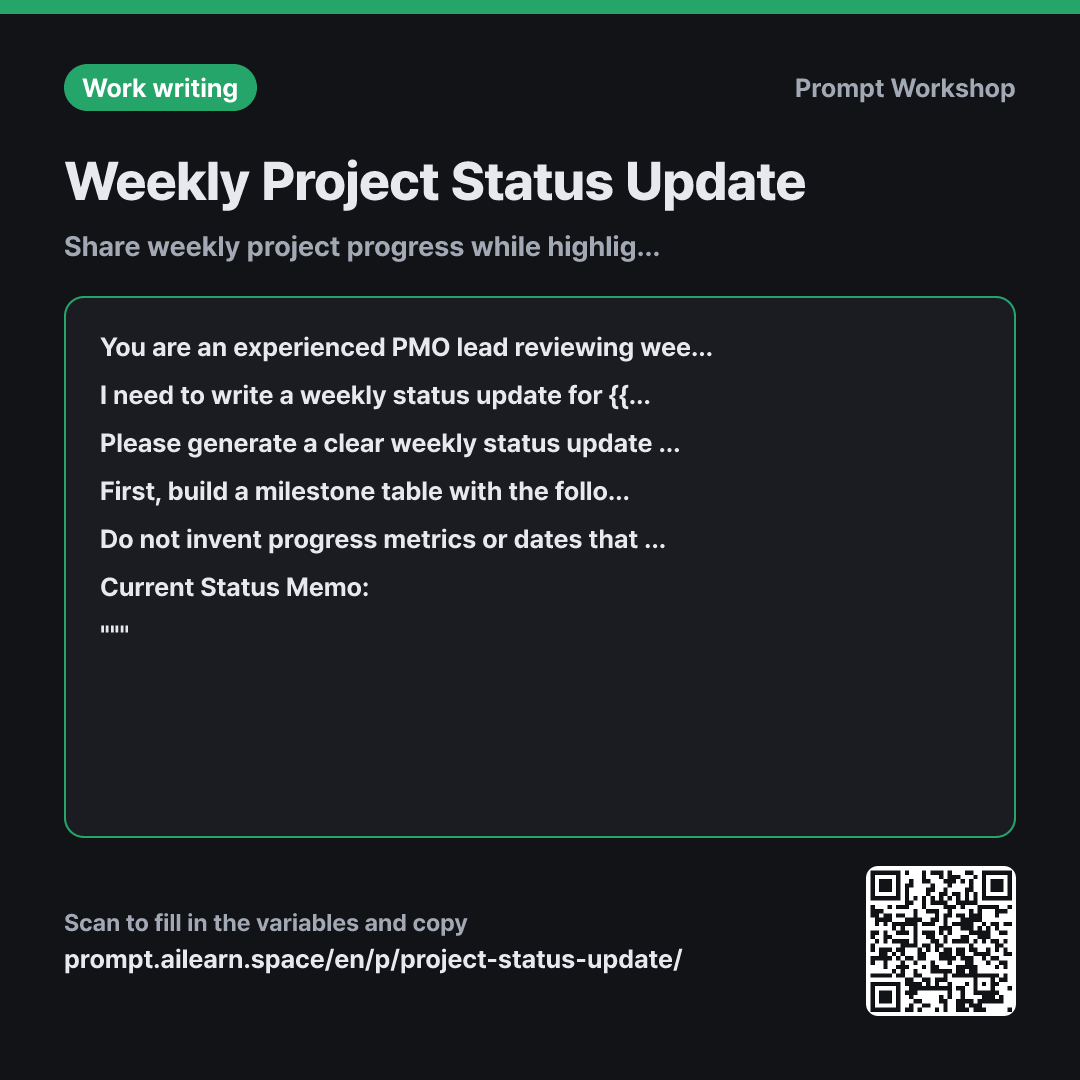
A weekly project status report becomes useless when it turns into an overly optimistic "all-green" update that hides real friction. Problems often blow up two weeks before the release deadline when stakeholders no longer have time to help. This prompt ensures bad news and blockers have a designated, visible spot in the report.
In the format instructions, limiting the status options to "On Track," "At Risk," and "Blocked" prevents vague filler phrases like "In Progress" from disguising delays. The "One-line Justification" column forces clear facts next to every rating so readers can instantly validate the assessment.
The constraint rule stating that "milestones linked to issues must never be marked On Track" is critical. Language models tend to smooth out reports and lean toward optimism even when notes explicitly list bottlenecks. Similarly, establishing a dedicated "Help Needed" section forces actionable escalation items to be written out explicitly.
The final self-review instruction ensures the model checks its own output. AI models often forget earlier negative constraints as they write longer drafts; this step filters out hallucinated all-green dashboards.
Unfamiliar terms? See Aha AI: output-format, self-consistency
Compared with a bad example
Summarize this week's project status for me.
(Paste raw weekly notes)
This prompt produces a superficial paragraph focusing solely on completed items, such as "Design review completed and QA environment ready." The critical fact that backend development is blocked by missing vendor specs gets reduced to a minor detail like "pending some verifications." Without a milestone-based status table, team leads cannot tell which deadline is at risk and have no clear next steps to unblock the team.
Variations
One-Page Executive Briefing
Summarize the current status of {{official project name}} into a concise one-page briefing for executive leadership. Start at the very top with a single line labeled "Decisions Needed Now," followed by an overall project health indicator (On Track · At Risk · Blocked) with a two-sentence factual rationale. Conclude with a simplified milestone timeline based on {{project milestone}}. Avoid internal jargon and keep the entire summary under 200 words.
""" {{current status memo}} """
Executives prioritize required decisions and overall risk over granular task lists. This variant flips the structure and condenses the length.
Initial Delay Notification
Draft an initial delay notification for {{official project name}} to inform cross-functional partner teams about an upcoming schedule slip. In the very first sentence, state clearly in exact figures/dates what is delayed and by how much. Provide the objective cause in no more than two factual sentences. Then, outline the revised timeline proposal, recovery action plan, and adjustments requested from partner teams in order. Keep any apology to a single professional sentence without making excuses.
""" {{current issue item}} """
Delay announcements lose credibility when buried in lengthy apologies. This variant centers on transparent facts and adjusted timelines.
Model notes
Some models may skip the internal self-check step and output an overly optimistic initial draft. If this happens, prompt it once more with: "Please re-evaluate every item marked 'On Track' against the reported blockers and justify the status."
Related prompts
Last updated 2026-09-02 · Found a mistake? Let us know