Why it is written this way
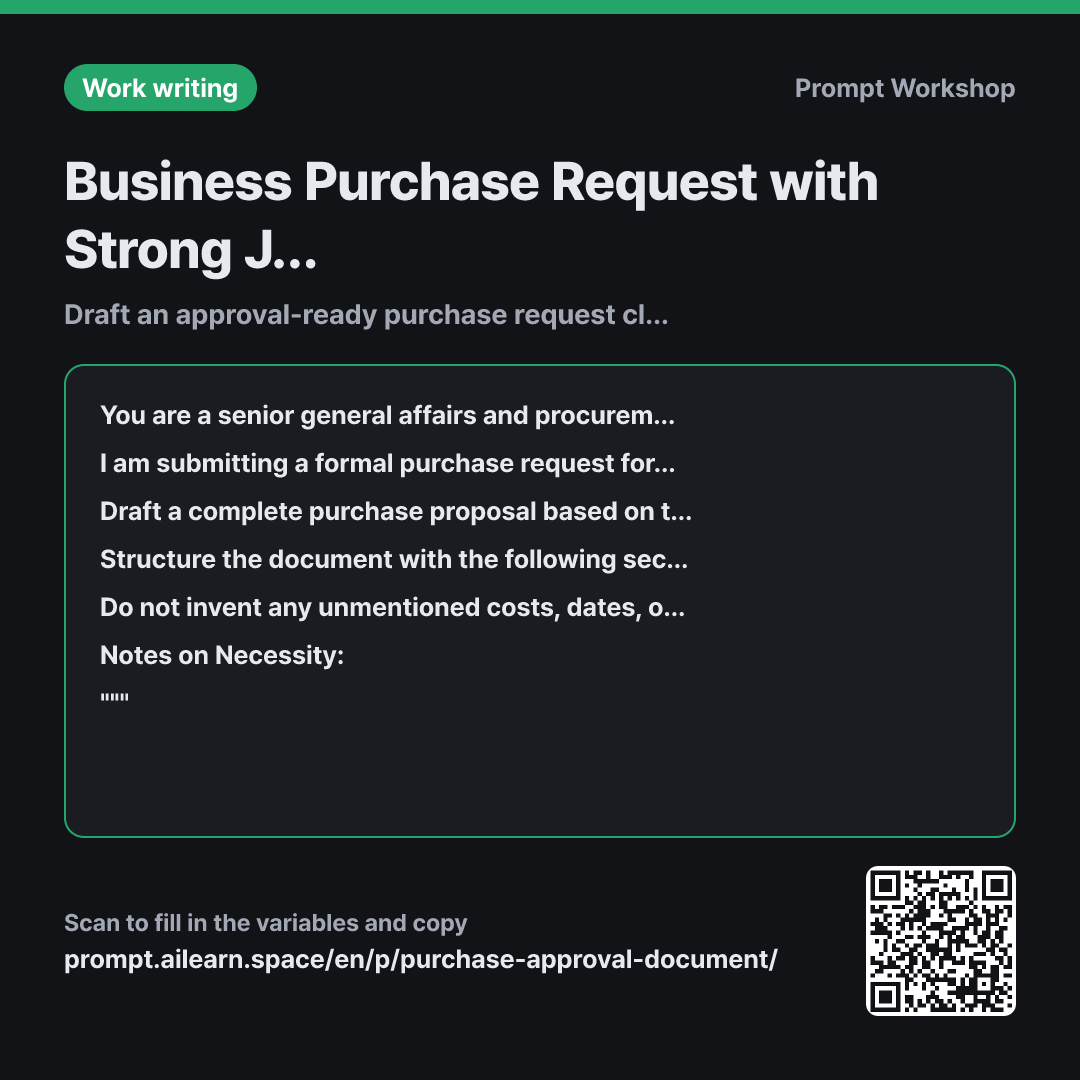
Purchase proposals are usually rejected not because of the price tag, but because of a weak justification. A single sentence like "Needed to perform daily business operations" forces decision-makers to question what will actually happen if we do not buy it now, or if there is a cheaper workaround. Preventing this generic reasoning is the primary goal of this prompt.
This is why the Context section explicitly includes the total cost, approval chain, and alternatives. Approvers evaluate a $300 purchase very differently from a $3,000 one, and finance directors scrutinize the underlying cost logic much more strictly. Addressing the alternative comparison upfront proactively resolves the inevitable objection: "Did you consider cheaper alternatives or leasing?"
In the Task section, separating "current problems without the item" from "improvements after purchase" provides the core framework for a rock-solid business case. The Format section mandates a structured order and standardizes item details into a table because numbers are much easier to audit in a tabular view.
Lastly, the Constraints require [Needs Verification] placeholders to prevent AI hallucination on prices and dates. Asking the AI to raise up to three clarifying questions first ensures that critical gaps are surfaced back to you rather than filled with assumptions.
Unfamiliar terms? See Aha AI: prompt, output-format
Compared with a bad example
Write a purchase proposal for 4 monitors. Around $3,200.
A prompt this vague results in generic fluff like "To enhance operational efficiency and drive team productivity." Approvers get zero concrete decision-making criteria from such statements and will inevitably bounce the request back asking for justification. Furthermore, without quotation details, the AI will invent unit prices and totals, creating discrepancies that require re-submitting amended requests later.
Variations
When a Submitted Proposal Was Rejected
Below is the justification section of a purchase proposal for {{purchased items}} that was rejected by management. Before rewriting it, please diagnose the flaws: ① Sentences the approver would view as lacking concrete evidence, ② Points that provoke unanswered questions about cheaper alternatives, and ③ Adjectives that should be replaced with hard metrics or data. After the breakdown, provide a revised justification addressing the most critical issues.
""" {{required necessity reason}} """
Asking for an immediate rewrite without diagnosing the root cause often leads to repeating the same mistakes in future proposals. Getting a critique first builds better long-term proposal habits.
For Recurring Consumables and Supplies
Draft a purchase request for recurring orders of {{purchased items}}. The estimated total amount is {{monetary amount}}, and this will be submitted as a recurring quarterly expense rather than a one-time purchase. Base the justification strictly on consumption data (monthly burn rate, current inventory levels, projected stock-out date), and explain in one sentence why the requested order batch quantity is optimal.
""" {{required necessity reason}} """
Proposals for recurring supplies get stuck on quantity validation rather than basic necessity. This variant shifts the justification focus onto inventory metrics and burn rates.
Model notes
LLMs can occasionally make arithmetic errors when summing totals in markdown tables. After receiving your draft, always double-check the calculations with a quick prompt: "Recalculate the table totals to verify the math is accurate."
Related prompts
Last updated 2026-09-02 · Found a mistake? Let us know