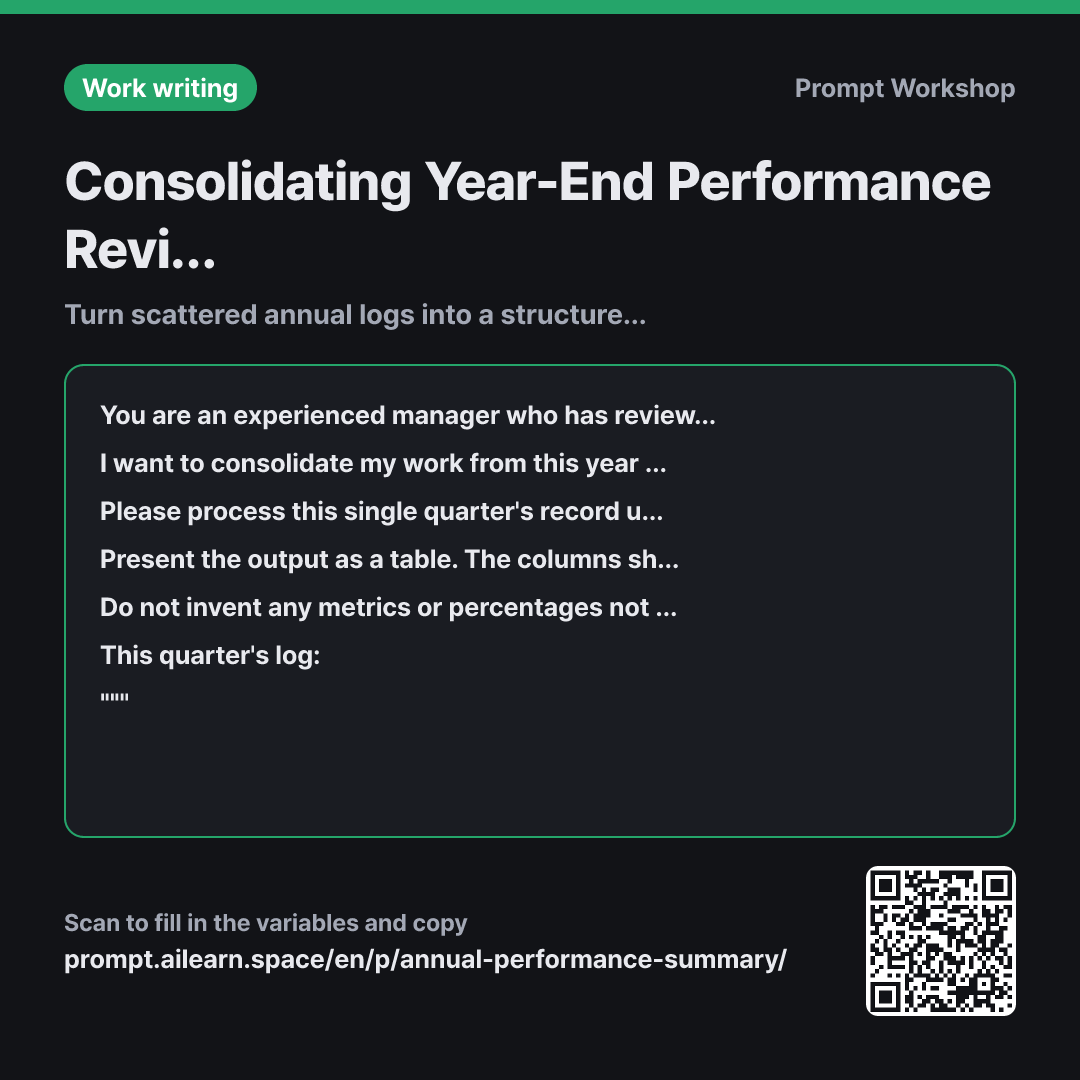
Why it is written this way
At the end of the year, people often dump an entire year's worth of notes into an AI prompt at once. Doing so often leads the model to drop tasks from January and February entirely, because token context limits cause later information to push out earlier details. This is why a quarter-by-quarter workflow is essential for year-end reporting.
The final paragraph acts as a deliberate anchor. Instead of dumping everything at once, you run four separate iterations across quarters within the same chat session and ask the model to combine them at the end. Because previous quarterly tables remain in the chat history, the final synthesis retains full context without losing early-year details.
Breaking down the process into four steps separates organization from evaluation. If you ask for completion checks, goal alignment, quantification, and grouping all at once, the model tends to blur them into vague fluff like "successfully revamped the system." Specifying the four columns in the format section forces each evaluation criteria into its own distinct cell.
The [Verify Metric] placeholder in the constraints section guards against the biggest risk in performance reviews: hallucinated metrics. Models easily invent numbers like "reduced closing time by 40%" to sound impressive, which becomes impossible to defend in an appraisal interview. Requiring setbacks to be documented alongside lessons learned gives you a defensible narrative for any missed targets.
Unfamiliar terms? See Aha AI: context-window, output-format
Compared with a bad example
Summarize what I did this year and write a year-end performance report.
(Pastes entire year's worth of work logs)
The output will heavily skew toward tasks from the second half of the year. Work from Q1 and Q2 will be reduced to a couple of lines or omitted entirely, and alignment with annual goals will not be tracked. The text will be packed with empty buzzwords like "actively supported and successfully completed," which offer no concrete evidence to reviewers. Furthermore, any hallucinated percentages will be difficult to defend during an evaluation interview.
Variations
When Merging Four Quarters into a Final Report
Please merge the quarterly tables created so far into a single year-end performance report. If the same initiative spans multiple quarters, group it together and provide a one-line timeline showing progression across milestones. Structure the final document as follows: a 5-sentence annual executive summary · a table showing target vs. achievement against {{annual target goal}} · 3 to 4 core initiatives · areas for improvement and action plans. Please place {{achievements to highlight}} prominently in an upfront section. Do not introduce any new information that was not present in the previous tables.
Use this follow-up prompt in the same conversation after generating all four quarterly tables. Without the explicit instruction "Do not introduce any new information," the model may hallucinate extra accomplishments during the synthesis step.
When Converting into a Self-Evaluation Statement
Please convert the year-end summary below into a performance self-evaluation statement format. For each item, write a paragraph structured as Situation · Action Taken · Result, keeping each entry under 150 words. Ensure the tone aligns with the expected role and scope of a {{organization affiliation}}, and do not add unverified achievements or metrics—mark them as [Verify Metric] instead.
""" {{annual work record}} """
While a year-end review lists factual deliverables, a self-evaluation emphasizes individual role execution and impact. This variant reorganizes the same raw material into the structure evaluators look for during formal appraisals.
Model notes
Pasting an entire year's worth of logs at once often causes early-year details to be dropped from the summary. Run the prompt four times across separate quarters in the same chat, then ask the model to merge them in the final step.
Related prompts
Last updated 2026-09-02 · Found a mistake? Let us know