Why it is written this way
What really wastes time when processing work requests is not the difficulty of the task, but the brevity of the instruction. A one-liner like "look into root causes and prepare an action plan" specifies neither report length, strategic scope, nor the relevant timeframe for the data. Hesitating to ask clarifying questions often leads to guessing, only to hear "this isn't what I asked for" after finishing the entire project.
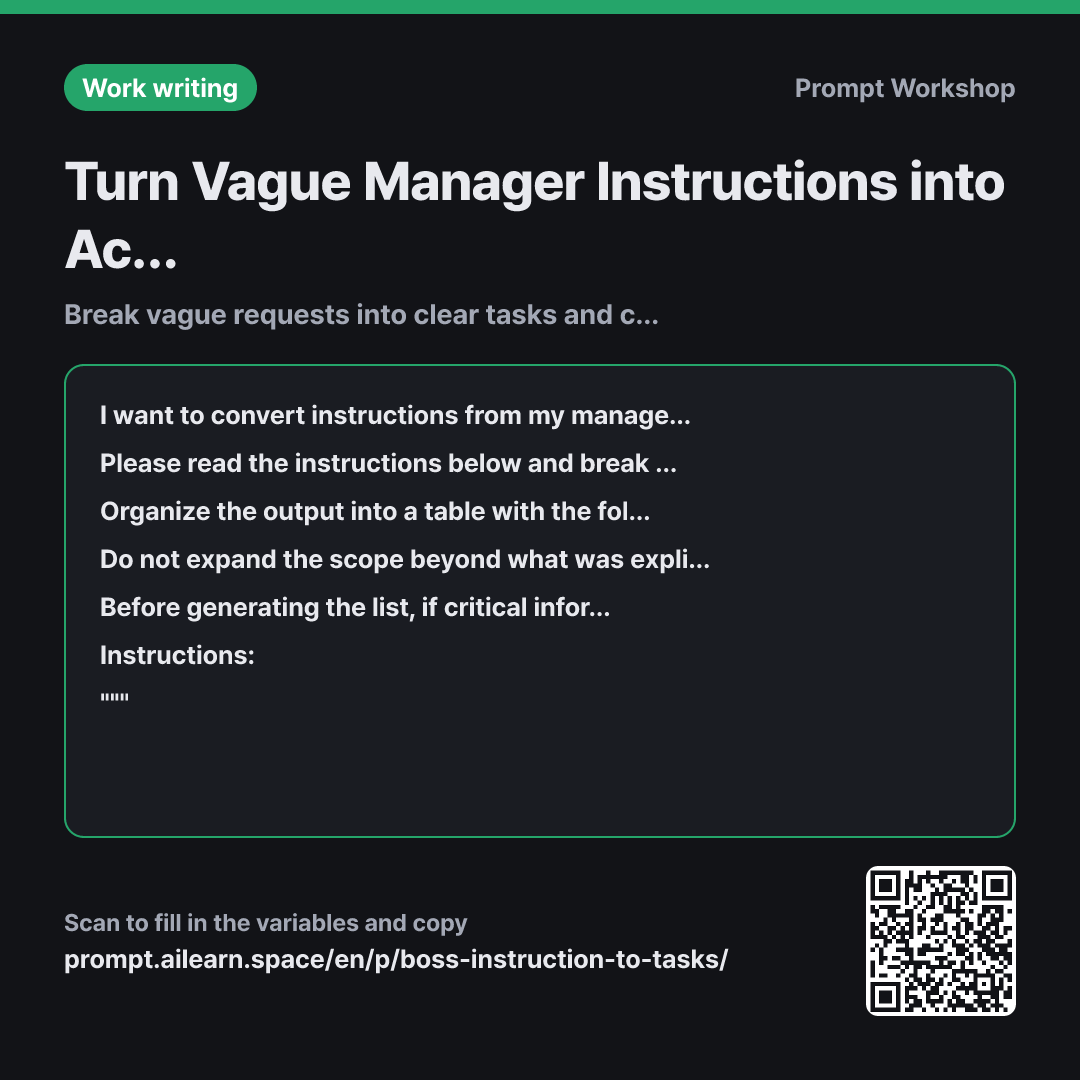
The Task paragraph specifies sizing tasks to "a single sitting" because without explicit breakdown instructions, the model defaults to giant, unstartable blocks like "Analyze churn causes." Requiring concrete deliverables instead of "review" serves the same purpose: you need a tangible output to know when a task is truly done.
The "Deliverable / Outcome" column in the Format paragraph is the core of this prompt. Filling this out often reveals what deliverables were unclear in the first place. The Constraints paragraph prevents the opposite failure mode: left unchecked, AI tends to hallucinate extra steps like "competitor benchmark survey" or "customer focus group design," needlessly doubling your workload.
The follow-up questions in the final paragraph pair with the "Items to Clarify First" list. The most valuable outcome when organizing ambiguous instructions is often not the task list itself, but the two or three strategic questions to ask your manager before starting. Asking those upfront eliminates rework entirely.
Unfamiliar terms? See Aha AI: prompt, hallucination
Compared with a bad example
Make a to-do list for this task.
(Paste instructions)
You will get a plausible five-step list, but most of it will be unrequested generic filler. Generic steps like "Data collection → Analysis → Insight extraction → Report writing" leave you unsure of what tool or file to actually open first. Ambiguities are not flagged as questions; instead, the AI makes arbitrary assumptions and embeds them directly into the tasks.
Variations
When multiple requests arrive at once
Below are multiple requests received throughout today. Each has a different timeline, but the earliest deadline is {{deadline time}}.
First, group the instructions by individual request, then tag each one as "Do this week / Defer to next week / Delegate to someone else." Afterward, compile an ordered action list containing only the items marked "Do this week."
""" {{instruction command detail}} """
When dealing with multiple assignments, prioritization comes before task decomposition. Filter and categorize before breaking down the workflow.
Drafting clarifying questions for your manager
I received the instructions below and need to clarify a few points. Please write a brief message I can send to my manager.
First, summarize my understanding of the request in 2–3 sentences. Then, list up to 3 specific questions that need clarification. For each question, provide my proposed recommendation/option so my manager only needs to review and pick one. The deadline is {{deadline time}}.
""" {{instruction command detail}} """
Listing raw questions can make it look like you are passing the burden back to your manager. Stating your current understanding and offering options gets you much faster, decisive answers.
Model notes
Estimated completion times generated by AI are generally optimistic. After receiving the table, ask: "Recalculate the timeline by factoring in time for gathering sources and waiting for approvals," to get a much more realistic schedule.
Related prompts
Last updated 2026-09-02 · Found a mistake? Let us know