Why it is written this way
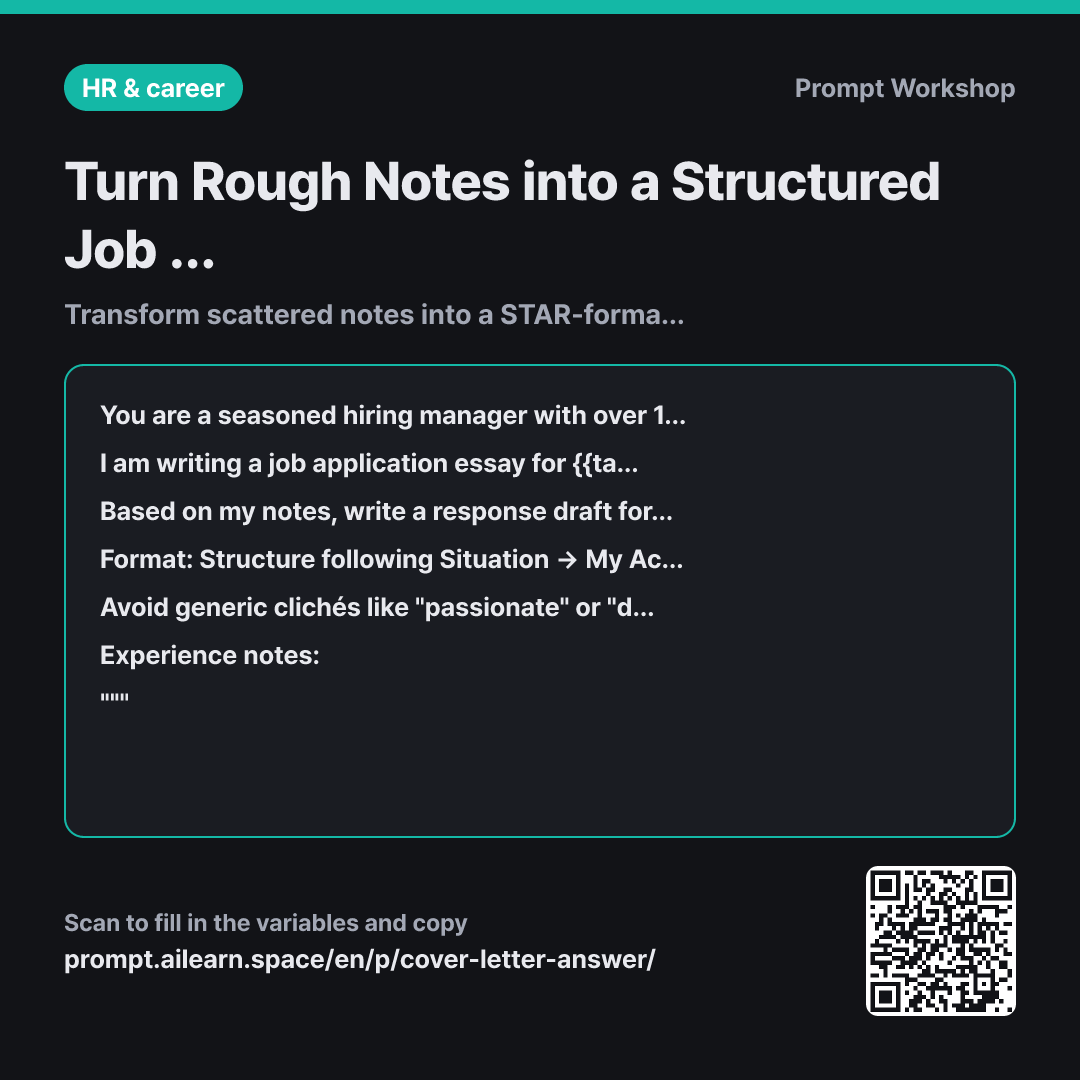
The biggest risk of relying on AI for job application essays is plausible hallucination. AI naturally invents claims like "increased subscribers by 40%" just to make the text flow smoothly. Getting questioned about made-up figures in an interview can be disastrous. This is why the prompt goes beyond telling the AI "do not make things up" in the Task section and explicitly instructs it to leave placeholders in brackets. When merely forbidden from doing something, AI tends to fill the gap anyway; offering a clear alternative (leaving blanks) ensures compliance.
Combining the Role of a "hiring manager and career writing coach" bridges the perspective of a critical evaluator with the craft of an effective writer. A recruiter persona alone yields dry, bureaucratic text, while a writing coach alone might neglect hiring priorities. The Context fields for role and target company help highlight the most relevant facets of the candidate's background.
In the Format section, the "Situation → Action → Result → Takeaway" (STAR) framework matches the standard evaluation criteria recruiters look for. Leading with the conclusion prevents hiring managers, who review hundreds of essays, from losing interest. The Constraints against clichés eliminate typical AI markers. Enclosing raw notes in """ delimiters ensures statements like "persuading team members was tough" are processed as factual source material rather than instructions.
Finally, requesting "2 follow-up questions" bridges essay drafting directly into interview prep. Following up with "Help me add a paragraph answering question #2" allows you to refine the draft effectively (iterative refinement).
Unfamiliar terms? See Aha AI: hallucination
Compared with a bad example
Write a job essay for me. Prompt: Experience solving a tough problem. I managed a YouTube channel.
With only one line of context, the AI fills the rest with pure imagination. The result will be filled with generic phrases and unverified numbers that cannot be defended in an interview, lacking both structure and word-count control.
Variations
Reviewing and Critiquing an Existing Draft
You are a seasoned hiring manager with over 10 years of experience recruiting for {{job position role}} roles. Below is my draft response to the application prompt "{{question item}}" for {{target application company}}.
Do not rewrite it right away; evaluate it first. Please point out 2 specific examples for each of the following: ① What a recruiter would be most curious or doubtful about, ② Sentences where the evidence/action is weak, and ③ Clichés or unnecessary fluff. Afterward, provide a revised version addressing only the single most critical flaw.
""" {{experience notes}} """
The instruction "Do not rewrite it right away; evaluate it first" is essential. Asking the AI to edit immediately often overwrites the candidate's authentic voice with generic AI phrasing.
Short Cover Letter Paragraph
You are a hiring manager with 10+ years of experience recruiting for {{job position role}} roles. I am applying to {{target application company}}. Using only the notes below, draft a cover-letter paragraph answering: "{{question item}}". Do not invent numbers or experiences; mark gaps as [add specific number]. Structure: situation → action → result → lesson, about 150 words, lead with the outcome. Avoid clichés like "passionate" and "hard-working".
""" {{experience notes}} """
Ideal for drafting a concise STAR-method paragraph for standard Western-style cover letters.
Model notes
AIs often struggle to match exact character or word count limits on the first try. After receiving the draft, follow up with: "Count the words/characters and adjust the length to fit within the target range."
Related prompts
Last updated 2026-09-02 · Found a mistake? Let us know