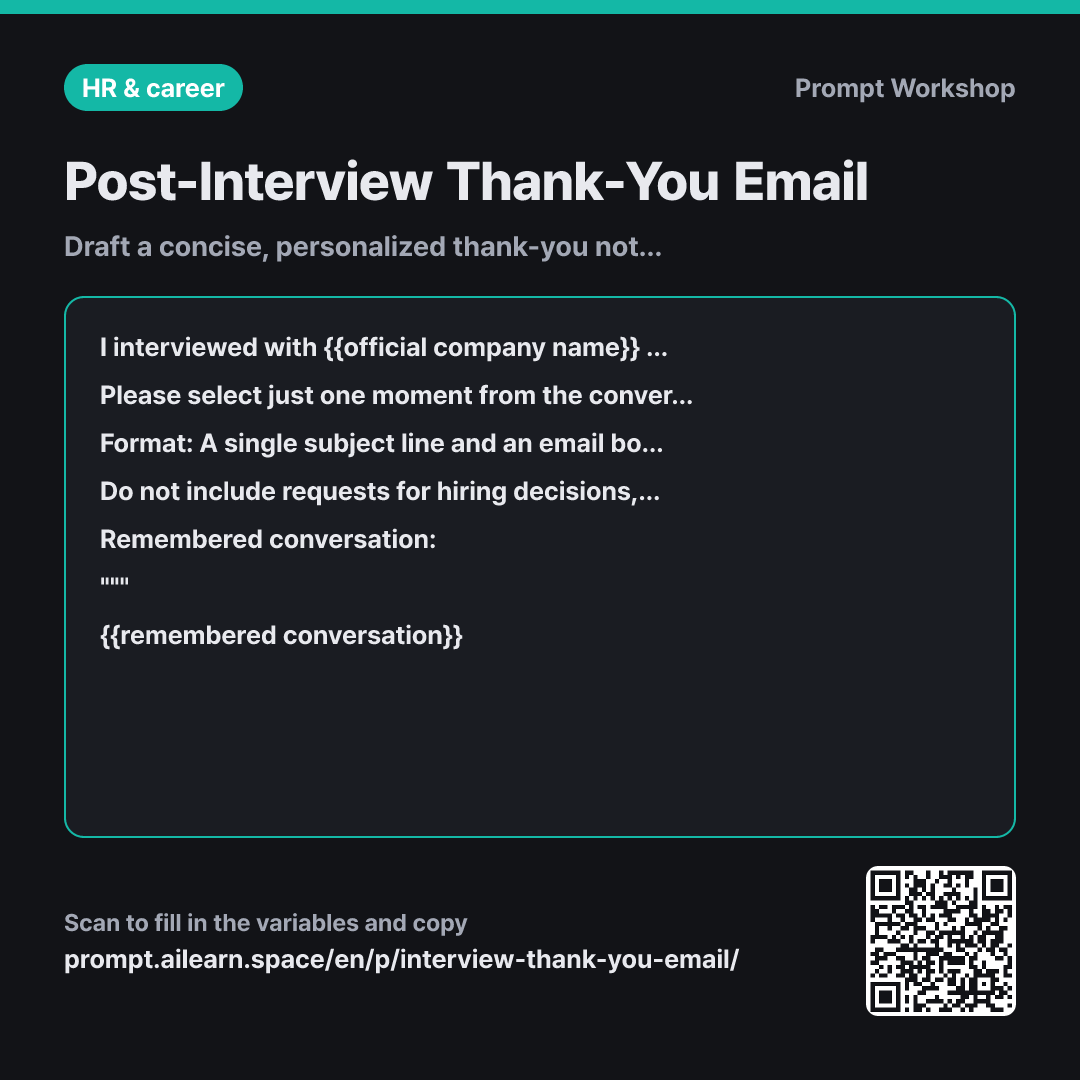
Why it is written this way
A post-interview thank-you email that is too long becomes a burden to read, and one that is too generic gets ignored. A generic email starting with "Thank you for your valuable time, I hope for good news" leaves no impression of who sent it. This prompt anchors the message in an actual moment from the interview. Interviewers remember the questions they asked, not generic polite greetings.
In the Context section, specifying the interview date and company name sets the right tone and urgency for the message. An email sent the next day should open differently from one sent a week later. Directing the model to "pick only one moment" from the notes is key; including every topic turns the thank-you note into an interview transcript.
In the Task section, prompting the model to finish an incomplete answer provides a meaningful reason to send the email. A plain thank-you note is easily dismissed, but adding 2–3 sentences of substance creates real reading value. In the Constraints, barring timeline inquiries and requests for the job prevents the email from sounding desperate. Restricting invented company facts is also crucial; without this rule, models often hallucinate corporate initiatives that do more harm than good if inaccurate.
Setting a strict limit of under 8 lines in the Format ensures readability. Interviewers often skim these emails on their phones between meetings. A message that fits on a single mobile screen without scrolling is the highest form of professional courtesy.
Unfamiliar terms? See Aha AI: output-format, hallucination
Compared with a bad example
Write a thank-you email after an interview. I had it yesterday and it went really well.
Without the company name or specific discussion points, the output will look identical to generic templates found online. It often includes hollow phrases like "I deeply resonate with your vision," which immediately signals a copy-pasted email if vision was never actually discussed.
Variations
When Sending to HR for Multiple Interviewers
I interviewed with {{official company name}} on {{interview date}}. Since there were multiple interviewers, I would like to send a single email to the HR coordinator asking them to forward my thanks to the panel.
Please draft an email based on the notes below. Instead of focusing solely on one interviewer, briefly reference two key discussion points in one sentence each. Format: One subject line and a body under 8 lines, including a polite opening line asking to pass the note along. Do not ask about hiring outcomes or decision timelines.
Remembered conversation: """ {{remembered conversation}} """
Sending separate, identical emails to multiple interviewers can backfire if they compare notes. Routing a single note through HR that acknowledges multiple panel topics is much more natural.
Standard English Follow-Up
I interviewed at {{official company name}} on {{interview date}} and want to send a short thank-you email the next day.
Using only the notes below, write a subject line and a body of no more than eight lines. Pick one moment from the conversation, restate it in a single sentence, and use it to lead into two or three sentences that finish an answer I had to cut short. Do not add company facts that are not in my notes, do not ask about the timeline or the decision, and do not offer to send extra materials. Sign off with [Name]. Keep the tone plain and professional.
""" {{remembered conversation}} """
English thank-you emails are typically direct and concise. Prompting directly in clear English prevents awkward literal translations of honorific or deferential phrasing.
Related prompts
Last updated 2026-09-02 · Found a mistake? Let us know