Why it is written this way
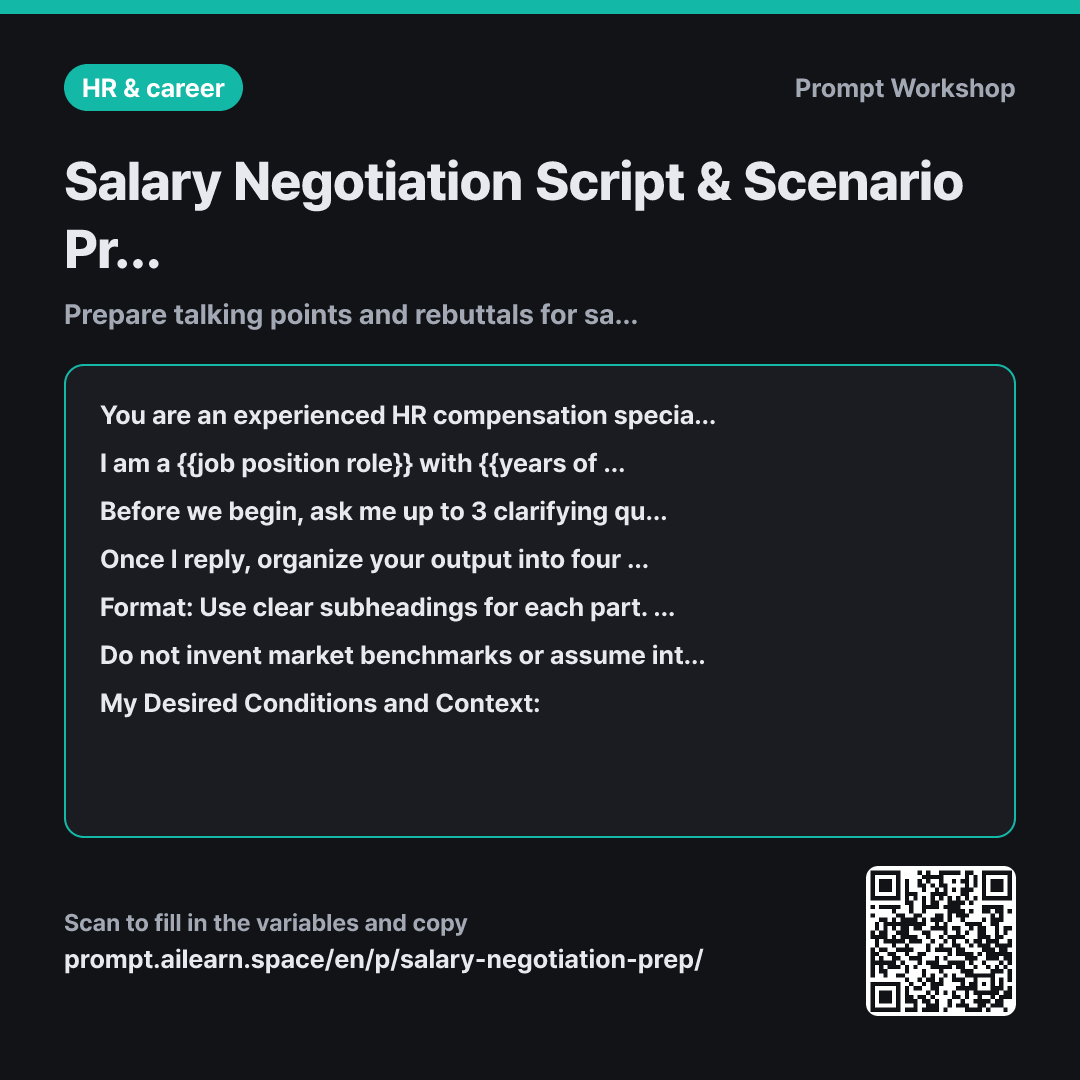
Many candidates stop their negotiation prep once they pick a target number. When recruiters ask "Why this amount?" they freeze up, or they immediately fold at the first lower counter-offer. This prompt prepares you not just for the number, but for the actual dialogue and follow-up statements. That is why each point includes an actionable backup response if the initial point meets pushback.
Setting the role as an HR specialist while explicitly stating "act as my advocate, not the company's" prevents the AI from falling into employer-centric conservatism. The goal is to leverage someone who knows hiring tactics to stand on your side. In the context, the years of experience and role ensure the talking points focus on the appropriate seniority and domain value.
Paragraph 3 establishes an interactive check. Negotiations hinge on nuances—like your timeline or leverage at your current job. Limiting the AI to asking up to 3 clarifying questions ensures custom advice without stalling the preparation.
The format requirement of "a single spoken sentence I can say verbatim" gives you exact phrasing rather than vague theoretical advice. Finally, the constraints act as guardrails: asking the model for market rates often leads to hallucinated data, which can unravel your credibility at the negotiation table.
Unfamiliar terms? See Aha AI: role-prompting, hallucination
Compared with a bad example
I'm a marketer with 5 years of experience. How should I negotiate salary and how much should I ask for?
Asking open-ended compensation questions yields ungrounded numbers and generic advice like "be confident." When you repeat those figures without concrete justification or contingency phrases, you risk losing leverage the moment the recruiter counters.
Variations
When Requesting a Raise at Your Current Company
You are an experienced team lead who has decided compensation reviews for {{job position role}} roles. I am a {{job position role}} with {{years of experience}} of experience, and I want to request an internal promotion and salary raise at my current company.
First, ask up to 3 clarifying questions about my situation. Once I answer, please draft: ① A brief message to my manager requesting a 1-on-1 compensation meeting ② 3 justification statements to present during the meeting ③ 3 constructive follow-up questions to secure a concrete timeline or milestone plan if the answer is "not this cycle." Write each point as a natural, professional spoken sentence I can use verbatim. Do not use language that implies I will quit immediately.
My Desired Conditions and Context: """ {{desired condition requirement}} """
Internal raise requests differ because you cannot easily use an outside offer without straining relationships. This variant focuses on securing next steps even if the immediate request is delayed.
Follow-Up Email Summary After Negotiation
Below are the key discussion points and agreed terms from a compensation meeting that just concluded, along with my target requirements. Please draft a professional follow-up confirmation email to the recruiter.
Format: A single subject line, and an email body under 7 lines. Include: ① A thank you for their time ② A bulleted recap of the terms verbally confirmed today ③ A polite question regarding any pending/unresolved items ④ A gentle request for the expected timeline for the revised offer letter. Keep the tone courteous, clear, and non-demanding, referencing only the details provided below.
Discussion Notes and Desired Conditions: """ {{desired condition requirement}} """
Verbal agreements can easily be remembered differently. Sending a written recap on the same day establishes a clear paper trail for the final offer letter.
Model notes
If you ask the model for actual market compensation benchmarks, it often hallucinates plausible-looking numbers. Research your market value independently, enter only validated numbers into the conditions variable, and let the model focus on crafting the persuasive script.
If you want to roleplay the conversation, follow up with: "Now, act as the hiring manager and simulate the negotiation conversation with me based on these points." As long chats may cause the model to forget previous salary boundaries, re-paste your target conditions if necessary.
Related prompts
Last updated 2026-09-02 · Found a mistake? Let us know