Why it is written this way
The most common mistake when using AI to write resumes is dumping years of work notes at once and asking it to "clean this up." This usually results in generic fluff like "Leveraged diverse skills across multiple cross-functional projects." Recruiters cannot tell what you actually did, and you will not know what needs editing.
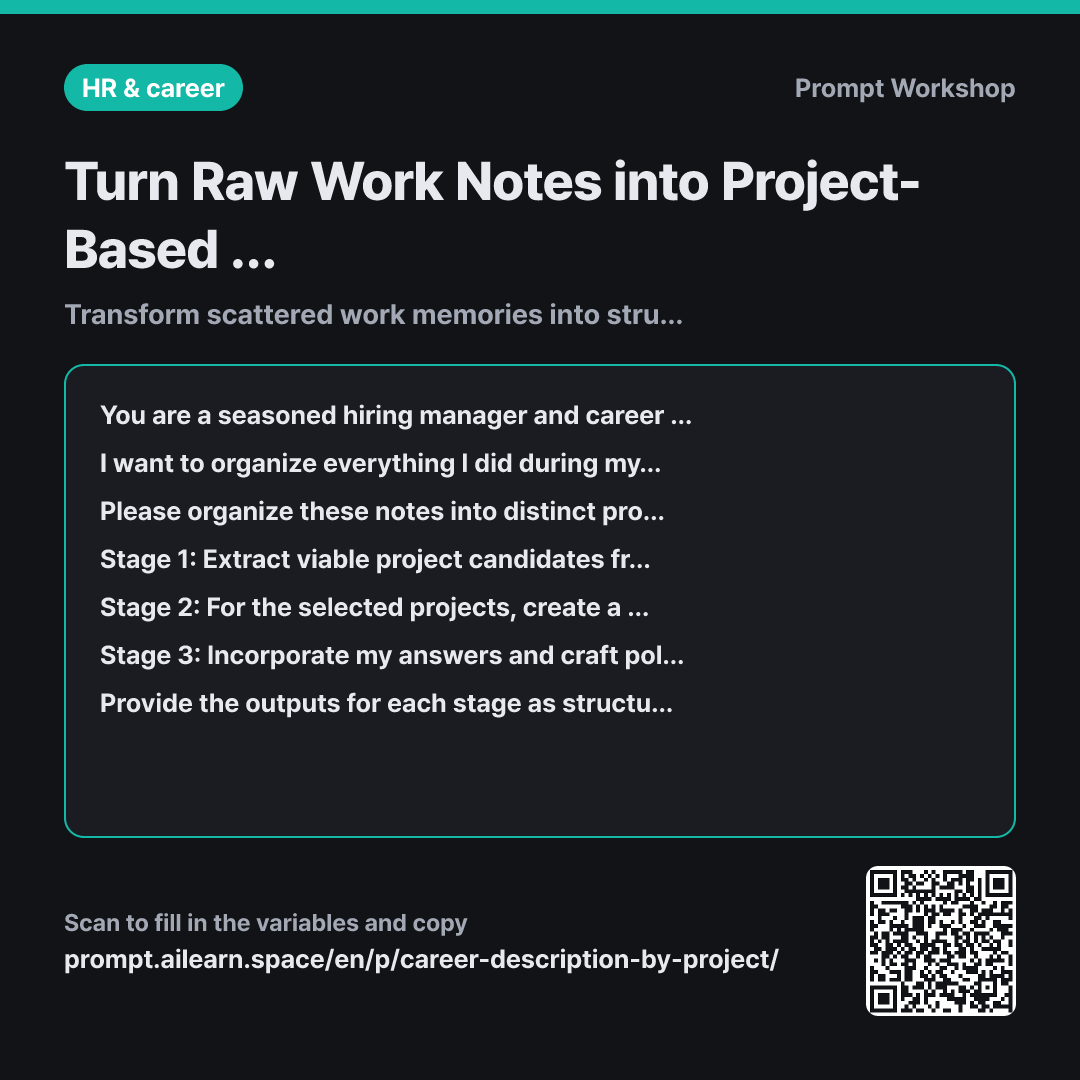
This prompt avoids that by breaking the process into three distinct steps: Inventory → Selection → Detail. Extracting project candidates in Stage 1 helps you recall forgotten achievements, while keeping you in charge of deciding which projects to highlight instead of letting the AI guess.
Without explicit instructions to pause after each stage, the AI will rush through all steps at once and spit out the final version, defeating the purpose of iterative review. Asking the AI to turn unknown details into questions in Stage 2 prevents it from hallucinating plausible-sounding metrics.
Requiring the format to be structured tables and bullet lists makes it easy to compare projects side by side. Enclosing the work notes in """ prevents any old instructions inside your notes from being interpreted as prompt commands, while anonymizing client names ensures company confidentiality is protected.
Unfamiliar terms? See Aha AI: chain-of-thought, context-window
Compared with a bad example
Write my resume. I worked 4.5 years as a backend engineer and built a payment system and an admin tool.
With only three lines of context, the AI fills in the rest with generic industry clichés, such as "Engineered high-throughput architecture to optimize latency by 40%." Because it sounds professional, you might be tempted to keep it—only to struggle defending it during an interview.
Variations
Quick single-project breakdown
The notes below describe a single project I handled as a {{job position role}}. Please summarize it under five sections: "Background & Problem · My Role · Actions Taken · Results · Tools Used". Do not invent any unmentioned details; label missing items as "Needs Clarification". After summarizing, list 3 potential interview questions a hiring manager might ask based on this project.
""" {{work note}} """
A condensed version for when you are short on time. Missing details are tagged as "Needs Clarification" so you can fill them in later.
Trimming an overly long resume draft
Below is my resume draft covering my {{period of employment}}. Without rewriting the text, rank which sentences should be removed first if I need to cut the length in half. Provide a one-line reason for each cut, and identify 3 must-keep sentences along with the rationale for retaining them.
""" {{work note}} """
Cutting down a resume is often harder than writing one. Asking the AI to rank items for removal leaves the final editorial decision in your hands.
Model notes
Because this involves multiple interactive steps, the conversation will be long. Be sure to copy and save your outputs from Stages 1 and 2 before moving on to Stage 3.
Some models may ignore the instruction to pause after each step and output all three stages at once. If this happens, simply reply: "Please stop and show only the Stage 1 table first." For lengthy notes, models might also overlook items near the bottom in Stage 1, so double-check the initial list against your original notes.
Related prompts
Last updated 2026-09-02 · Found a mistake? Let us know