Why it is written this way
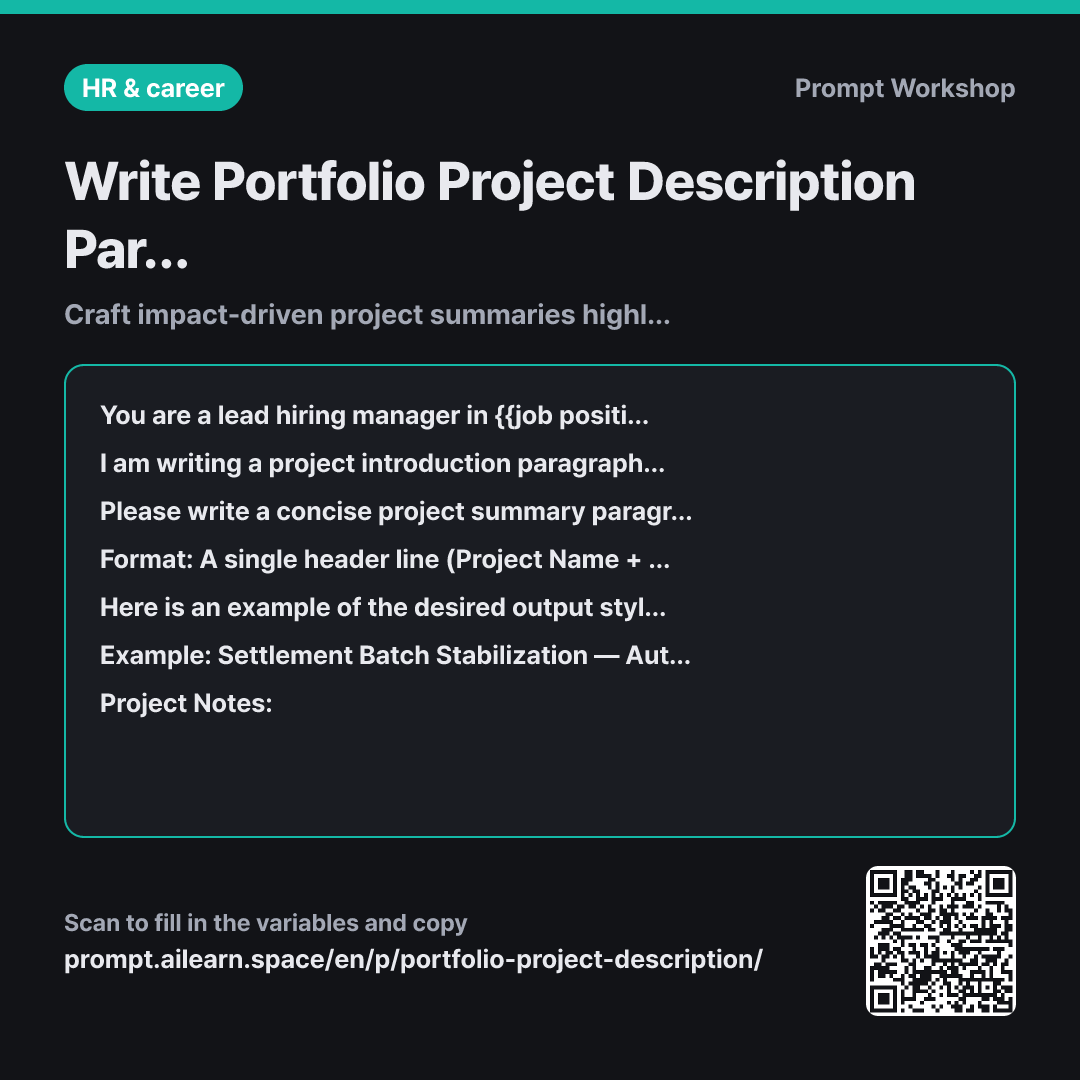
When you simply ask an AI to write a portfolio description, it almost always returns a generic feature list. Saying "I built the login, checkout, and admin pages" explains what was built, but reveals nothing about why it was built that way. Recruiters read portfolios to evaluate your problem-solving mindset. That is why this prompt strictly enforces the order of Problem → Decision → Action → Outcome and instructs the model to leave missing numbers in brackets. Without explicit instructions to use placeholders, models will readily hallucinate plausible-sounding metrics.
Setting the Role to a "lead hiring manager who reviews dozens of portfolios weekly" establishes an intuitive sense of conciseness—experienced reviewers value brevity. Defining the Context with "the reader knows nothing about my domain and will scan for 10 seconds" forces the model to naturally unravel internal jargon and company acronyms without carrying raw abbreviations over from your notes.
Fixing the Format to a one-line title, a 4–6 sentence paragraph, and a tech stack footer reflects how portfolios are actually consumed on screen. Starting with the problem rather than the result grounds the narrative. Most importantly, the Example does the heavy lifting: merely giving the "problem-action-result" rule often lapses back into listing features, but showing a complete sample paragraph locks in both sentence rhythm and a professional, matter-of-fact tone.
Wrapping the user's raw notes in """ ensures that informal phrases like "had trouble convincing manager" are treated purely as context data rather than execution instructions.
Unfamiliar terms? See Aha AI: few-shot, hallucination
Compared with a bad example
Write a portfolio project description for me. I revamped an inventory lookup screen using Spring and MySQL.
Because the prompt lacks detail, the model invents fake data like "improved query performance by 40%"—metrics you cannot defend in an interview. Missing the decision-making context makes you sound like an order-taker who just followed directions. The output length will also be unpredictable, making multiple project entries look inconsistent across your portfolio.
Variations
Condensing into a Single Resume Bullet
Condense the project notes below into a single resume bullet point. Follow the structure: "[What I achieved] by [why/how I decided and acted], resulting in [outcome]" in one concise sentence under 30 words, tailored for a {{job position role}} recruiter scanning quickly. Provide 3 different variations highlighting different strengths, and add a brief note explaining which company culture or role each version suits best. Leave brackets like [metric] for unmentioned numbers.
Project Notes: """ {{project note memo}} """
A resume bullet and a portfolio paragraph share the same core elements at different lengths. Getting 3 distinct angles helps you tailor your resume per company.
Preparing for Verbal Interview Explanations
You are a {{job position role}} interviewer. Based on the project notes below, write a natural, spoken 60-second response to the interview prompt: "Can you walk me through this project?"
Structure it as Problem → My Decision & Action → Result. Use a conversational, professional tone suitable for speaking aloud. Then, provide 3 likely follow-up questions an interviewer might probe into, along with a 1-sentence tip for each on which part of my experience to pull from when answering.
Project Notes: """ {{project note memo}} """
Portfolio blurbs are read with the eyes, while interview answers are processed through the ears. Preparing spoken scripts and follow-up defenses completes your interview readiness.
Related prompts
Last updated 2026-09-02 · Found a mistake? Let us know