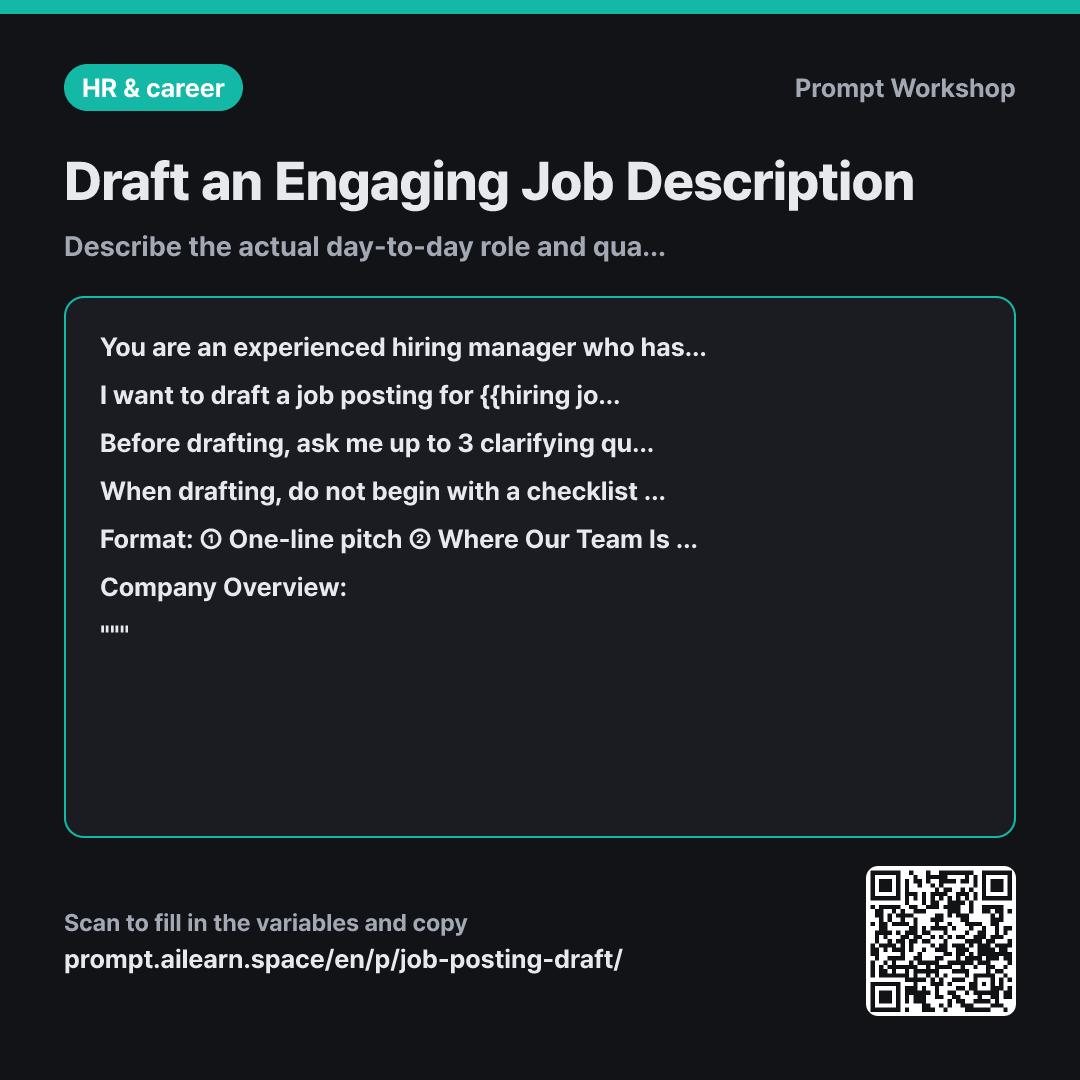
Draft an Engaging Job Description

Describe the actual day-to-day role and qualifications in candidate-first language.

Prompt · 3 variables

You are an experienced hiring manager who has written numerous job postings for {{hiring job role}}, and you deeply understand the perspective of qualified candidates deciding whether to apply.

I want to draft a job posting for {{hiring job role}} for our team. The company background and team context are provided below.

Before drafting, ask me up to 3 clarifying questions if key information is missing that would significantly impact candidate interest (e.g., remote policy, salary range disclosure, hiring process stages). Wait for my answers before writing the final draft.

When drafting, do not begin with a checklist of requirements. Start with what the person will actually do day-to-day after joining, followed by what is genuinely required to do the job. Do not invent perks, funding details, or revenue figures not provided in the prompt; mark unverified facts as [Confirm]. Avoid generic clichés like "passionate team player," "sense of ownership," or "work hard, play hard." Keep core requirements strictly to absolute must-haves.

Format: ① One-line pitch ② Where Our Team Is Right Now (3–4 sentences) ③ What You'll Do Daily (4–6 bullet points, one sentence each) ④ What You Need to Bring (Max 4 must-haves) ⑤ Nice-to-Haves (Max 3 items) ⑥ Hiring Process & Work Arrangement. Keep the total length around 400–500 words.

Company Overview: """ {{company introduction overview}} """

Team Situation: """ {{current team situation}} """

Copy, then paste here · ChatGPT and Claude open with the prompt filled in Open in ChatGPT ↗Open in Claude ↗Open in Gemini ↗ Edit in builder Download classroom card

Some variables here may contain personal data. Replace real names, numbers and company names with placeholders.

Why it is written this way

Role
You are an experienced hiring manager who has written numerous job postings for {{hiring job role}}, and you deeply understand the perspective of qualified candidates deciding whether to apply.
Context
I want to draft a job posting for {{hiring job role}} for our team. The company background and team context are provided below.
Ask back
Before drafting, ask me up to 3 clarifying questions if key information is missing that would significantly impact candidate interest (e.g., remote policy, salary range disclosure, hiring process stages). Wait for my answers before writing the final draft.
Task
When drafting, do not begin with a checklist of requirements. Start with what the person will actually do day-to-day after joining, followed by what is genuinely required to do the job. Do not invent perks, funding details, or revenue figures not provided in the prompt; mark unverified facts as [Confirm]. Avoid generic clichés like "passionate team player," "sense of ownership," or "work hard, play hard." Keep core requirements strictly to absolute must-haves.
Format
Format: ① One-line pitch ② Where Our Team Is Right Now (3–4 sentences) ③ What You'll Do Daily (4–6 bullet points, one sentence each) ④ What You Need to Bring (Max 4 must-haves) ⑤ Nice-to-Haves (Max 3 items) ⑥ Hiring Process & Work Arrangement. Keep the total length around 400–500 words.
Input
Company Overview: """ {{company introduction overview}} """
Input
Team Situation: """ {{current team situation}} """

When prompted to write a job description, AI typically defaults to a laundry list of requirements first. A post that opens with "3+ years experience, great communication skills, strong ownership" states what the company wants but answers zero questions the candidate actually cares about. Top candidates will simply pass if they cannot see what the day-to-day job looks like, who will support them, and why the role exists right now. This prompt flips the sequence: day-to-day impact comes first, requirements second.

This is why the Role is set to someone who understands both hiring managers and candidates. A manager-only persona produces a selfish corporate wishlist, while a candidate-only persona yields an unrealistic, romanticized posting. Providing the Context of team dynamics and hiring reasons ensures the post naturally frames the role as "helping solve our immediate bottleneck."

Asking clarifying questions in the third paragraph prevents hallucinated filler. Key details like salary transparency or remote flexibility make or break applicant interest; capping questions at three keeps the workflow concise.

The 6-part Format mirrors how top candidates evaluate postings. Capping must-haves at four bullet points drastically boosts qualified applications—overly long requirement lists discourage great talent from applying.

Unfamiliar terms? See Aha AI: role-prompting, output-format

Compared with a bad example

Common bad example

Write a job post for a content marketer. We are a startup with a team of 4.

Lacks business model and hiring context, generating a generic posting that could belong to any startup. It will hallucinate perks like free books or flexible hours and list ten generic requirements starting with "3+ years experience," leaving candidates unsure of the actual job scope.

Variations

Reviewing an Existing Job Post from a Candidate's View

Reviewing an Existing Job Post from a Candidate's View

You are a candidate with 3–5 years of experience looking for a {{hiring job role}} role. Below is our current job posting draft.

Do not rewrite it yet. First, provide candid feedback from your perspective on: ① Where you would hesitate and drop off ② Parts where the actual daily work remains vague ③ Generic phrases that make us sound like every other company. Point out 2 items for each category. Then, provide a revised version focusing only on the single most critical section that needs fixing.

Current Job Post: """ {{company introduction overview}} """

Writers fill in missing details with their own assumptions. Viewing the draft through candidate eyes highlights immediate friction points and ambiguity.

Condensing a Post into a Short Referral/LinkedIn Blurb

Condensing a Post into a Short Referral/LinkedIn Blurb

Based on the company overview and team context below, write a short hiring blurb announcing the {{hiring job role}} opening. This will be shared directly on LinkedIn or in internal referral channels.

Format: 3 distinct options. Each option must be under 5 lines, stating who we are looking for in the very first line. Below each option, add a single-sentence note explaining what type of candidate this angle targets. Do not add perks or metrics not in the context, and avoid hashtags and emojis.

Company Overview: """ {{company introduction overview}} """

Team Situation: """ {{current team situation}} """

People rarely click bare job board links. A crisp, 5-line summary clarifying the exact role profile generates far more qualified referrals.

Related prompts

Last updated 2026-09-02 · Found a mistake? Let us know