Why it is written this way
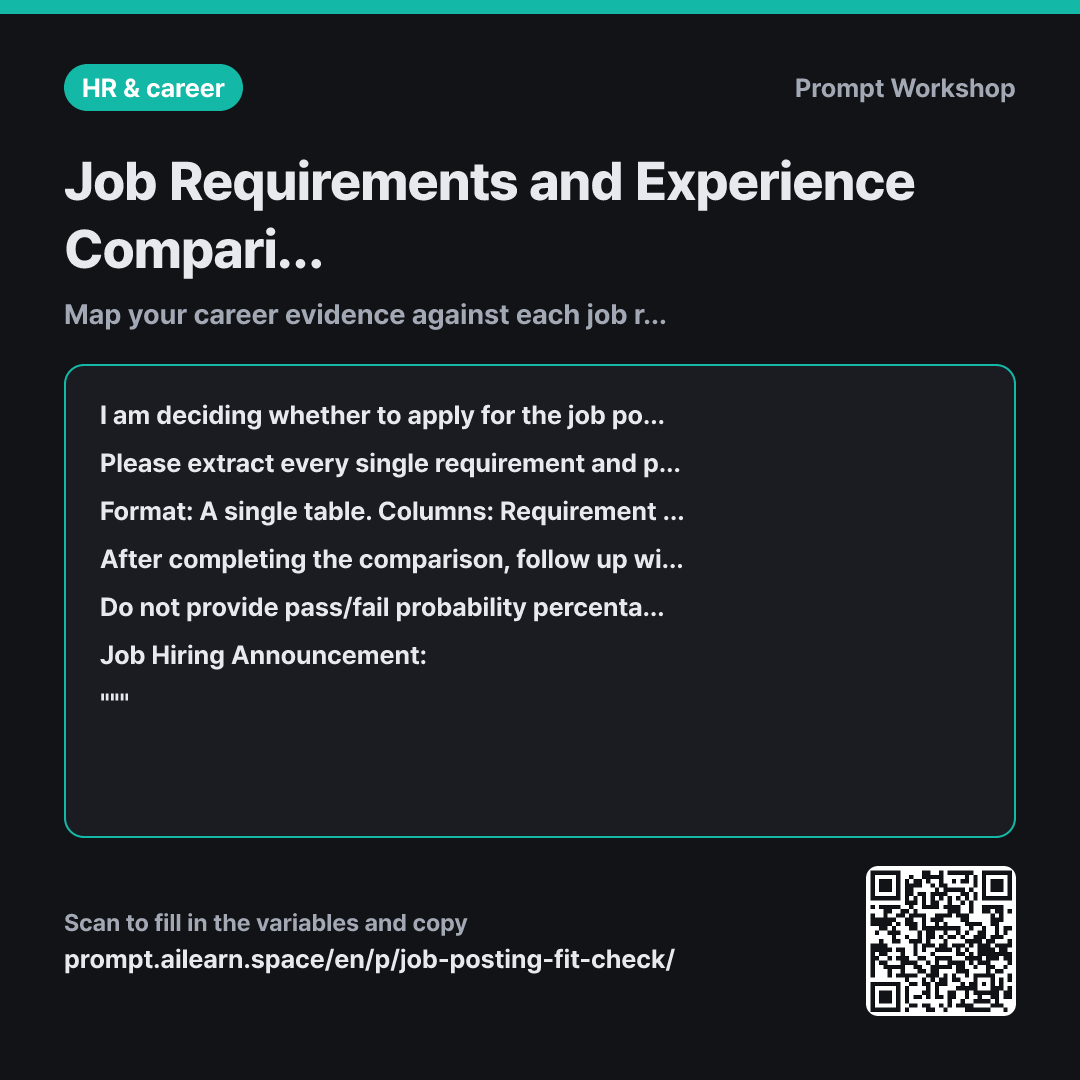
When people ask AI to analyze a job posting, they typically ask, "Should I apply for this?" The response is usually just reassurance—pointing out a few strengths and concluding that it's worth a shot, leaving the actual gaps completely hidden. This prompt shifts the core question. Instead of asking if you'll pass, it breaks requirements down line by line to systematically separate where you have evidence from where you don't.
There is a specific reason the Task paragraph specifies extracting items "sentence by sentence without skipping anything." A single bullet point in a job description often contains two or three separate criteria. If you treat "Proficient in SQL with proven collaboration with non-technical teams" as one item, a half-match gets smoothed over as fully met. Furthermore, without an explicit instruction to leave unmatched fields blank, models tend to fabricate connections from loosely related experiences just to fill the space.
Fixing the Format as a table ensures the output is an objective inventory rather than subjective judgment. Categorizing the status into three distinct tiers—Met, Partial, and None—serves the same purpose. Sorting the gaps beneath the table into "quick fixes" and "unfixable for now" clearly establishes what to emphasize in your application and what to acknowledge as limitations. The follow-up question step is particularly valuable when your career summary is brief, preventing the model from making unilateral assumptions on borderline items and instead handing the clarification back to you.
Wrapping both source texts in separate """ blocks prevents them from blending together. Without this separation, phrases from the job description can easily be misinterpreted as your own background. Explicitly instructing the model to treat the job post solely as source data also guards against accidental prompt injections if the posting contains directive phrasing.
Unfamiliar terms? See Aha AI: prompt-injection, output-format
Compared with a bad example
Should I apply for this job? (paste job posting) I'm a data analyst with 5 years of experience.
You will only get a generic response like "You are quite competitive" with two or three lines of vague justification. You will still have no idea which of the eight specific qualifications you lack, forcing you to reread the entire job description from scratch when writing your cover letter.
Variations
Prioritizing Multiple Job Postings by Effort
Below are several job postings alongside my career summary. For each posting, count how many required qualifications I meet versus how many gaps remain, then rank the jobs in ascending order of effort required to apply.
Format: A table. Columns: Job Title/Posting | Required Qualifications Met (Count/Total) | Missing Required Qualifications | Number of New Application Essays to Draft. Below the table, provide a single-sentence recommendation for only the top 2 postings highlighting which core experience to lead with in the application. Only rank the options; do not decide whether I should apply.
Job Hiring Announcements: """ {{job hiring announcement}} """
My Career Summary: """ {{my career summary}} """
When comparing multiple opportunities simultaneously, the level of effort needed to submit a strong application is often a better ranking factor than estimated odds of acceptance.
Aligning Experience Descriptions with Company Terminology
Extract the recurring keywords, tone, and phrases used throughout the job posting below. Then, map them against my career summary to create a side-by-side translation table connecting my past work to their preferred vocabulary.
Format: A table. Columns: Company's Phrasing | My Equivalent Experience/Term | Recommended Sentence for Application. Only connect items when the underlying meaning truly matches; mark anything that requires a stretch as "No Direct Match." Do not invent experiences just to use terms from the job posting.
Job Hiring Announcement: """ {{job hiring announcement}} """
My Career Summary: """ {{my career summary}} """
Different companies use different terms for the exact same responsibilities. Aligning your vocabulary with the company's language helps reviewers recognize your fit much faster.
Related prompts
Last updated 2026-09-02 · Found a mistake? Let us know