Why it is written this way
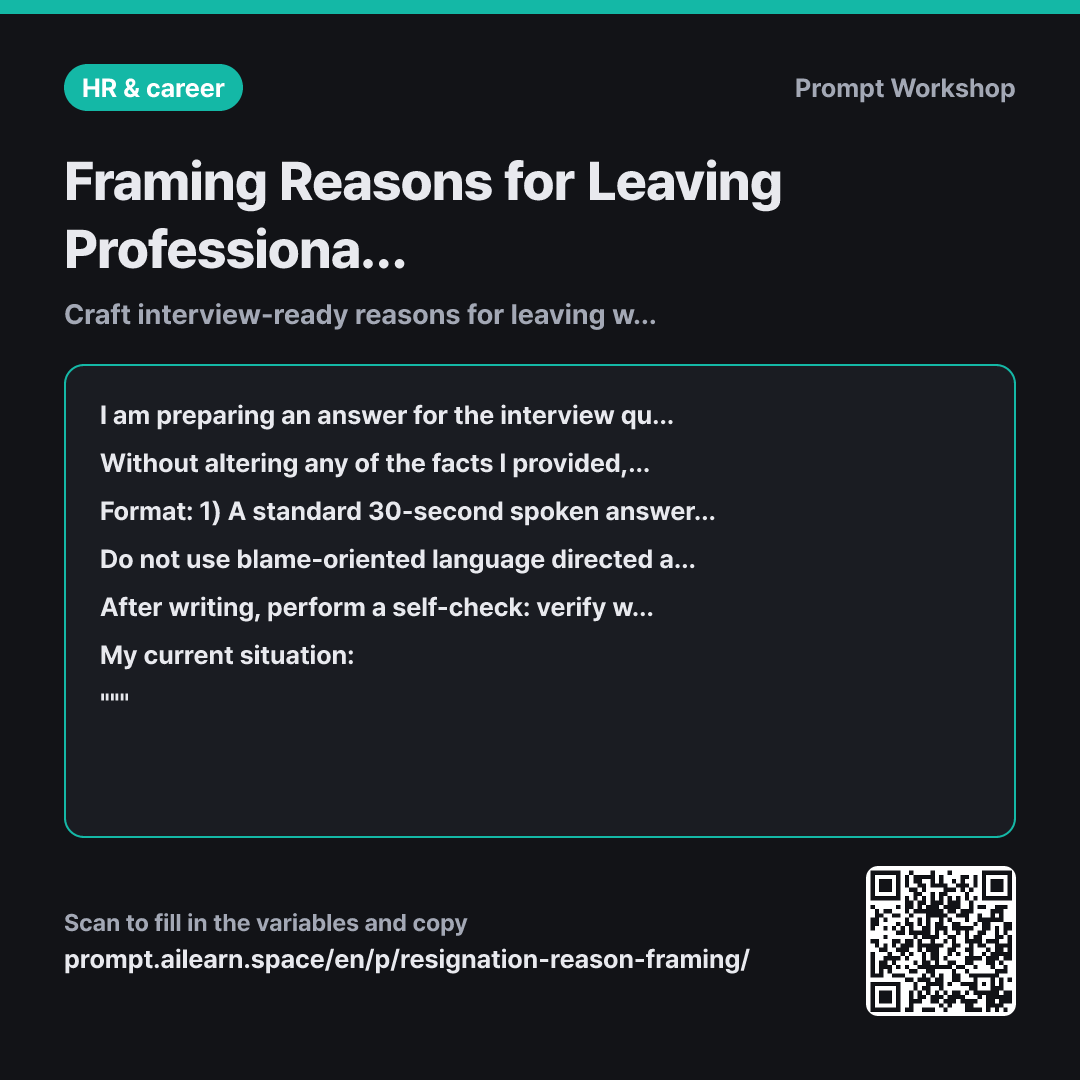
When explaining reasons for leaving, being too blunt sounds like complaining, while over-embellishing sounds dishonest. Consequently, many candidates retreat into vague clichés like "I'm looking for a new challenge." Interviewers hear this dozens of times a day, which instantly triggers the follow-up: "What specific challenge are you looking for?" This prompt aims to solve that problem by keeping the core facts intact while pivoting the focus from backward-looking complaints to forward-looking goals.
Stating the target role early in the context is crucial because the framing changes depending on where you are applying. For instance, having data analysis tasks eliminated is a compelling and natural reason when applying for another analytics role, but it requires different positioning for other career paths. Furthermore, instructing the model to "not alter facts" ensures you receive an answer you can genuinely defend. Fabricating motives causes the narrative to collapse under basic follow-up questions.
Explicitly banning specific clichés in the constraints prevents the AI from falling back on generic templates, which happens when merely asked to "make it sound good." It also filters out accusatory tones. Mentioning salary naturally instead of hiding it is recommended because hiding obvious compensation factors often leads to awkward answers that interviewers easily see through. The one-line summary in the format acts as an anchor when nervous, and the three follow-up questions prepare you for where interviewers actually test your story.
The final self-critique step ensures quality control. Even with strict constraints, first drafts often contain subtle undertones of blame. Instructing the model to self-audit and correct before output guarantees a refined response.
Unfamiliar terms? See Aha AI: hallucination, prompt
Compared with a bad example
What should I say in an interview when asked why I want to switch jobs? I'm leaving because I don't get along with my manager and the work is boring.
Providing only a single vague sentence prompts the AI to generate textbook clichés like "I felt limited in my growth and wanted a new challenge in a fresh environment." When the interviewer digs deeper with "What limitations did you face?", you will have no follow-up ready. Conversely, some models might reflect your raw frustration word-for-word, including direct complaints about your manager in the script.
Variations
Explaining an extended employment gap
I am currently unemployed and preparing an answer for the interview question: "What have you been doing during this gap?" The position I am applying for is {{applied job role}}.
Without altering the facts below, create a concise answer that smoothly connects my reason for leaving to my gap period. The format should include one 30-second standard answer and three follow-up questions with responses. Avoid making long excuses; instead, highlight only the activities from that period that directly relate to the target role in one clear sentence. Do not invent activities I did not mention.
My current situation: """ {{current overall situation}} """
The longer you explain an employment gap, the more it sounds like an excuse. The key is linking the departure reason and the gap into a single, concise narrative.
Reviewing and critiquing an existing draft
Below is the draft answer I prepared for my reason for leaving. Please critique and evaluate it first without rewriting it.
Evaluate it across three specific criteria: 1) Sentences that could sound like complaining or blaming others, 2) Vulnerable points the interviewer is likely to probe into, and 3) Generic phrases that sound unmemorable. Then, from the perspective of an interviewer hiring for {{applied job role}}, provide three challenging follow-up questions based on this answer. Do not rewrite my script unless I specifically ask afterwards.
My draft answer: """ {{current overall situation}} """
Asking the model to rewrite immediately often strips away your natural voice, making delivery awkward in real interviews. Getting a critique first allows you to refine the wording yourself.
Related prompts
Last updated 2026-09-02 · Found a mistake? Let us know