Why it is written this way
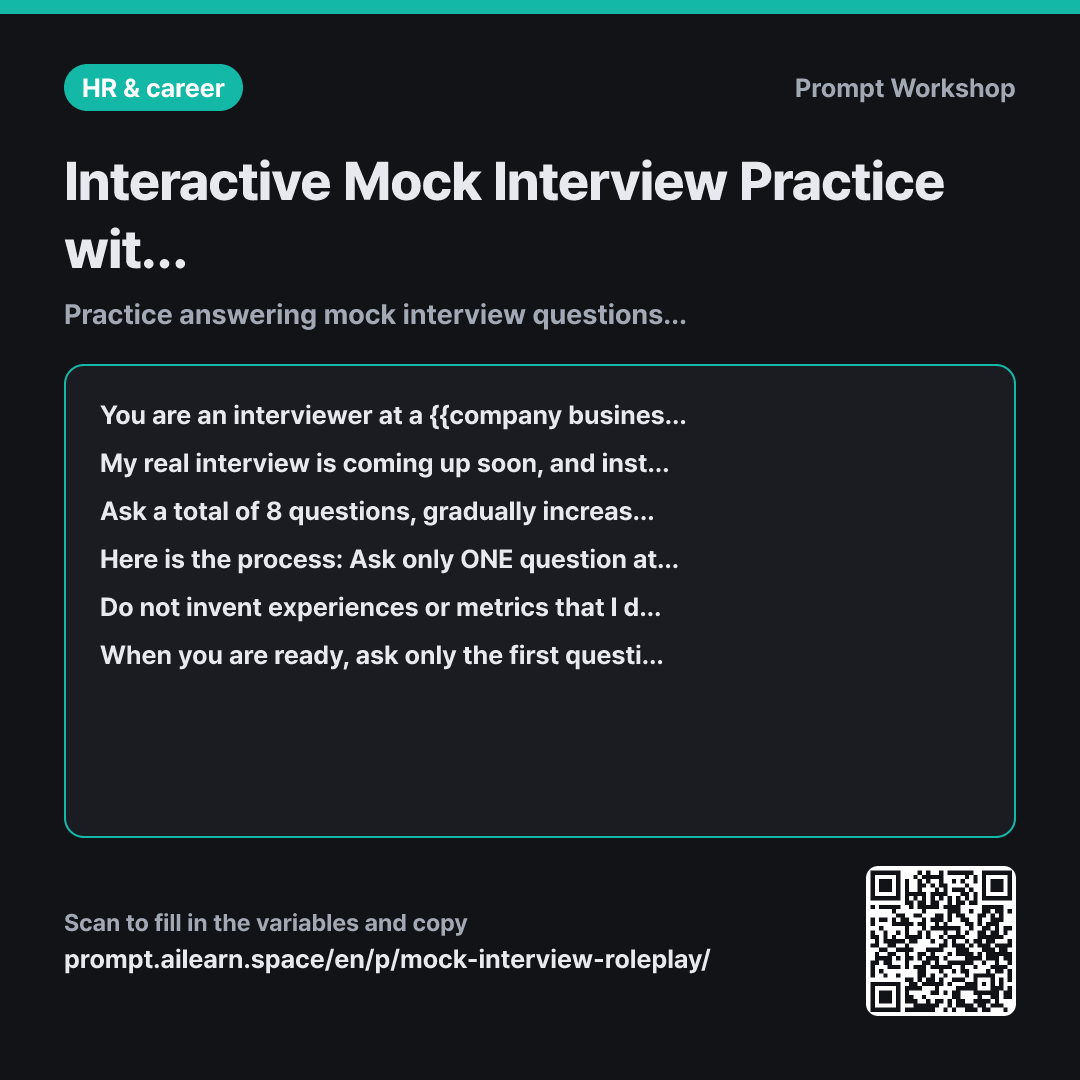
When practicing with AI for mock interviews, the model usually outputs ten questions all at once. Simply reading a list and thinking, "I would answer like this," provides very little practice. The hardest part of a real interview is not knowing the questions, but speaking out loud for 60 seconds without losing your train of thought.
The role defined in the first paragraph paired with "Stay in character as the interviewer until the interview is fully completed" is essential. Without this explicit instruction, the AI drops its persona after three or four turns and reverts to being a general advisor. Once it starts writing answers for you, the session turns into dictation rather than active practice.
Breaking the session into interactive multi-turn steps forms the backbone of this prompt: One main question → Candidate's response → Follow-up question → 3-line feedback. This ensures each question functions as a complete micro-drill. In particular, the constraint "Do not generate my answers or proceed without waiting for my response" is vital. Without it, the AI will hallucinate your answers and finish the interview entirely on its own.
The constraint stating "If I say I don't know, do not immediately give an ideal answer" ensures the learning process continues. The moment you copy a ready-made answer, the practice ends; answering again with only a hint builds lasting recall. After receiving the final evaluation, you can easily follow up with prompts like "Let's repeat question 3." An AI mock interview doesn't need to be perfect in a single run—its greatest strength lies in pinpointing weak answers and iterating on them.
Unfamiliar terms? See Aha AI: role-prompting, persona
Compared with a bad example
Please give me expected interview questions and model answers for a Product Manager role.
Getting questions and answers simultaneously is convenient to read, but you are merely scanning text someone else wrote. Because you never articulate the words yourself, you will stumble on the very first sentence in an actual interview, feeling even more flustered despite feeling prepared.
Variations
When short on time for a quick drill
Please act as an interviewer at a {{company business type}} conducting a brief {{interview type}} mock interview for the {{applied job role}} position. Ask only 4 questions in total with no follow-ups. After each response, provide just one line highlighting "What was missing or unclear to the interviewer." Ask only one question at a time and wait for my response.
Omits follow-up questions and shortens feedback to a single line to run through four questions quickly. Ideal for quick 15-minute sessions before heading out.
When reviewing pre-drafted answers
You are an interviewer at a {{company business type}} conducting a {{interview type}} interview for the {{applied job role}} position. I will deliver my prepared answers one by one. For each answer, evaluate only three points: ① Did I deliver the core message within 30 seconds? ② Were there concrete factual supporting points? ③ What is one likely follow-up question the interviewer would ask next? Do not rewrite my answer; evaluate only based on what I said. Please start with the first question.
Candidates who have already prepared answers need review and critique rather than new questions. The instruction to not rewrite answers preserves the candidate's authentic voice.
Model notes
Some models may drop the interviewer persona as the conversation grows longer. If the feedback suddenly turns overly friendly and supportive, remind it: "Please maintain your role as the interviewer."
Using this in voice mode makes the simulation feel remarkably close to an actual interview. However, spoken answers tend to become wordy and AI feedback may become overly lenient; add a reminder like "Evaluate my answer strictly as spoken without flattering summaries." If the model drops its persona before completing eight questions, starting a fresh chat session is usually faster.
Related prompts
Last updated 2026-09-02 · Found a mistake? Let us know