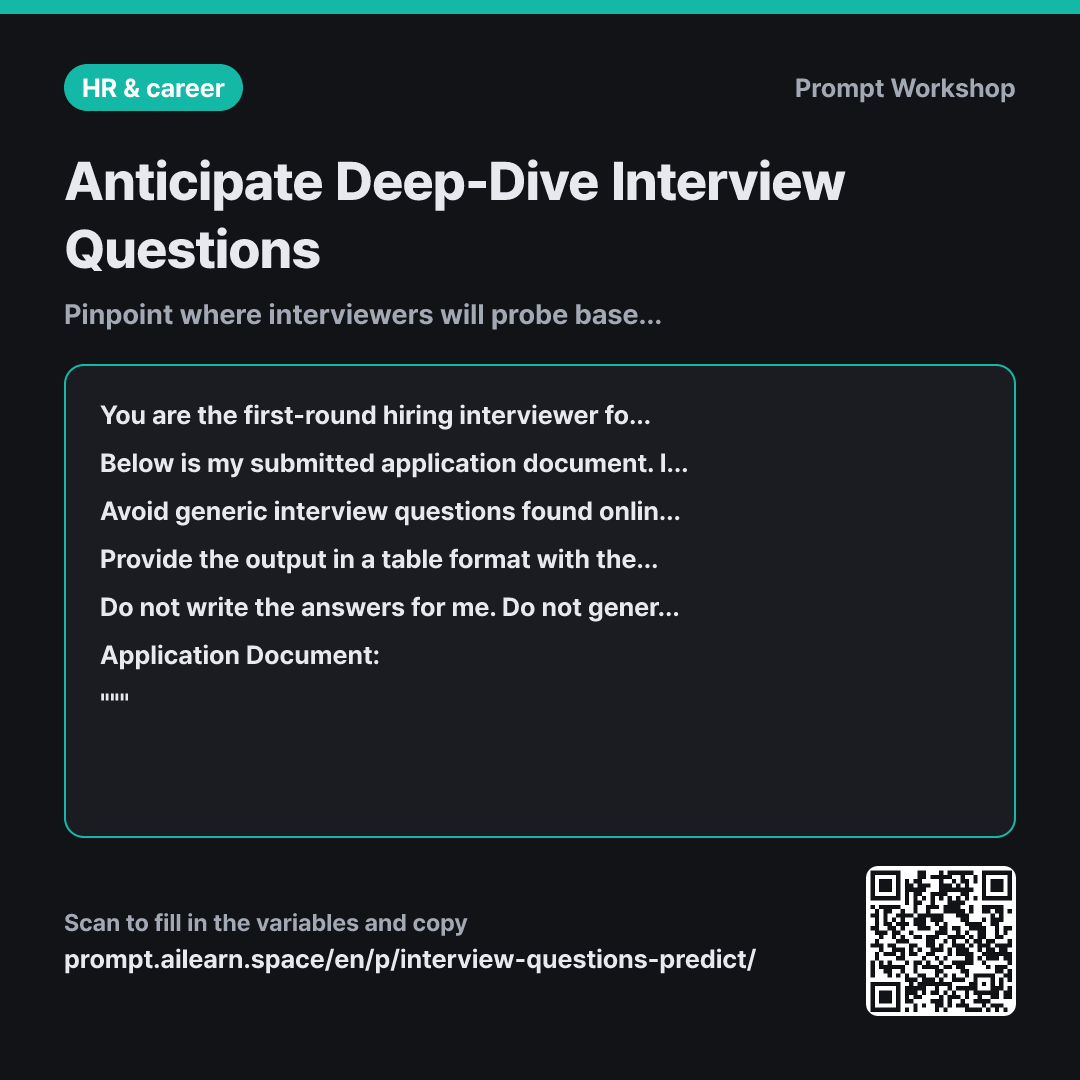
Why it is written this way
When searching for interview prep prompts, you often get generic lists like "Top 50 Common Interview Questions." Those generic lists can easily be found via search, and the questions that truly challenge you in an actual interview are never on them. The truly risky questions always stem from the weak spots in your own submitted materials.
That is why the Role in the first paragraph is narrowed down from a simple interviewer to a "first-round interviewer who habitually highlights parts to probe further." If you only specify an interviewer, the AI acts like a friendly counselor; giving it a habit of scrutinizing forces it to read the document with healthy skepticism.
In the Task section, explicitly requiring questions that "can arise specifically from reading this document" and instructing it to target weak evidence and unverified numbers first is the core mechanism. The "Quoted Text from Document" column in the table Format serves as a guardrail to enforce this: if there is no line to quote, it reveals a generic question and gets filtered out.
Wrapping the application document in """ prevents statements like "I am diligent" from being parsed as prompt instructions. The explicit constraint "Do not write the answers for me" is also intentional. Memorizing AI-generated answers makes your delivery sound unnatural and easily detectable by interviewers. It is much safer to receive sharp questions and craft your responses in your own voice.
Unfamiliar terms? See Aha AI: role-prompting, prompt-injection
Compared with a bad example
Give me expected interview questions.
(Paste resume / cover letter)
Even if you paste your materials, you will mostly get generic questions like "Why did you apply?" or "What are your strengths and weaknesses?" With only one or two tailored questions, you end up walking into the interview without preparing for the areas that truly need defense.
Variations
Drilling Down with Follow-Up Questions
You are an interviewer for a(n) {{applied job role}} position. Select the single statement in the document below that most urgently requires verification, and create a 5-stage chain of follow-up questions stemming from it. For each stage, add a one-line explanation of what the interviewer would probe next if the candidate gives a vague answer.
""" {{application document form}} """
In actual interviews, five consecutive follow-ups on a single point are far more challenging than ten separate questions. Seeing how deep an interviewer can probe helps you calibrate the depth of your answers beforehand.
Preparing for an Executive / Final Interview
You are an executive interviewer conducting the final interview for a(n) {{applied job role}} position. Rather than technical or practical execution details, you want to assess attitude, cultural fit, and long-term retention potential. Read the document below and generate exactly 7 questions focused solely on this perspective, including a one-line note on what each question evaluates. Do not include questions regarding private life or family.
""" {{application document form}} """
First-round and executive final interviews focus on different aspects. Simply shifting the role entirely changes the tone and angle of the questions.
Model notes
Some models mix in generic questions just to reach the count of 10. You can resolve this by adding: "Drop any question that does not have a direct quote from the document."
If the document is long, some models may extract fewer questions from the later sections. Asking a follow-up such as "Generate 5 more questions strictly from the later half of the document" will ensure balanced coverage. Some models also add answering tips; instead of memorizing those tips verbatim, rely on the "Essential Key Points to Include in the Answer" column as your reference.
Related prompts
Last updated 2026-09-02 · Found a mistake? Let us know