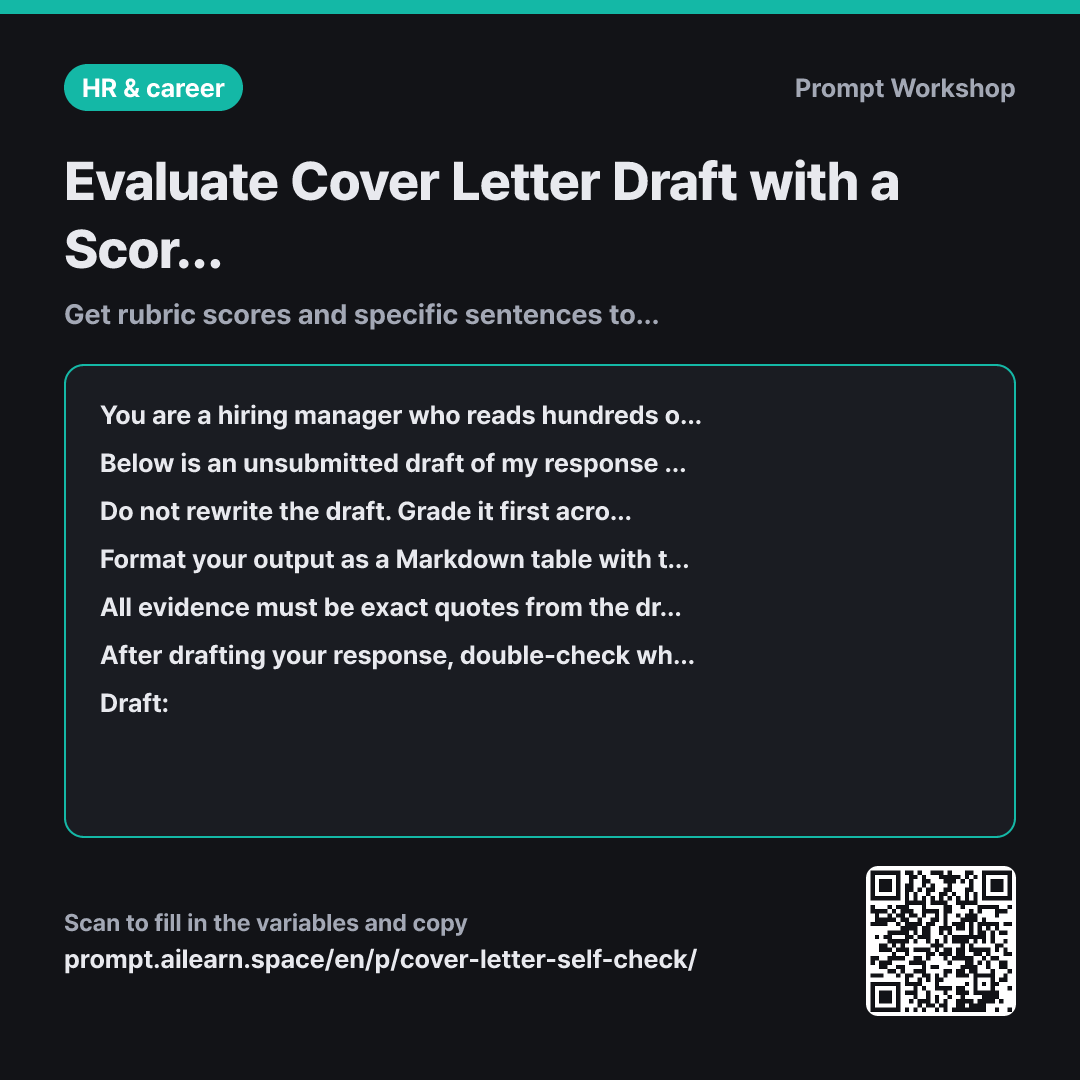
Why it is written this way
The most common mistake when using AI for application essay feedback is dumping the draft and asking to "fix this." The resulting text may read smoothly, but almost none of your own voice remains. When an interviewer asks for more context on a specific line, you won't be able to answer naturally because it is no longer truly your writing.
The rubric format accounts for half of this prompt's effectiveness. Receiving only a score leaves you wondering what to change, while receiving unstructured paragraph feedback blends compliments with criticism, leading to analysis paralysis. The four columns—"Criteria · Score · Evidence · Revision Direction"—make your next action clear the moment you read them. Requiring exact quotes in the evidence column forces the AI to look at concrete sentences rather than giving vague generalities.
The negative constraint "Do not provide a rewritten full version" is critical. Without it, models tend to append a fully polished rewrite at the end, which most applicants will simply copy-paste. The instruction against fabricating metrics serves the same goal. Wrapping the draft in """ delimiters prevents candidate statements like "I will learn diligently" from being interpreted as system instructions.
The final paragraph forces the AI to self-audit. Requiring it to verify that quotes actually appear in the source text significantly reduces hallucinated evidence. When iterating, simply plug your revised draft back in to verify whether the scores improve.
Unfamiliar terms? See Aha AI: hallucination, output-format
Compared with a bad example
Proofread my cover letter draft.
(Paste draft)
If you ask like this, the AI will immediately spit out a completely rewritten version. Because it doesn't explain what was weak or why, you will repeat the same mistakes on your next application, and the returned text will likely be filled with generic corporate cliches.
Variations
Quick Sanity Check Right Before Submission
Please check whether the cover letter draft below properly answers the prompt "{{question item}}". Do not rewrite anything. Point out up to 2 instances for each of the following: ① Missing requirements from the prompt, ② Unsupported assertions/claims, ③ Sentences that can be safely deleted. Include verbatim quotes for each.
""" {{cover letter draft}} """
Right before a deadline, you do not need a full scorecard. Quickly identifying missing elements and fluff allows you to tighten your draft in five minutes.
Post-Mortem Review on a Rejected Application
Below is a job application essay that was rejected. The prompt was "{{question item}}". Without making definitive assumptions about why it was rejected, identify 5 friction points that would catch a recruiter's eye if they only skimmed this for 30 seconds. For each point, quote the exact sentence and provide a one-line actionable takeaway for future applications.
""" {{cover letter draft}} """
No one knows the exact reason for a rejection. Instead of obsessing over why, assuming a 30-second skimming recruiter helps highlight truly actionable improvements.
Model notes
Many models score generously. If everything comes back as 4 or 5 out of 5, prompt it once more: "Regrade this strictly based on the standards of a highly competitive initial screening."
Some models may generate an unprompted rewritten draft at the bottom even after completing the table. Ignore that section and focus only on the rubric. If your draft exceeds 1,000 words, split it into two halves and grade each separately for more accurate citations.
Related prompts
Last updated 2026-09-02 · Found a mistake? Let us know