Why it is written this way
If you paste raw notes into AI and ask for "performance review comments," it typically generates a generic compliment followed by a vague "look forward to your continued growth." The employee feels fine reading it, but learns nothing about what to improve, leading to the exact same issues six months later.
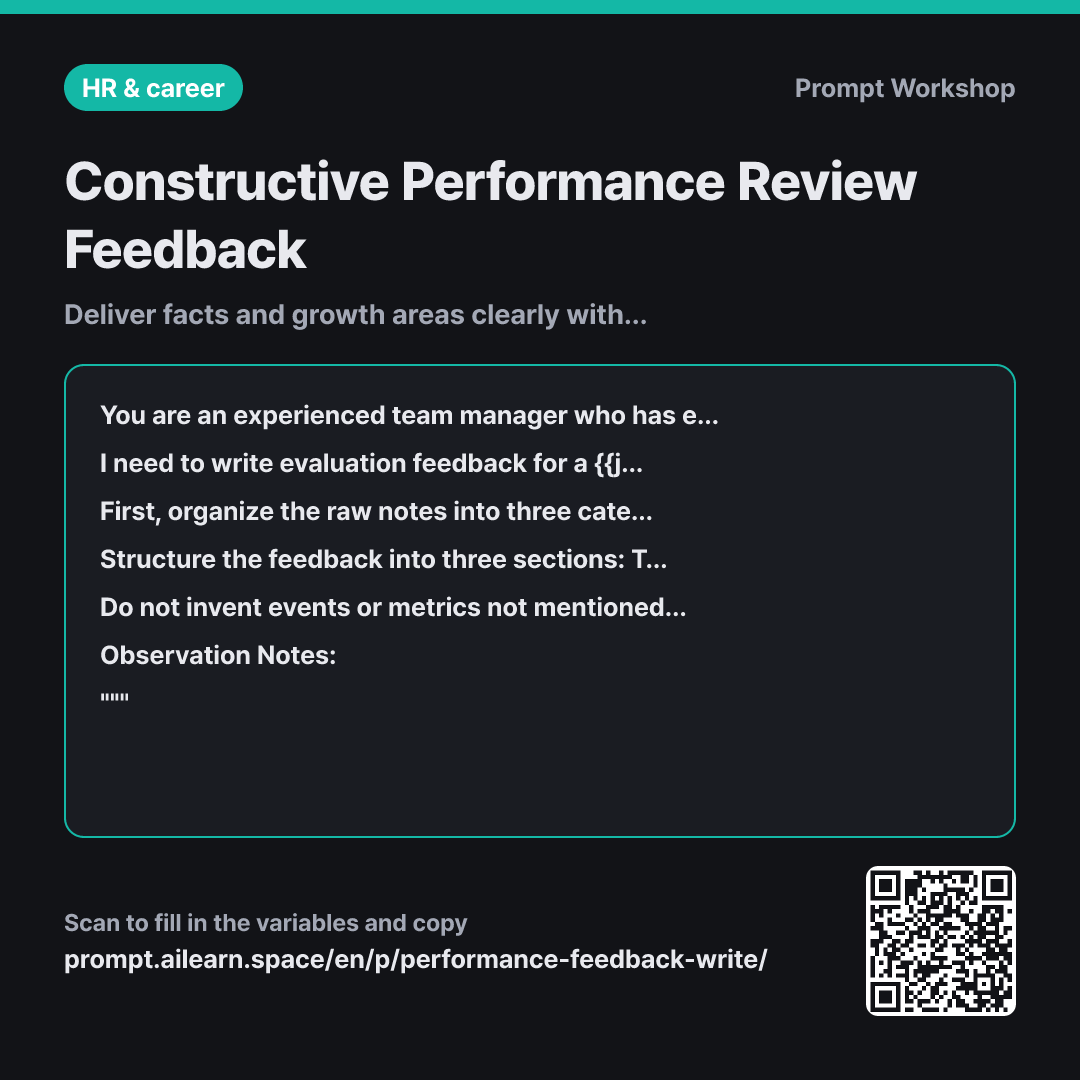
This prompt establishes a preparatory structuring phase before drafting. By categorizing notes into facts, impacts, and assumptions—and excluding the assumptions from the final text—it eliminates the most disputed element of reviews. Labeling someone as "lacking initiative" is unfalsifiable and hurts rapport. Keeping assumptions aside provides valuable material for inquiry during the review meeting.
Setting the role as a manager who delivers reviews in person ensures the tone is practical for face-to-face delivery. The constraints forbidding personality labels and mandating [Verify Example] placeholders work together: one prevents unfair characterizations, while the other prevents hallucinations when data is sparse.
Wrapping the notes in """ delimiters isolates fragments like "rarely voices dissenting opinions" so the model treats them as raw data rather than prompt instructions. Clear separation prevents unintended behavior during generation.
Fixing the structure to strengths, improvements, and discussion questions sets the right tone. Listing only negatives feels like a reprimand, while listing only praise halts growth. The two final questions ensure the review meeting opens as a collaborative dialogue rather than a lecture.
Unfamiliar terms? See Aha AI: hallucination, chain-of-thought
Compared with a bad example
Write performance review feedback for my team member.
(Pastes raw notes)
Generates generic statements like "Consistently demonstrates dedication and strong teamwork." Such boilerplate text could apply to anyone and feels impersonal. Specific issues like missed deadlines get diluted into "Room for improvement in time management," obscuring actionable steps while potentially fabricating unmentioned metrics.
Variations
Verbal 1-on-1 Delivery
I want to deliver the {{evaluation time period}} feedback drafted above verbally in a 1-on-1 meeting rather than as a written document. Please convert it into a 15-minute conversation script. Organize it into: Opening question to ask, Transition response after listening to their input, Framing the improvement area constructively, and Final agreements to establish. Also provide two de-escalation phrases in case the team member reacts defensively.
Written reviews and verbal conversations require different pacing. Bringing up critical feedback too early makes the employee shut down defensively.
Addressing Urgent Performance Issues
The {{job position role}} member described below has repeated the same performance issue throughout {{evaluation time period}}. Write a direct, clear feedback message addressing the specific behaviors without personal attacks. Structure it as: Repeated objective facts and dates → Resulting impact → Specific measurable standards for the next 3 months → Support I will provide as manager. Do not include disciplinary or contract decisions; focus entirely on factual actions and expectations.
""" {{observation notes}} """
Sugarcoating critical performance gaps hides their severity. Pairing clear standards with manager support transforms a top-down mandate into an actionable alignment.
Model notes
If personal names are included in your notes, they will appear in the output. Replace them with initials or "Team Member A" before pasting.
Related prompts
Last updated 2026-09-02 · Found a mistake? Let us know