Why it is written this way
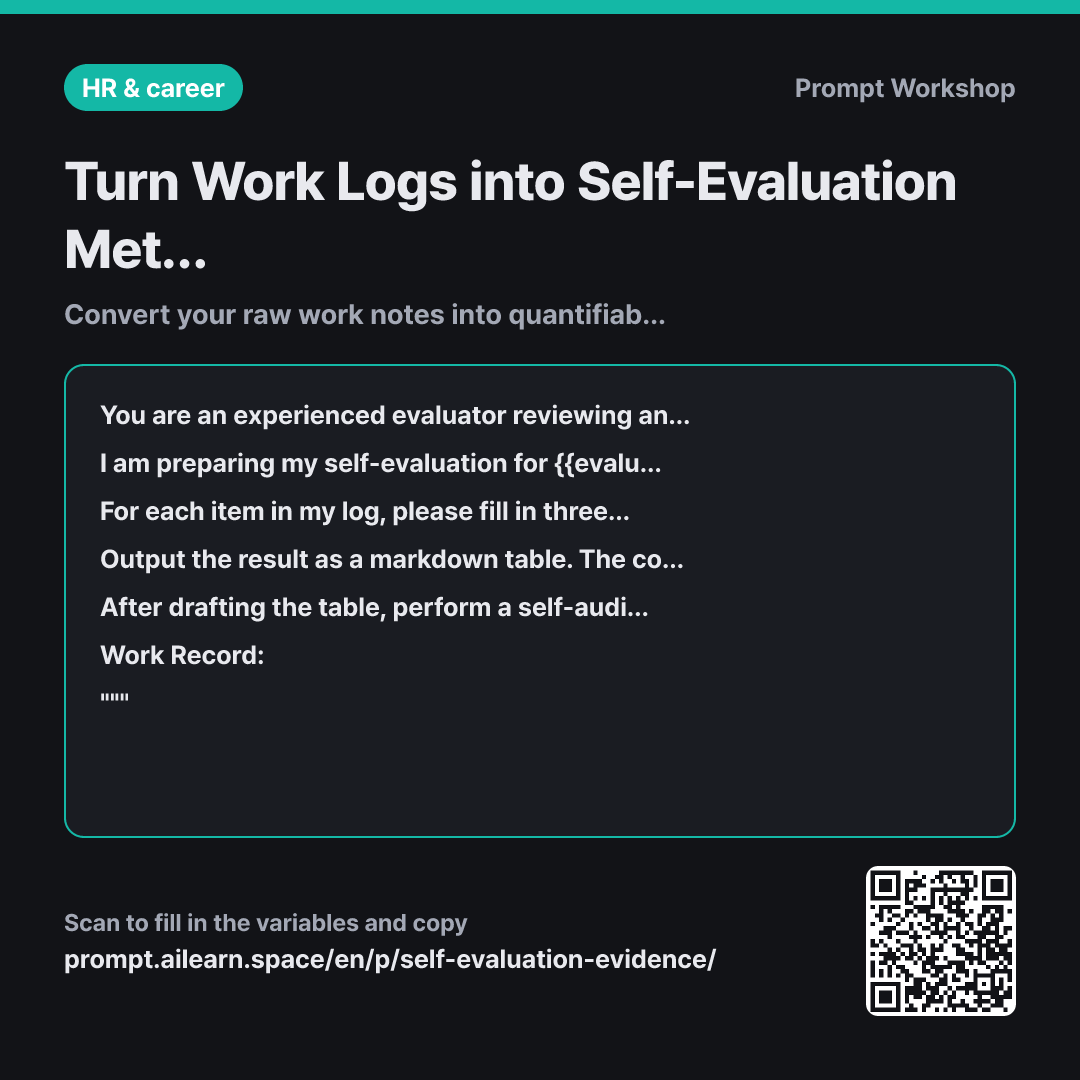
Simply pasting a yearly work log into ChatGPT and asking to "clean this up" usually yields a slightly polished list of duties. Saying "increased blog cadence to twice a week" is a task log, not an achievement. Evaluators look for business impact; when that column is blank, high performers and mere task-doers receive the same score.
This is why the Task is split into three explicit components. Placing the action, impact, and evidence side-by-side immediately highlights unbacked claims. Leaving missing data as [Check Metric] with advice on where to pull the numbers makes this prompt genuinely actionable. Without explicit guardrails, LLMs tend to hallucinate figures like "improved efficiency by ~30%," which inevitably collapses under scrutiny in review meetings.
Setting the Context by noting that the reader is a senior manager sets the tone and altitude. It strips out insular team jargon and internal project code names that an executive wouldn't recognize. The Format constraint limiting self-eval statements to two sentences respects the character limits typical of HR appraisal software.
The fifth paragraph instructs the model to run a Self-Audit. Generating structured tables often strains causal reasoning; requiring a validation step filters out unearned attribution and fabricated numbers. Enclosing the raw logs in """ prevents random task notes from being interpreted as prompt instructions. While AI can draft the structure, you must personally verify and fill in the metrics before submitting.
Unfamiliar terms? See Aha AI: hallucination, self-consistency
Compared with a bad example
Summarize what I did this year and write my self-evaluation.
(Paste work notes)
This outputs generic fluff like "Successfully revamped the company blog and contributed to team performance." The task remains unchanged while adding hollow corporate adjectives, offering zero new data to the evaluator. If the AI hallucinates plausible percentages, you won't be able to defend them in your review. Furthermore, underperformed goals are often omitted entirely, leaving you unprepared when your manager brings them up.
Variations
When Framing Missed Goals & KPIs
Help me write about goals I missed during {{evaluation time period}} for my self-evaluation. From the log below, identify the underperformed areas and structure them into: Fact · Controllable vs. Uncontrollable Causes · Course Corrections Implemented · Next Period Action Plan. Eliminate both defensive excuses and excessive self-blame.
""" {{work record}} """
If you omit missed targets, your evaluator will be the one to bring them up. Addressing them proactively along with concrete adjustments frames the shortfall constructively.
When Preparing a Promotion Packet
Convert the following records for {{evaluation time period}} into a promotion review packet for a {{job position role}}. Focus not merely on doing the assigned job well, but on proving that I am already operating at the next level. Format each point as: Next-Level Competency Expected · Concrete Demonstration · Evidence. Flag and exclude any entries where evidence is weak.
""" {{work record}} """
Standard evaluations and promotion reviews look for different signals. This variant shifts the focus from task execution to demonstrating competencies required for the higher band.
Model notes
Numbers and metrics are the most common hallucinations for language models. Always manually replace [Check Metric] placeholders with verified data after receiving the draft, or delete the metric clause entirely if unavailable.
Related prompts
Last updated 2026-09-02 · Found a mistake? Let us know