Why it is written this way
Most people search for resume prompts for the same reason: their bullet points read like job descriptions ("handled customer inquiries", "managed sales data"), giving recruiters no clue about their true capabilities. However, simply asking AI to "make it outcome-focused" often leads to hallucinated metrics like "improved efficiency by 20%."
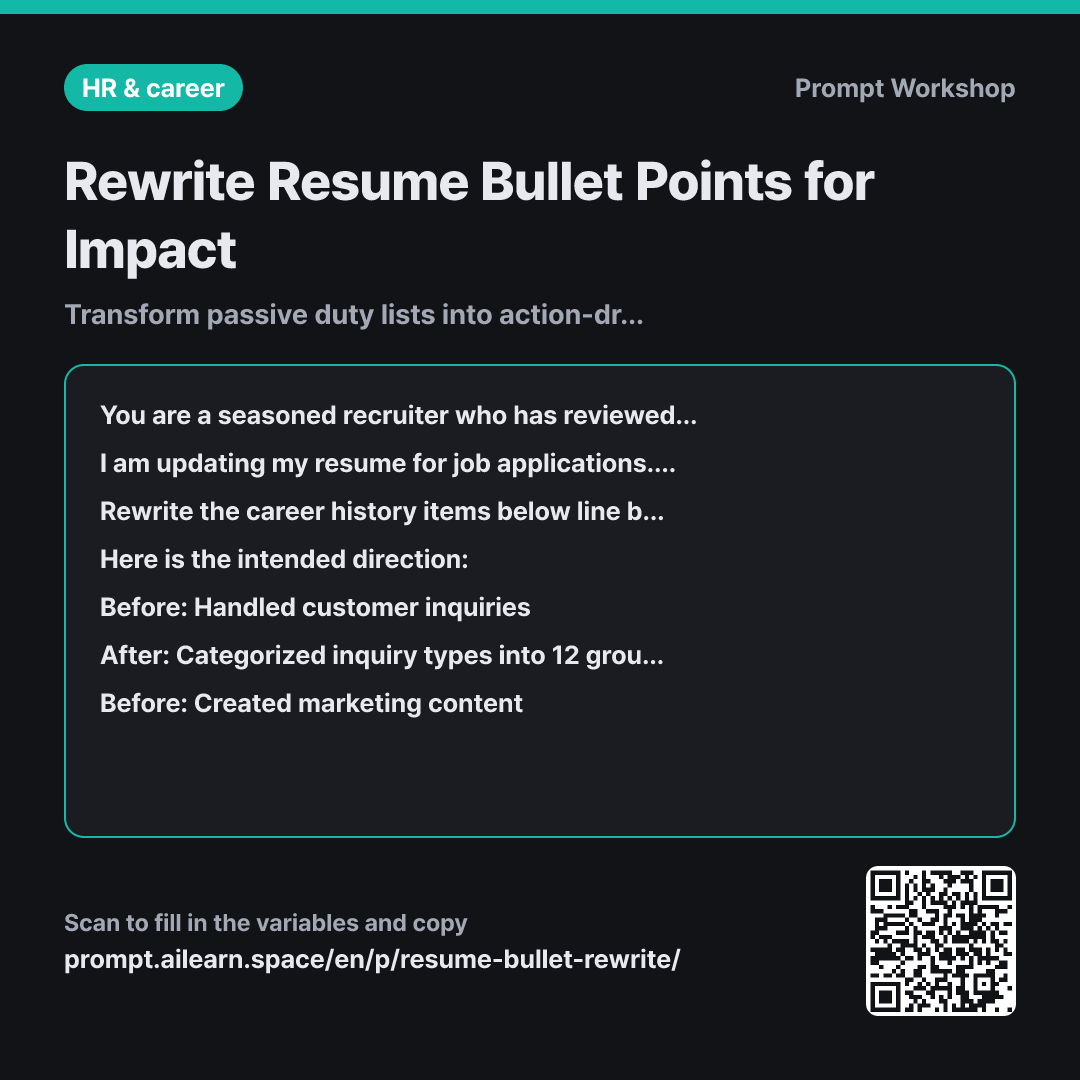
This is why the Task paragraph strictly specifies the structure ("What · How · What changed") and enforces starting with a strong action verb. Constraining the sentence pattern pushes the AI to identify missing structural information instead of simply padding the text with empty adjectives.
The two before/after Examples in the subsequent paragraph are the most powerful elements of this prompt. Showing one concrete rewrite is far more effective than dozens of abstract instructions. Crucially, embedding placeholders like [X mins] and [N keywords] teaches the AI by demonstration. When provided with a template that deliberately leaves numbers blank, the AI faithfully mirrors that behavior. Negative constraints ("do not fabricate") rarely work on their own, but providing a clear pattern ensures reliable compliance.
The tabular Format places original and rewritten lines side by side, allowing you to instantly spot any exaggerations. The "Details to Confirm" column acts as a clear checklist of real data points you need to retrieve. Finally, wrapping the input in """ delimiters prevents previous notes and unstructured phrasing from being misread as instructions.
Unfamiliar terms? See Aha AI: few-shot, hallucination
Compared with a bad example
Make my resume bullet points sound impressive and outcome-oriented.
Handled customer inquiries / Managed internal CS knowledge base / Compiled monthly ticket metrics
Asking like this almost always generates fabricated claims like "Boosted customer satisfaction by 20%." You won't have real sources for those metrics, leaving you vulnerable in an interview. Because it doesn't display the original text side by side, it's also hard to tell which parts are your genuine experience and which parts are AI hallucinations.
Variations
When metrics cannot be quantified
Please rewrite the {{job position role}} bullet points below. I do not have quantitative numbers to showcase. Without fabricating metrics, revise them into statements that highlight "what challenge existed · how it was solved · what workflow improved." If there are factual scale indicators (volume handled, team size, timeline) in the text, include only those in the sentences.
""" {{career history items}} """
For junior or entry-level positions, showing operational improvements often reads better than forced numbers. This instructs the AI to leverage contextual scope rather than making up metrics.
Condensing for a single resume section
Condense the {{job position role}} bullet points below into exactly three high-impact lines fitting a single resume role section. Select one largest-scale initiative, one core long-term competency, and one achievement difficult for others to replicate, discarding the rest. Provide the discarded items in a separate list, and do not introduce any achievements not listed below.
""" {{career history items}} """
When space is limited, curation takes priority over rewriting. Listing discarded points lets you quickly restore anything essential that was cut.
Model notes
When tables grow lengthy, some models attempt to abbreviate sentences. If your list exceeds 10 items, process them in batches of 5.
Some models may accidentally copy the sample metrics from the prompt (like resolution times or keyword counts) as if they belong to your experience. When you receive the table, scan for any non-bracketed numbers and remove figures you did not supply. If you plan to paste the result into Excel or Google Sheets, adding "Provide the table as tab-separated values (TSV)" makes importing seamless.
Related prompts
Last updated 2026-09-02 · Found a mistake? Let us know