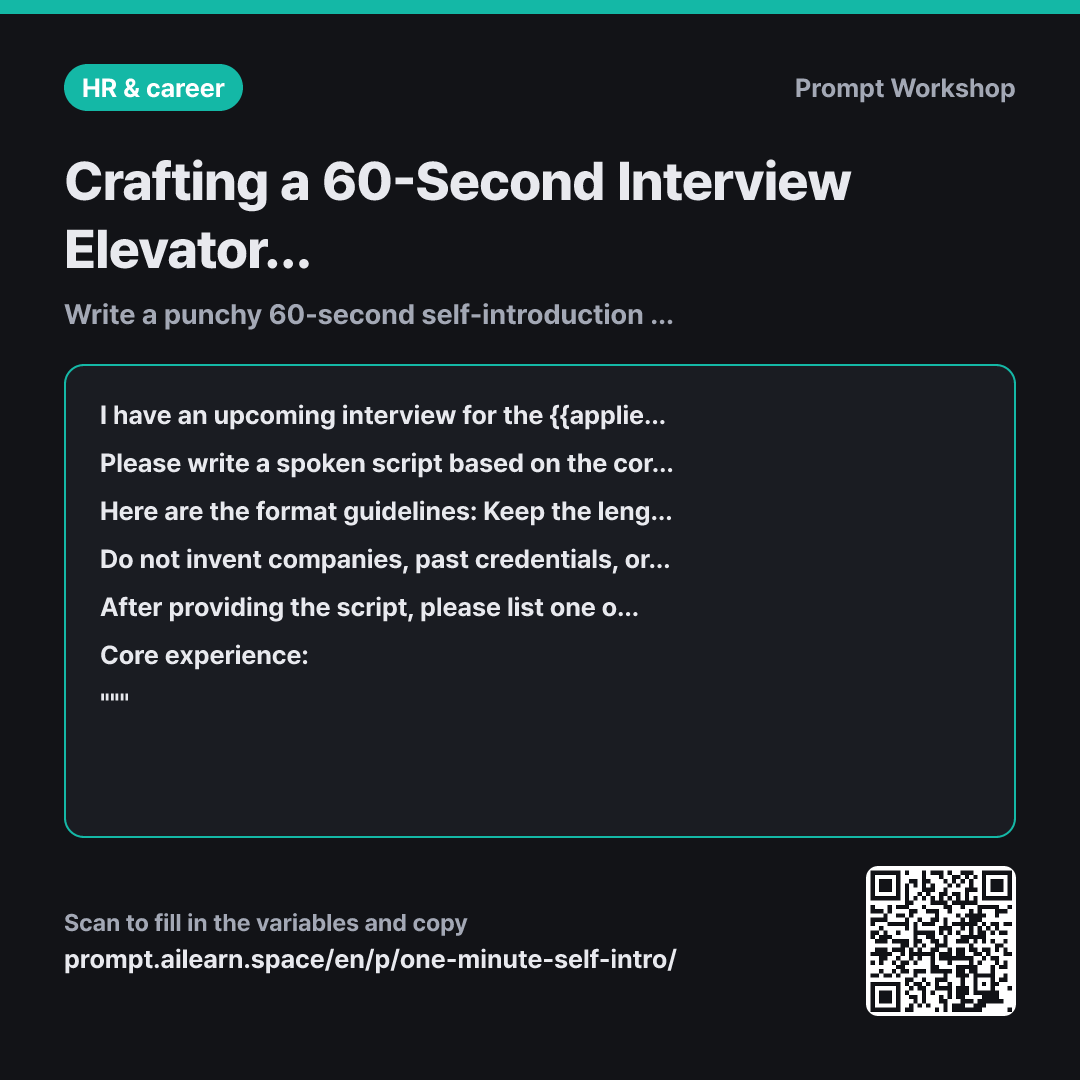
Why it is written this way
When asking an AI for a "1-minute self-introduction," the output often takes 2 to 3 minutes to read aloud. Without a specific word count, AI interprets "one minute" as a vague tone rather than a strict duration. Going over time in an interview risks getting cut off before delivering your closing punchline.
In the first paragraph, context details like "interview opener," "listener is the hiring manager," and "first time hearing my background" are crucial. Defining the audience encourages the AI to explain technical jargon clearly and frame the background context upfront.
The format paragraph provides an explicit target of "130–150 words" grounded in spoken delivery pacing. Providing this rationale prevents the model from bloating the text. The 4-part structure and slash ( / ) pause version transform written prose into an actionable spoken delivery script.
Under constraints, "Do not invent companies, past credentials, or metrics" is critical. The self-introduction sets the tone for the first 30 seconds and feeds subsequent interview questions; introducing unverified facts forces you to defend them later. Finally, asking for an optional cut-sentence and add-on sentence lets you adjust pacing on the fly without rewriting the entire pitch.
Unfamiliar terms? See Aha AI: context-window, output-format
Compared with a bad example
Create a 1-minute self-introduction. I'm applying for a Product Manager role at a startup.
Without specific experiences provided, the AI defaults to generic clichés like "I am a passionate problem-solver dedicated to user satisfaction." The pacing will also be arbitrary, likely exceeding a minute while leaving out your actual achievements.
Variations
Adapting for Experienced Hires
Please write a 60-second interview introduction script for an experienced {{applied job role}} candidate. Instead of focusing on a beginner's growth story, lead with the scope of my past responsibilities and the immediate value I can bring to the team. Keep it around 130–150 words with concise sentences under 20 words. Do not invent any companies or metrics not listed below.
""" {{core user experience}} """
Experienced candidates should lead with "what I can deliver today" rather than a learning narrative. Shifting this sequence immediately elevates professional credibility.
Trimming an Existing Draft to Fit Time Limits
Below is my current self-introduction draft. Without inventing new content, trim it down to 130–150 words for a 60-second delivery. Provide a bulleted list of what was removed, highlight one must-keep sentence with the rationale, and flag any awkward phrasing that catches when read aloud.
""" {{core user experience}} """
Use this when your existing draft runs too long. Reviewing the deleted elements ensures you can restore critical points if needed.
Model notes
Many models struggle to adhere precisely to length limits on the first try. After getting the initial draft, ask follow-up edits such as "Count the words and trim this down to 130–150 words."
Many models struggle with exact word counts and may generate 180+ words even when asked for 140. Time yourself reading the draft aloud; if it runs long, ask: "Please trim two non-essential sentences from this draft." Removing content retains voice consistency better than asking for a complete rewrite.
Related prompts
Last updated 2026-09-02 · Found a mistake? Let us know