Why it is written this way
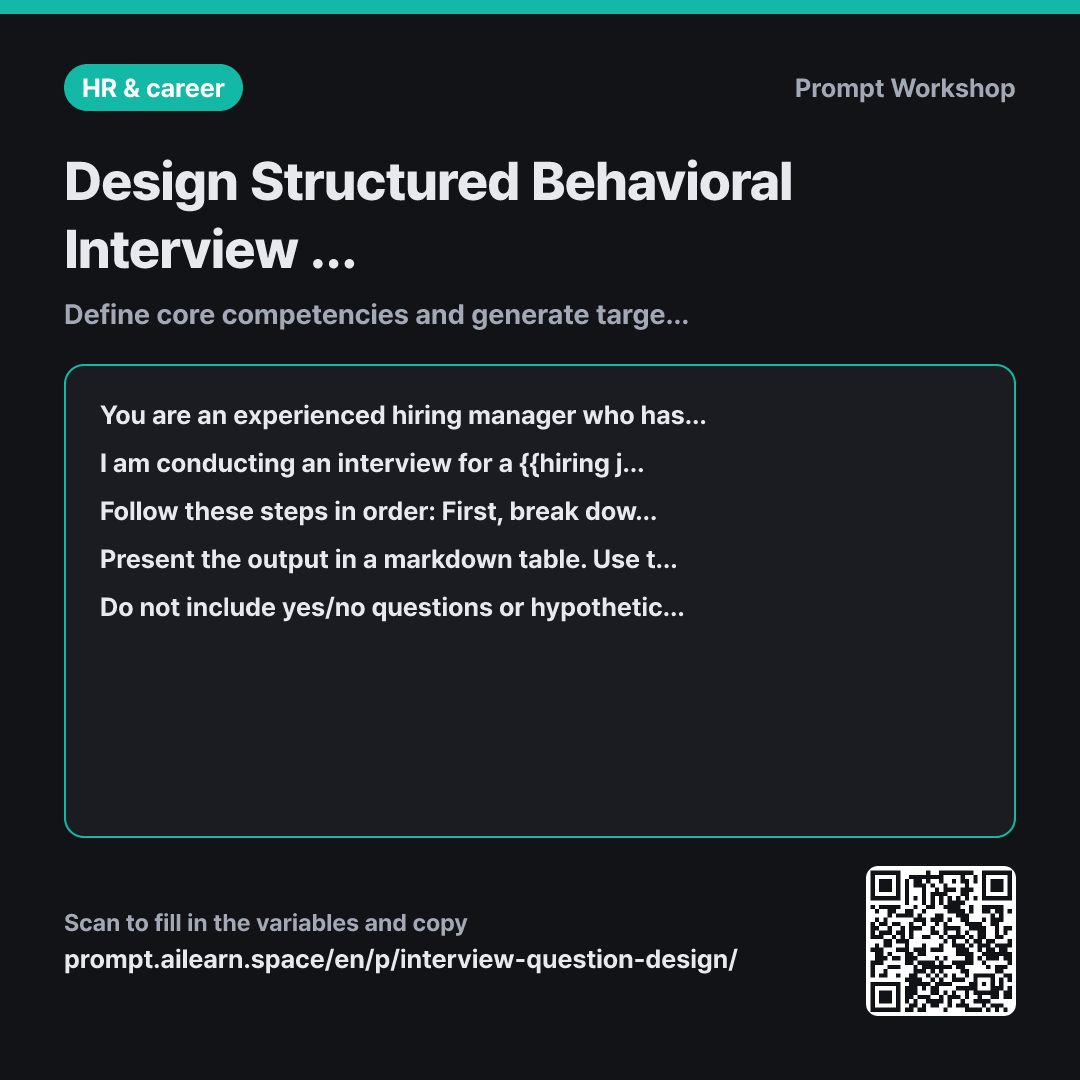
If you simply ask an AI to "create 10 interview questions," it usually generates repetitive, generic prompts. In a real interview, you run out of time after the first few questions without ever validating the core skills required for the job. This prompt prevents that failure by anchoring the entire process in core competencies first.
Setting the role as a practical "hiring manager" rather than a general HR recruiter keeps the focus grounded in hands-on execution rather than superficial etiquette and broad personality traits. Only someone looking through the lens of actual day-to-day work will ask questions that probe for tangible specifics.
Breaking the task into four clear steps is essential. Translating abstract competencies into observable behaviors requires different analytical thinking than drafting interview questions. Asking the model to do everything at once causes it to skip straight to cliché question banks. Structuring the steps explicitly ensures each output directly feeds the next, establishing a coherent line: Competency Definition → Behavioral Question → Rubric Criteria.
Specifying the exact table format with six columns creates an actionable evaluation sheet ready for live interview use. Including green/red flags ensures the scoring criteria are explicit rather than remaining ambiguous in the interviewer's head. Asking for a minute-by-minute time breakdown forces the model to keep the question count realistic—fitting 12 detailed questions into a 30-minute interview simply isn't feasible.
Finally, the explicit constraints filter out unhelpful hypothetical questions (which only test how well someone invents a story on the spot) and legally risky personal inquiries. The instruction to consolidate duplicate questions ensures a tight, high-signal interview guide.
Unfamiliar terms? See Aha AI: chain-of-thought, output-format
Compared with a bad example
Create 10 interview questions for a content marketer.
This produces generic questions like "What are your greatest strengths?" or "Tell me about a difficult collaboration." Candidates simply recite prepared scripts, interviewers lack clear evaluation criteria, and the hiring decision devolves into gut feeling and surface-level impressions.
Variations
When Interview Time Is Tight (30 min)
I have only {{interview time}} to interview for the {{hiring job role}} position. From the following list of {{required core competency}}, select the top two competencies that cannot be evaluated from a resume alone, and provide a one-line rationale for your choice. Then, create two primary behavioral questions and four follow-up probes focused strictly on those two competencies. For the remaining competencies, provide a one-line suggestion on alternative assessment methods (e.g., take-home assignment, reference check, post-hire onboarding).
When time is limited, evenly trimming all questions results in a shallow assessment. This version forces you to prioritize which competencies must be validated live versus asynchronously.
For Entry-Level & Career-Changer Roles
I am interviewing an entry-level candidate for the {{hiring job role}} role for a total of {{interview time}}. Translate {{required core competency}} into observable behaviors transferable from non-corporate settings (e.g., university coursework, student clubs, internships, freelance, personal projects). Then, create primary questions asking what they actually built or resolved in those contexts, along with probing questions to verify personal contribution versus team effort. Format as a table: Competency | Alternative Experience Scenario | Primary Question | Follow-up Probes.
Applying senior-level corporate questions to entry-level candidates results in vague, rehearsed answers because they lack the direct enterprise experience.
Model notes
If you ask for too many questions at once, the output often becomes redundant. After generating the table, prompt: "Review the table above, identify any overlapping questions, and consolidate them into a more concise set."
Related prompts
Last updated 2026-09-02 · Found a mistake? Let us know