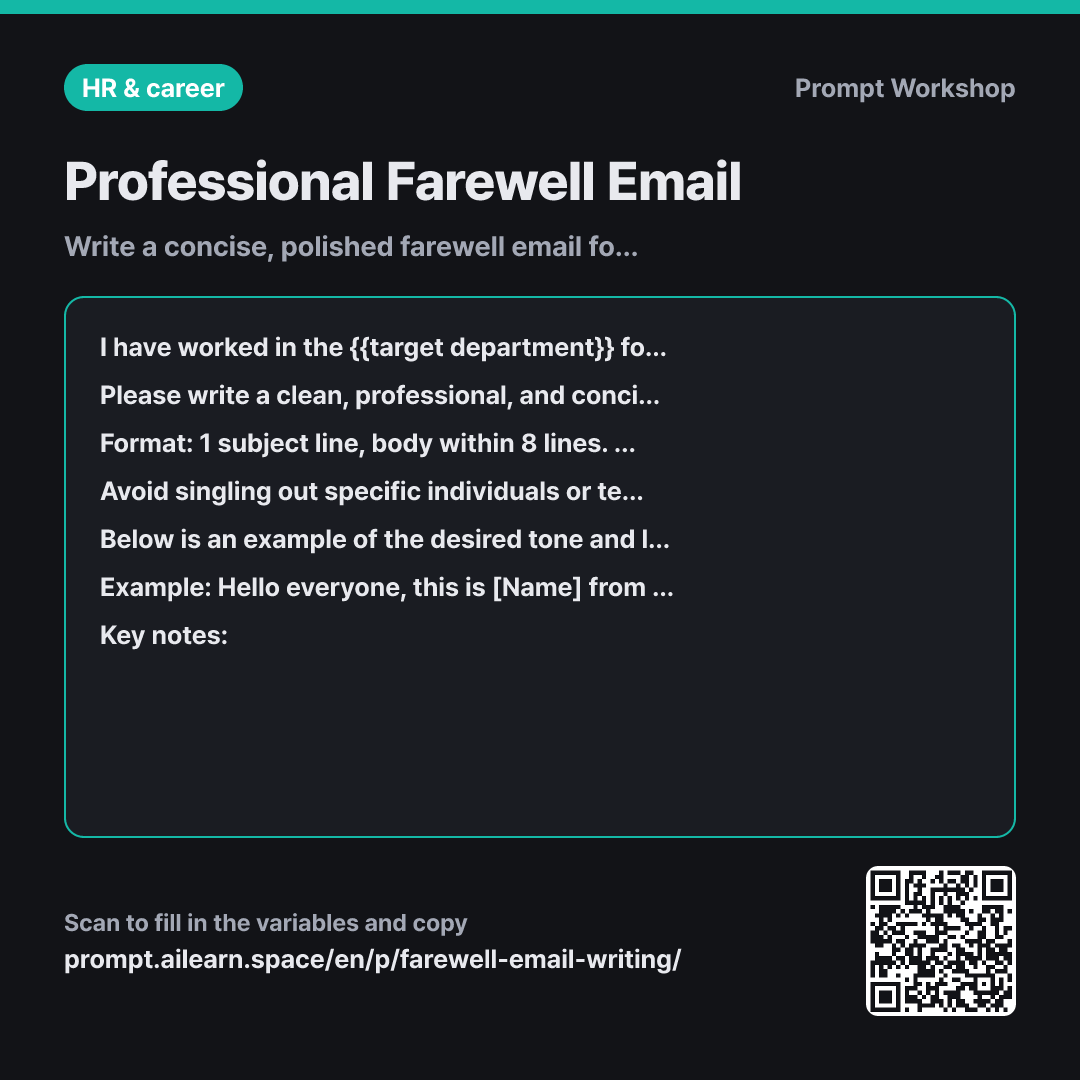
Why it is written this way
Problems with farewell emails usually stem from predictable issues: leaking unchecked emotions, singling out specific people, or subtly hinting at grievances or reasons for leaving. This email will be read by the entire company, archived, and seen by colleagues you may encounter again in the industry. Therefore, this prompt strictly limits the content to three core components: gratitude, handover info, and contact details. Setting clear boundaries on what to include is much more effective than trying to block every possible unwanted phrase.
The Context segment clearly states, "Many recipients may not know me well personally." Without this, the model tends to draft an overly intimate letter suitable only for close peers, which makes most company-wide readers uncomfortable.
The Constraints make up the longest part of the prompt. Prohibiting praise for specific individuals prevents feelings of exclusion among unmentioned colleagues, while filtering out emotional undertones avoids future regrets. Explicitly listing and banning clichés ensures the email stays polished and grounded. Setting the Format to an 8-line limit and using bracketed placeholders prevents the model from hallucinating names while making final personalization easy.
Finally, the Example sets the exact tone. In farewell messages, nailing the right emotional register is harder than controlling length. Providing a complete sample clearly communicates sentence pacing, warmth, and a clean sign-off.
Unfamiliar terms? See Aha AI: few-shot, output-format
Compared with a bad example
Write me a farewell email. I worked here for 3 years and today is my last day.
This produces a generic, cliché-ridden email filled with dramatic lines like "Thank you for guiding me despite my shortcomings" and "Please wish me luck on my new journey." It lacks handover details, leaving colleagues scrambling to find project owners next week.
Variations
Farewell message for your immediate team
I have worked in the {{target department}} for {{period of employment}}, and I want to write a short farewell message specifically for my immediate team members, separate from the company-wide email.
Please write a concise message based on the notes below. The tone should be slightly more personal than a company-wide email, but do not single out specific individuals by name for praise. Format within 6 lines, leaving a placeholder [Contact Information] on the last line. Do not mention reasons for leaving or where I am moving.
Key notes: """ {{closing remarks}} """
A team message naturally carries a warmer tone than a company-wide email. However, naming specific teammates can easily leave others feeling excluded, so the rule against individual name-dropping is preserved.
Transition notice for external clients and partners
I have worked in the {{target department}} for {{period of employment}}, and I need to send an email to external partners notifying them of a change in point of contact.
Please draft an email based on the notes below. Format: 1 subject line, body within 6 lines. ① State departure and last working day. ② Leave successor name and contact info as [Successor Name] and [Contact Information]. ③ 1 line explaining how ongoing matters will transition. ④ Brief, professional closing. Do not include personal contact details, emotional expressions, or internal company context.
Key notes: """ {{closing remarks}} """
The primary goal of an external notification is handover continuity, not a personal farewell. The successor and ongoing projects take front and center, while gratitude is kept brief and professional.
Related prompts
Last updated 2026-09-02 · Found a mistake? Let us know