Why it is written this way
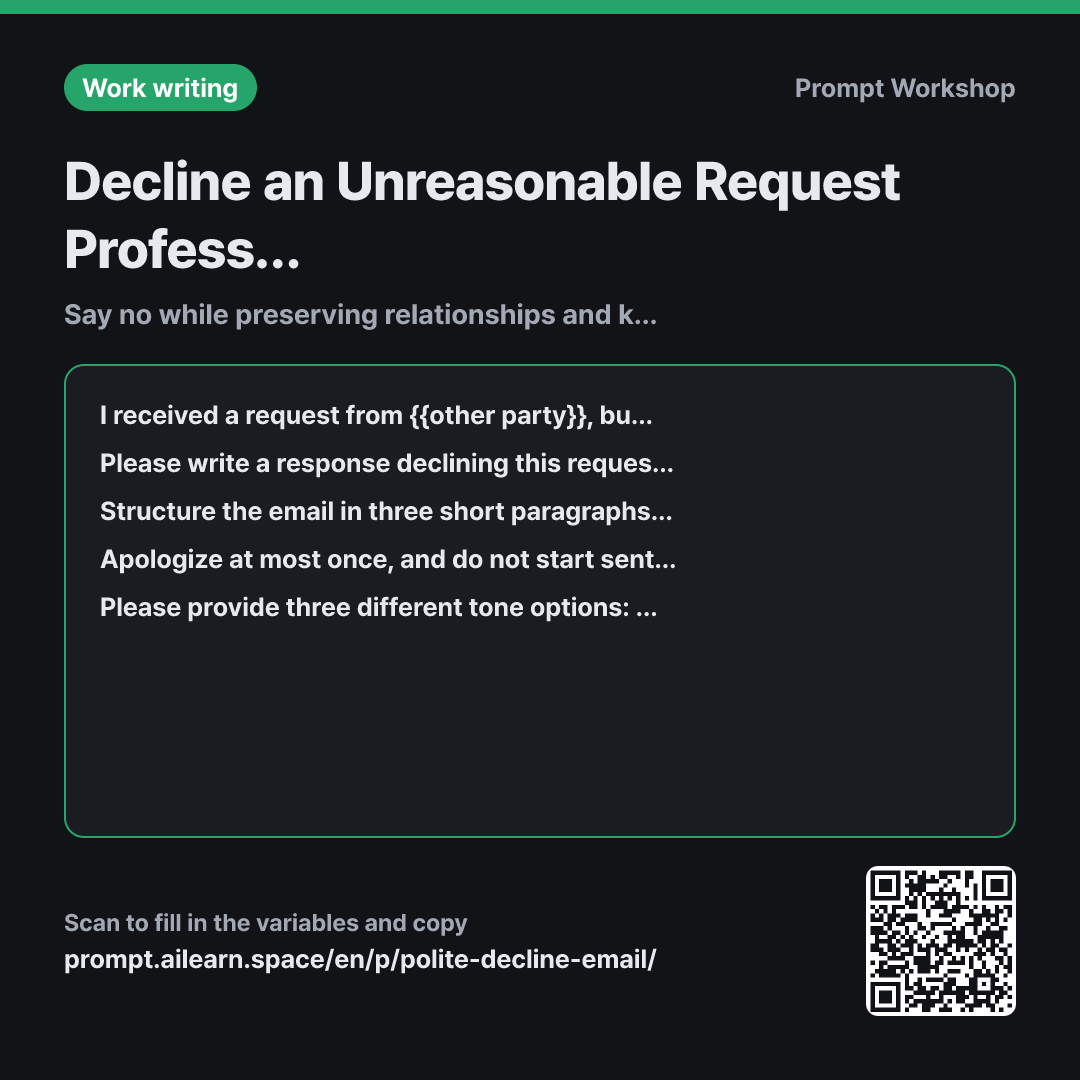
When asking AI to draft a rejection email, the most common mistake is over-explaining the rationale. Writing multiple paragraphs out of guilt often sounds like making excuses, giving the recipient room to push back with workarounds. Putting the conclusion first and summarizing the reason in a single line is far more effective for preserving business relationships.
In the first paragraph, the context stating "We need to continue working together in the future" dramatically alters the output. Without this line, models tend to generate cold, final termination notices that burn bridges. Clearly isolating who the sender is, what they asked for, and why it is difficult prevents the model from embellishing reasons.
The sequence set in the task paragraph (Decline → One-line reason → Alternative) forms the backbone of this prompt. Awkward refusal emails almost always suffer from inverted ordering. Burying the refusal at the end after lengthy explanations forces the reader to re-read to find the point. Requiring an alternative is crucial because the recipient's main concern is usually "what should I do next?"
The constraints section prevents hallucinated excuses. Without limits, models frequently plug gaps with fabricated company rules or executive orders, which can backfire later. Asking for three distinct tones at the end helps you choose the right firmness and refine it quickly (e.g., "Use option 2, but make the alternative more specific").
Unfamiliar terms? See Aha AI: context-window, hallucination
Compared with a bad example
Write a polite email declining this request.
(Pasted received email)
Asking only for a "polite" refusal leads the model to add excessive apologies and hedging. The result is a long, apologetic email that obscures whether it is a clear 'no' or a conditional 'yes', inviting the recipient to push back. Without a concrete alternative, the recipient is left stranded.
Variations
Accepting conditionally instead of a flat refusal
I cannot accept {{other party}}'s request for {{request content}} as-is, but it is feasible with conditions. The challenge is {{reason for rejection}}, and my available scope is {{alternative option}}.
Please draft a response as a conditional acceptance rather than an outright rejection. State what is possible clearly up front, and add a single line explaining why parts outside that scope require separate discussion. End with a one-sentence confirmation question so the other party can simply reply with "Yes/No".
Sometimes a conditional acceptance works better than a flat rejection. Defining the possible scope first prevents scope creep down the line.
Declining a request from an internal manager or senior colleague
I cannot take on the request for {{request content}} asked by {{other party}} right now. The reason is {{reason for rejection}}.
Please write a short internal message to a senior colleague. Do not use the word "reject" or "no"; instead, frame it as asking for guidance on prioritizing this new request against my current workload. Keep it under three lines and attach {{alternative option}} in the last line.
When dealing with internal superiors, framing the situation as a priority check works better than a direct refusal. It hands the decision back to them while still offering a practical alternative.
Related prompts
Last updated 2026-09-02 · Found a mistake? Let us know