Why it is written this way
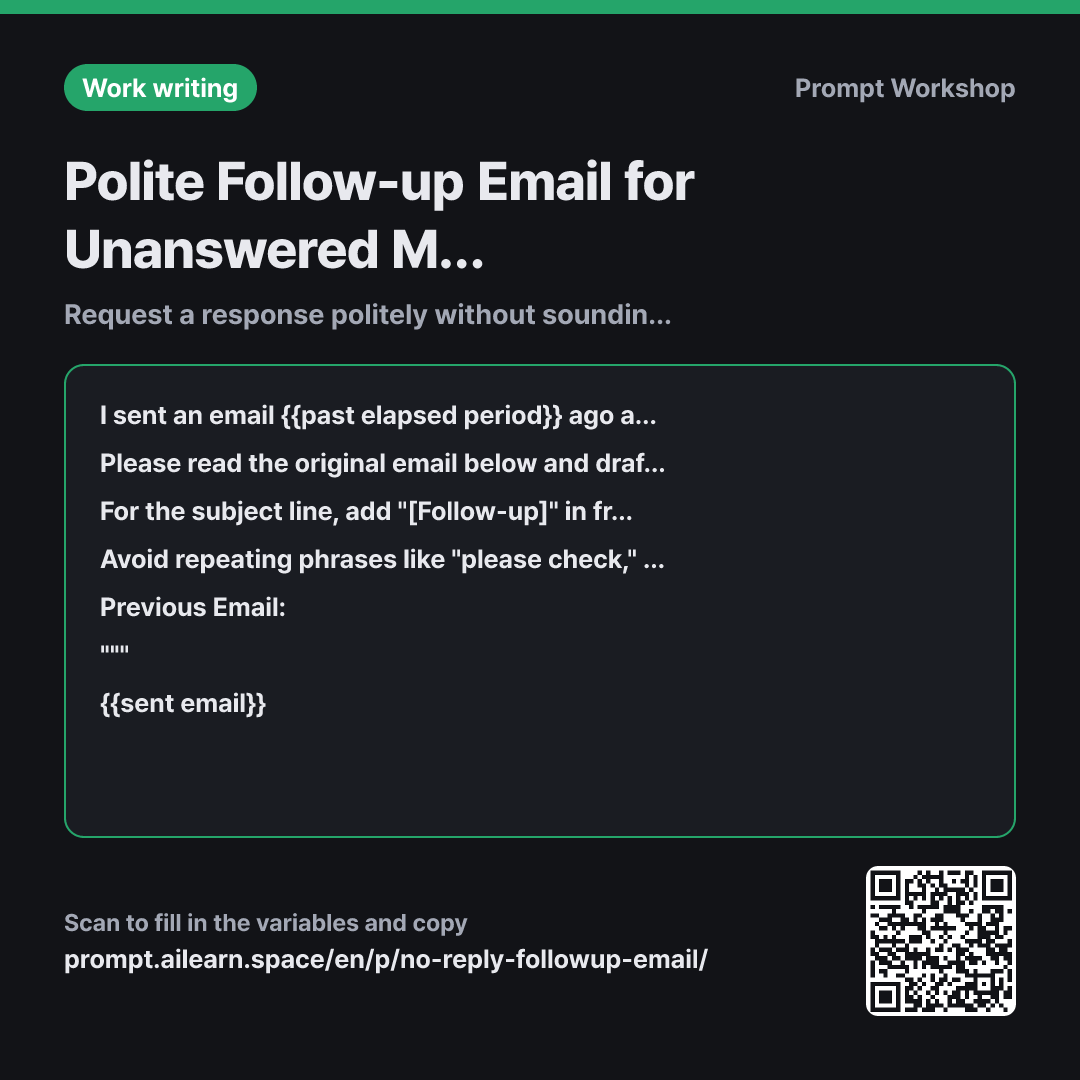
When using a prompt to follow up on an unanswered email, most people simply resend the original email with an added line like, "Just checking in on this." However, the reason the recipient didn't reply in the first place is usually that the email was too long or unclear about what specific action was required. Sending the exact same email leads to it being postponed again for the same reason. This prompt focuses on summarizing the context and narrowing the question down to a single, easily actionable response.
The Context in the first paragraph—noting that the recipient was likely busy rather than intentionally ignoring the message—sets the overall tone. Without this guidance, AI models tend to produce passive-aggressive or slightly guilt-tripping phrasing. Setting the elapsed time as a variable serves the same purpose; a follow-up sent after 3 days requires a very different tone than one sent after a month.
The instruction to "summarize in 3 lines or fewer" is the core of this prompt. When asked to draft a follow-up, ChatGPT often generates a longer, overly polite version of the original text, when what is actually needed is the exact opposite. Enforcing a strict word count and a 3-part sequence in the Format ensures that the summary, request, and timeline fit on a single screen without scrolling.
The Constraints block out pushy language and speculative excuses while prompting a binary (yes/no) or simple choice format. Emails that only require a quick pick or a one-line answer receive significantly faster responses. Wrapping the previous email in """ delimiters prevents phrases like "Please reply" inside the original text from being misread as new instructions. As the pasted context grows longer, this separation becomes increasingly crucial.
Unfamiliar terms? See Aha AI: context-window, prompt-injection
Compared with a bad example
I didn't get a reply so write me a follow-up email.
(pasting previous email)
The model will likely retain almost the entire original email, only adding generic greetings and nagging phrases. The result is an even longer email than the first, leaving the recipient still unsure of what to answer first. With no clear call to action or timeline, it gets pushed to their "deal with later" pile once again. By the time a third email is sent, the tone often stiffens, straining the relationship.
Variations
Polite Follow-up to an External Partner
I haven't heard back from an external contact regarding the email below sent {{past elapsed period}} ago. Please draft a polite follow-up email.
Assume that I am unfamiliar with their internal processes. Rather than pressing for an answer, ask if there has been a change in point of contact or if it would be better to reach out to someone else, and summarize the key information needed ({{required answer response}}) in a single closing line. Keep it under 80 words.
Previous Email: """ {{sent email}} """
When dealing with external partners, unanswered emails are often due to personnel changes or handoffs between departments. This variant replaces pressure with a routing question to smoothly get back on track.
Final Follow-up Before Moving Forward
It has been {{past elapsed period}} since I sent the email below, and this will be my final follow-up. If I don't receive {{required answer response}}, I will need to proceed with an alternative approach.
Write a concise email that calmly states how I will proceed if there is no response, without sounding confrontational. End with a welcoming note that their input is always appreciated rather than shutting the door completely. Keep it to 3 sentences or fewer.
Previous Email: """ {{sent email}} """
Use this variant when you can no longer wait for a response. It informs the recipient of the next steps without reading like a harsh ultimatum.
Model notes
When pasting a previous email, the model may occasionally retain the original greeting and email signature. If the output is longer than desired, follow up with: "Shorten the summary of the previous email to two lines and remove the signature."
Related prompts
Last updated 2026-09-02 · Found a mistake? Let us know