Why it is written this way
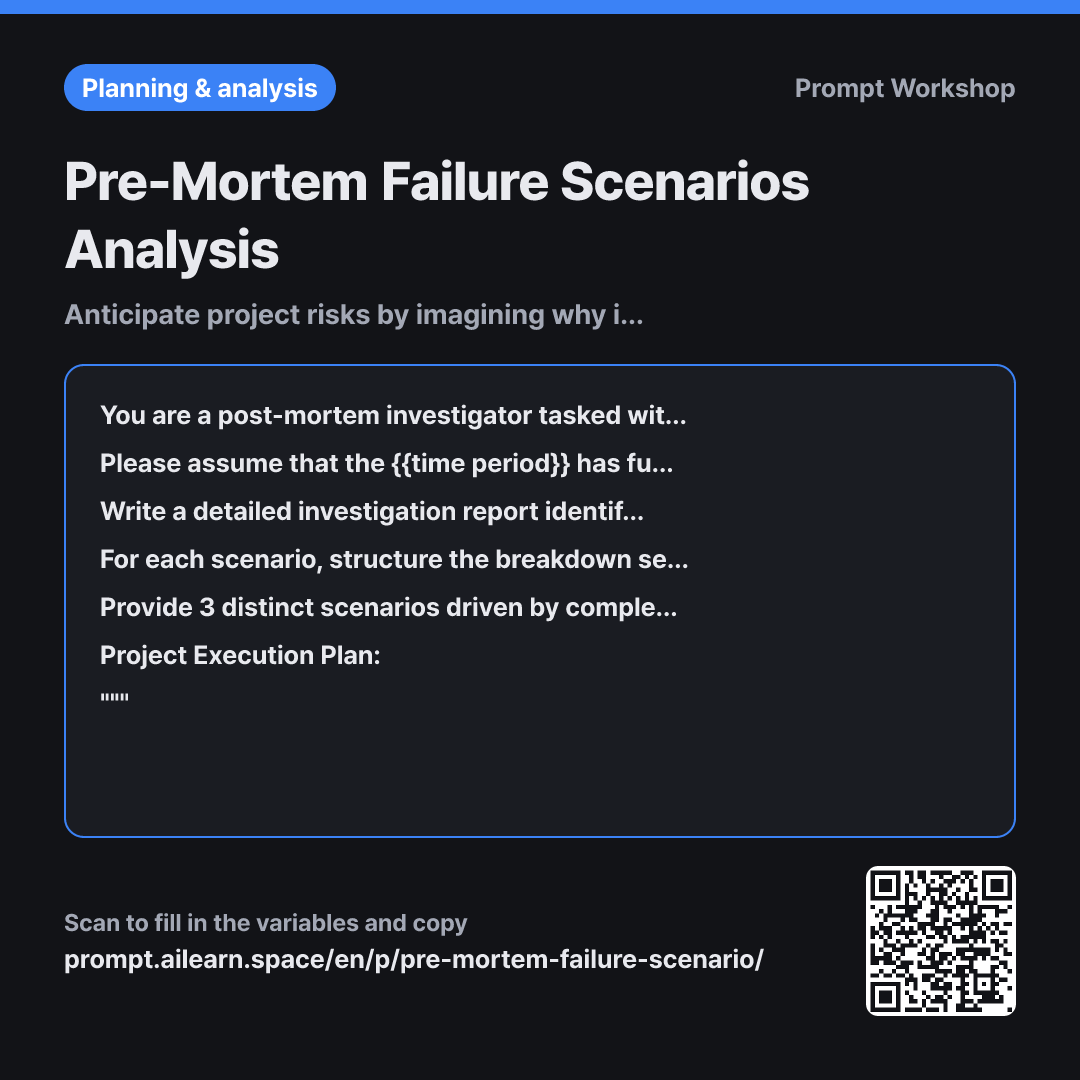
The primary goal of a pre-mortem prompt is to eliminate unhelpful optimism. If you hand over a plan and ask, "What do you think?", you usually get three generic compliments followed by a mild "The timeline might be tight." By firmly declaring upfront that the project has already failed, the entire trajectory of the response shifts. An investigator assigned to find root causes has no reason to list positive aspects.
The role in the first paragraph is not a consultant or advisor, but a post-mortem investigator. While an advisor tries to offer a balanced perspective, an investigator searches exclusively for fault lines. The context paragraph is the core engine of this prompt. Shifting the tense to "it has already failed" rather than "it might fail" stops the AI from evaluating probabilities and forces it to reconstruct a narrative of events.
The step-by-step framework paragraph forces a trace back from the final symptoms to the very first decisions. Asking open-ended questions about failure causes often results in surface-level excuses like "lack of resources." By enforcing this four-step sequence, the analysis exposes which specific decision triggered that resource shortage—and actionable changes today are almost always found at that initial decision point.
The format paragraph requires three distinct scenarios to prevent the analysis from converging on a single generic issue. When only one scenario is requested, it almost always ends up being a predictable schedule delay. Mandating distinct root causes forces the AI to explore different angles, such as technical debt, human factors, or external dependencies. The concluding summary paragraph reveals overarching patterns across all three narratives. Limiting preventative actions to two per scenario is also intentional; receiving ten action items rarely leads to executing even one.
Unfamiliar terms? See Aha AI: role-prompting, chain-of-thought
Compared with a bad example
What do you think of this project plan? Let me know if you see any issues.
(Paste project plan)
Asking like this typically yields two paragraphs of praise followed by a generic line like "The timeline seems slightly tight." This is far from proactive risk identification. Even if critiques are offered, they usually just echo the phrases written in the plan itself, leaving completely omitted blind spots entirely unaddressed.
Variations
For Running a Interactive Team Meeting
Assume that we executed the plan below over the {{time period}}, but the project completely failed. Generate 10 specific questions for the team to answer together in a meeting.
Instead of open-ended questions like "What went wrong?", phrase each question so it can be answered in a single direct sentence, such as: "Who failed to make what decision by when, causing work to stall?" In parentheses after each question, add the specific role or job function most likely to know the answer.
Project Execution Plan: """ {{project execution plan}} """
A pre-mortem is originally designed as a collaborative team exercise. Bringing a targeted questionnaire rather than a ready-made report encourages team members to surface the hidden risks visible from their respective roles.
For Mid-Project Checkpoints
We started with the plan below and are currently halfway through execution. If we fail to achieve our "{{success criteria}}" within the remaining {{time period}}, outline 3 distinct reasons why that would happen.
For each reason, specify: "Signals that have already appeared · Signals that have not yet appeared · What to verify this week". Do not write retrospective evaluations of past work.
Project Execution Plan: """ {{project execution plan}} """
During mid-project reviews, focus must stay on the remaining time rather than judging past actions. Categorizing warning signs into visible versus hidden makes it clear what needs immediate verification this week.
Model notes
Some models may ignore the assumption of failure and attempt to list success factors alongside risks. If this happens, follow up with: "Remove all success factors and rewrite only the failure investigation narrative."
Related prompts
Last updated 2026-09-02 · Found a mistake? Let us know