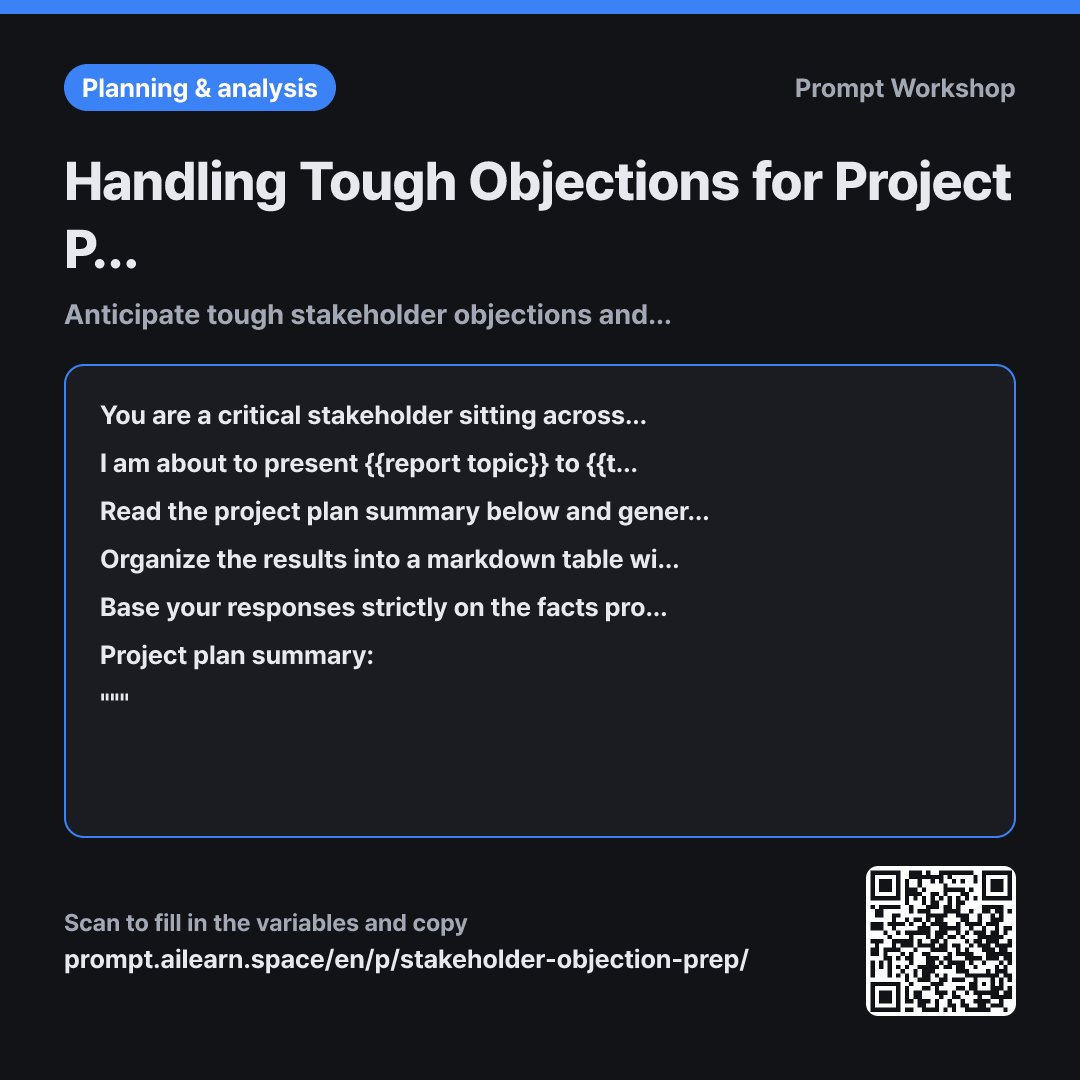
Why it is written this way
If you simply ask ChatGPT to "generate expected questions" for presentation prep, you'll end up with eight generic inquiries like "What are the expected benefits?" Those are not the questions you actually face in high-stakes meetings. Real decision-makers ask things like "Why must we do this right now?" or "Who is accountable if this fails?" This prompt is designed to draw out those critical challenges ahead of time.
Setting the Role in the opening paragraph to an opposing stakeholder rather than a supportive advisor makes all the difference. An advisor role tends to summarize the positive aspects of the pitch, whereas an adversarial role actively searches for holes in the exact same material. This single framing instruction is essential to unearthing sharp rebuttals.
The Context paragraph informs the model of what the audience prioritizes most. Working-level peers ask about implementation methods, while budget approvers scrutinize costs and risks. Without this context, you only get bland, one-size-fits-all questions.
In the Format instructions, the "Weakness of This Response" column doubles the practical value of the table. Memorizing an answer leaves you vulnerable, but recognizing its weakness shows you exactly where the follow-up question will strike. The final instruction to polish the two hardest responses serves the same purpose: initial outputs are often standard, and a second pass produces truly pitch-ready phrasing.
Unfamiliar terms? See Aha AI: role-prompting, persona
Compared with a bad example
I'm presenting this project plan soon. Can you give me some expected questions?
(Pasted project summary)
Asking like this produces a list of questions that simply mirror the outline of your proposal. You get questions already answered in the slides—like "What is the objective?" or "What is the timeline?"—which does nothing to prepare you. Crucial blockers, such as a missing security review or vague success metrics, get completely overlooked. Getting answers alongside these questions does not help much either; they just restate sentences from the slides, giving you no real tactical edge in the room.
Variations
Solo Rehearsal the Day Before the Presentation
I am preparing to present {{report topic}}. Roleplay as {{target listener}} and ask me one tough question at a time.
Once I reply, follow up with a probing question that targets the gaps in my response. After five back-and-forth exchanges, summarize the areas where my answers need improvement. Do not list multiple questions at once.
Project plan summary: """ {{project plan summary}} """
Reading a table is very different from responding out loud under pressure. An interactive back-and-forth helps you pinpoint the exact moments where your arguments falter.
Tailoring Responses Across Different Stakeholder Personas
I am presenting the project plan below to {{target listener}}. Segment the audience into three personas: "Cost-focused stakeholder", "Timeline-focused stakeholder", and "Risk-focused stakeholder". Generate 3 distinct objections for each persona.
For each persona, add a one-line key message explaining how to frame the exact same proposal to persuade them. If there are points where the interests of these three personas directly conflict, highlight them separately at the end.
Project plan summary: """ {{project plan summary}} """
When multiple decision-makers sit in the same room, their objections stem from different priorities. Grouping objections by persona clarifies which narrative angle to deploy for each stakeholder.
Model notes
Sometimes the model generates overly optimistic drafted answers alongside the objections. If this happens, follow up with: "Rewrite the weaknesses of these responses with a much more critical and skeptical eye."
Related prompts
Last updated 2026-09-02 · Found a mistake? Let us know