Why it is written this way
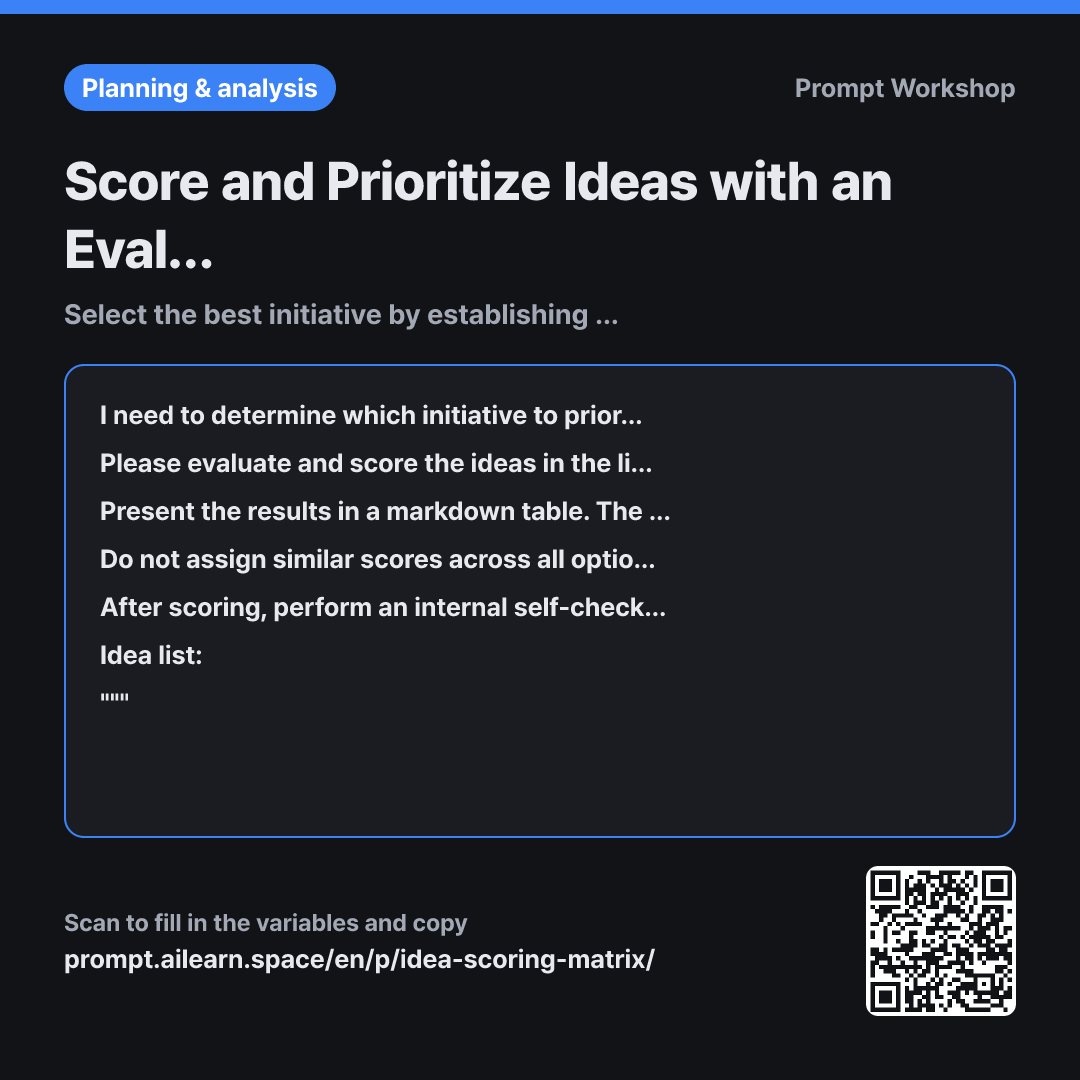
When asking AI to evaluate ideas by simply posing "Which one is the best?", you get subjective preference rather than sound judgment. Even if plausible-looking justifications are attached, it fails to clarify why that option outperforms the others. This prompt defers final selection and establishes criteria and weighting first.
In the Task paragraph, mandating weights before scoring is the critical sequence. Adding criteria after scoring turns the matrix into a post-hoc justification for an already decided answer. Setting weights based on context first makes it clear what needs adjustment if the final results conflict with reality.
In the Format paragraph, a justification column sits directly next to each score. A table full of bare numbers collapses in meetings when challenged with "Why did this get a 3?" The Constraint instruction "Do not assign similar scores" prevents the model's tendency to give safe 3s and 4s across the board, which effectively turns prioritization into a random draw. Prohibiting fabricated numbers serves the same purpose; one hallucinated market size estimate can derail an entire roadmap.
Finally, the Review instruction forces a verification pass over calculations and internal consistency. Mathematical errors are common in large tables, and a single calculation error can invert priorities. Asking only for the final table avoids clutter and confusion.
Unfamiliar terms? See Aha AI: output-format, hallucination
Compared with a bad example
Which of these looks the best? Give me a recommendation.
(Paste idea list here)
Asking like this usually defaults to picking the first or safest option, accompanied by three generic bullet points. It fails to explain why other options were discarded, making it useless for meeting alignment. It also ignores operational constraints like budget or headcount, often recommending initiatives that are currently impossible to execute.
Variations
When defining criteria together first
Given our situation: {{our situation}}, we need to prioritize which of the following ideas to execute first. Please start by proposing 4 distinct evaluation criteria.
For each criterion, write one sentence explaining "Why this criterion is critical to us right now," and consolidate any overlapping factors. Present only the proposed list of criteria first; once I review and confirm them, you will proceed with the scoring.
Idea list: """ {{idea list}} """
Scoring without agreed-upon criteria usually leads to redoing the entire matrix. Securing team consensus on the criteria first ensures the scoring is completed in a single effective step.
When deciding strictly between two options
We must choose strictly one of the two options below. Our situation is as follows: {{our situation}}.
Create a side-by-side comparison table evaluating the two options against our {{evaluation judgment criteria}}. Below the table, list three distinct items under "Trade-offs if choosing Option A" and three under "Trade-offs if choosing Option B." Conclude with a short paragraph explaining under what conditions neither option should be chosen.
Two options: """ {{idea list}} """
When choosing between only two candidates, explicit trade-offs matter more than weighted point totals. Listing what you sacrifice clarifies decision-making immediately.
Model notes
LLMs occasionally make simple addition errors in weighted sums. After receiving the table, asking "Please show the step-by-step arithmetic for the weighted total of each row" provides a reliable verification step.
Related prompts
Last updated 2026-09-02 · Found a mistake? Let us know