Why it is written this way
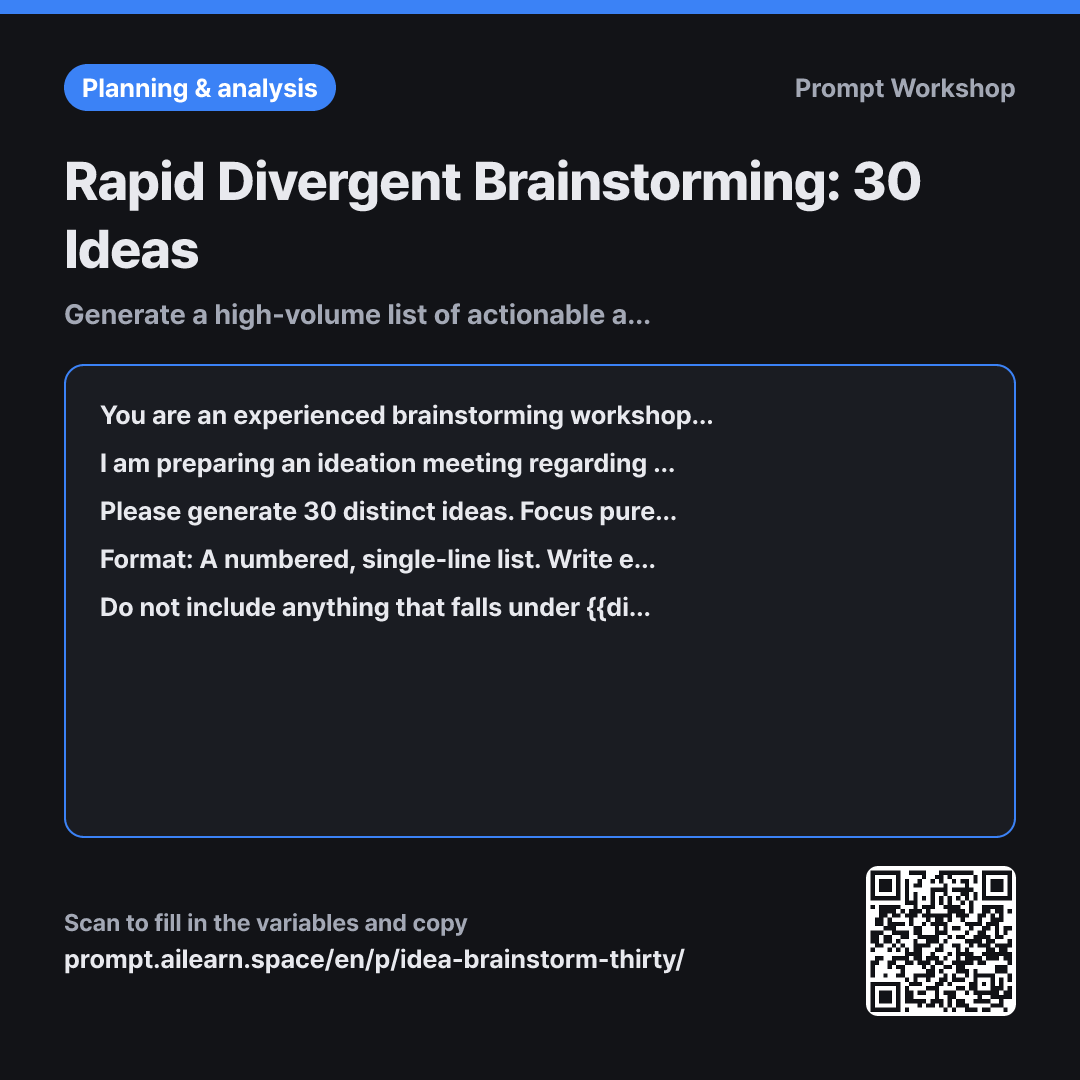
When asking an AI to "give me some good ideas," it often defaults to 3–4 generic, safe suggestions that you could easily find via a quick web search. Before a meeting, what you need is not 3 pre-selected items, but a large pool of 30 distinct options to choose from.
This is why the Role in the opening paragraph sets the AI as a "facilitator." If assigned as a consultant or domain expert, the AI tends to judge and recommend prematurely. A facilitator's job, however, is to expand the playing field. Specifying the target audience in the second paragraph serves the same purpose—without a clear user persona, the outputs remain generic.
The Task instruction "without adding evaluations or explanations" forces the AI to prioritize quantity. If it tries to justify each item, it often runs out of steam around 10. The concise length restriction in the Format ensures that scanning 30 items remains effortless and easy to read aloud during a meeting.
The three 10-item tiers in the Constraints section are the core engine of this prompt. Without structural tiers, all 30 ideas end up with similar complexity. Deliberately reserving a slot for unconventional ideas injects energy into the session. Generating 30 ideas is just the starting point; you can then combine favorites (e.g., "Combine #7 and #22 to create 5 new variations") to refine the best concepts.
Unfamiliar terms? See Aha AI: role-prompting, temperature
Compared with a bad example
Give me some summer menu ideas for a cafe.
A prompt like this typically yields about five generic items—mostly standard iced drinks you have seen everywhere. Without defining the target customer, there is no reason for the ideas to fit local office workers, and exhausted tactics like standard discounts will reappear. You will likely find yourself reviewing the list and thinking, "We've already tried all of these."
Variations
Narrowing Down the Generated Ideas
From the 30 ideas generated above, select the top 8 that {{target customer}} is most likely to actually pay for, ranked by purchase intent. Provide a single-line rationale for each selection. Then, from the remaining items, pick 3 "promising ideas for later, though not viable right now." Do not create any new ideas.
This separates divergent and convergent thinking into distinct steps. Without the explicit instruction "Do not create any new ideas," the AI often injects unprompted suggestions during the selection phase.
When the Ideas Feel Too Similar
Please regenerate ideas for {{main central topic}}, but alter the scenario constraints. Provide 5 distinct ideas for each of the following 3 situations: (1) Zero budget, (2) Solo operator with only 1 staff member, (3) A direct competitor just opened right next door. Continue to exclude {{direction to avoid}}.
Merely asking for more ideas often leads to repetitive variations. Introducing extreme constraint shifts forces the AI to explore entirely different angles.
Model notes
Running this prompt twice and combining the outputs easily yields over 40 unique concepts after removing duplicates. If the AI stops generating around item 20 due to token limits, simply reply: "Continue from #21."
Related prompts
Last updated 2026-09-02 · Found a mistake? Let us know