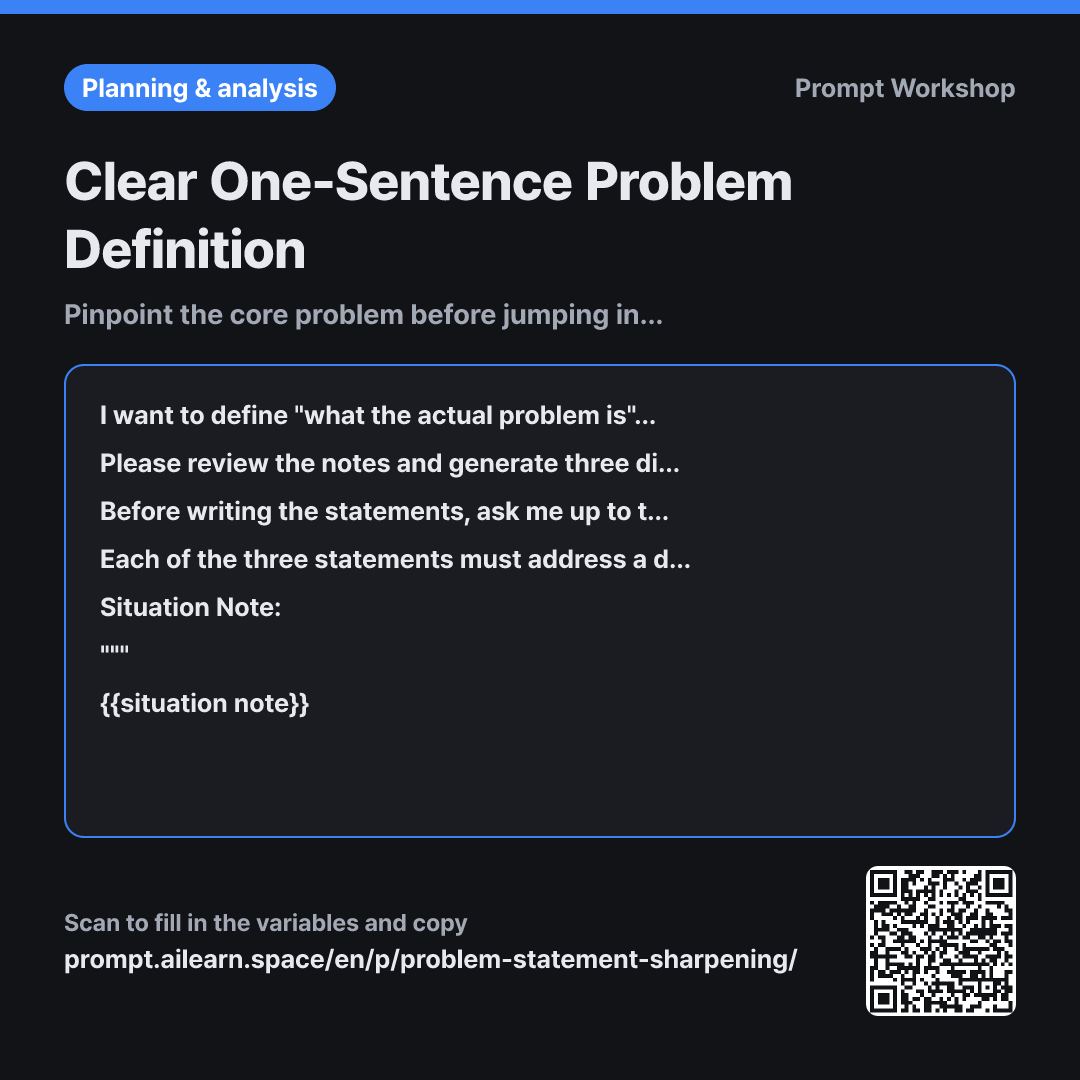
Why it is written this way
You need a problem definition prompt when you only know that "something isn't working right." Asking an AI for ideas at this stage immediately yields a flood of premature solutions. Simply stating that completion rates are low will return generic tips on sending push notifications, setting up communities, or offering certificates—even though no one has yet agreed on what the actual problem is.
This is why the third paragraph introduces clarifying questions. Based on raw notes alone, it is impossible to know whether learners drop off in Lesson 3 due to duration, pacing, or difficulty. Letting the AI ask questions first prevents the entire project from being built on guessed assumptions. Limiting the questions to three ensures the conversation stays on track and does not stall before generating statements.
Specifying the affected person in the opening context serves the same purpose. "Learners" and "working professionals taking the course after work" lead to fundamentally different problem spaces. The four components in the task paragraph represent the bare minimum anatomy of an actionable problem statement. Leaving out "what they consequently lose" makes it impossible to judge whether the problem is worth solving in the first place.
Requiring three statements with varying scopes in the constraints highlights that defining a problem is ultimately a strategic choice. A narrow scope can be fixed this month; a broad scope can pivot the entire product roadmap. Adding "what we intentionally choose not to address" under each statement makes the cost of each choice visible. Wrapping the raw notes in """ ensures they are treated purely as context rather than system instructions.
Unfamiliar terms? See Aha AI: prompt, hallucination
Compared with a bad example
Course completion rate is low. What should I do?
(Pasted raw notes)
This immediately produces a generic list of ten optimization ideas. While each idea sounds plausible, none address the specific drop-off at Lesson 3. Without an explicit problem definition, there is no criterion for prioritization, forcing the team to restart the discussion from scratch in the next meeting. Because the AI never asked what critical details were missing, flawed assumptions end up baked into the project.
Variations
When you already have a draft problem statement
Below is my draft problem definition statement. Please evaluate it before making any edits. Review it against these three criteria: ① Does it conceal a pre-determined solution? ② Does it reflect an actual friction experienced by {{affected person}}? ③ Can it be validated as true or false? After reviewing, provide a revised version that fixes only the single most problematic part.
""" {{situation note}} """
Draft problem statements written by humans almost always sneak in pre-conceived solutions. Asking the AI to simply edit it right away will polish the wording while leaving that underlying bias untouched.
Breaking the issue into five distinct sub-problems
Do not merge the problems in the notes below into one. Instead, break them down into five distinct, separate problems. Write each in the format of "Who / when / fails to do what", arranged in chronological order of what {{affected person}} experiences. Then, pick the single problem that must be tackled first and explain why in two sentences.
""" {{situation note}} """
What seems like one monolithic problem is often several smaller issues stacked together. Breaking them apart clarifies the exact point of intervention.
Related prompts
Last updated 2026-09-02 · Found a mistake? Let us know