Why it is written this way
When you request a full 3C analysis in a single prompt, the AI typically generates a superficial response with five brief lines per dimension (Customer, Competitor, Company). Trying to cover all three pillars at once prevents depth on any single one. While the resulting output looks polished, it lacks the substance needed to drive actual business decisions.
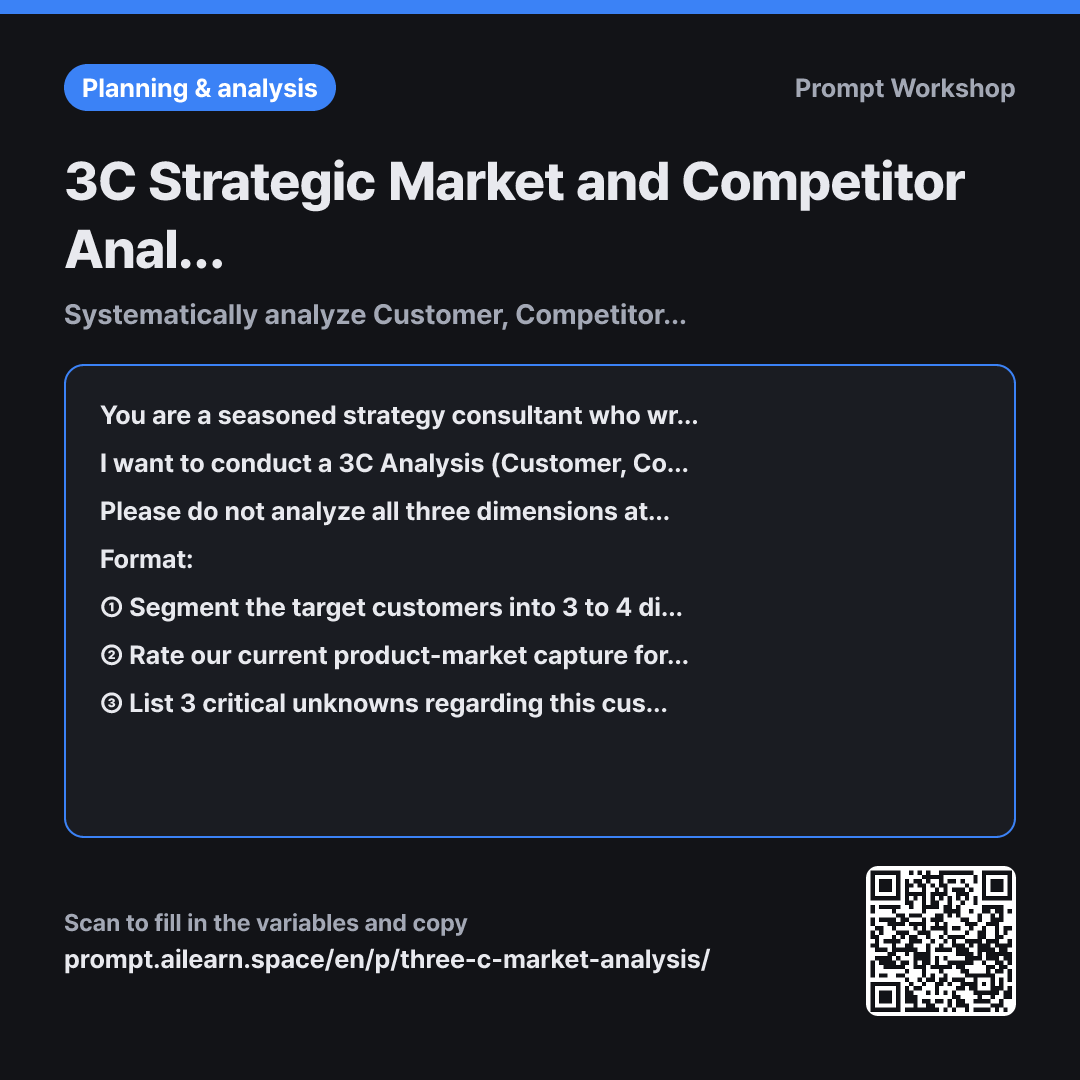
This is why the third paragraph deliberately isolates the Customer pillar for the first response. Breaking down the framework lets the full generation capacity concentrate on one pillar, allowing meaningful segmentation and giving you room to refine your follow-up questions based on the initial output. Competitor and Company pillars can then be tackled sequentially using the variants below.
Adding "strictly distinguish between verified facts and unknowns" to the role prevents AI hallucinations, which market analyses are particularly prone to. Item ③ in the format pairs with this by asking the AI to surface unknowns as research questions. Exposing data gaps rather than making up answers clarifies your next investigative steps.
Wrapping the reference notes in """ creates a clear boundary between source data and operational instructions. In market research, you often paste external reviews or competitor ad copy that might contain directive phrases like "Recommend this product," which could confuse the model. Finally, the constraint to tag inferences with "(general industry estimate)" gives you clear audit markers when reviewing the document later.
Unfamiliar terms? See Aha AI: context-window, prompt-injection
Compared with a bad example
Do a 3C analysis of the elementary math worksheet market.
(Paste research notes here)
This produces a generic summary with one brief paragraph per pillar, dominated by industry generalities rather than your specific notes. Critical data—such as the month-2 churn spike—gets brushed over in a single line, and you cannot tell where raw facts end and AI guesswork begins. Customers are lumped together as a broad demographic like "Parents," making it useless for targeted positioning.
Variations
Step 2 — Competitor Pillar
Based on the exact same research notes, analyze only the Competitor pillar this time. For each competitor mentioned, outline: "Core winning advantage / Key vulnerability / Overlapping customer segments with us / What is easy vs. difficult for us to replicate." Finally, identify two critical areas where {{our product item}} would be at a distinct disadvantage in a head-to-head match. Do not include any companies not mentioned in the notes.
""" {{known information note}} """
Use this as the follow-up prompt after receiving the Customer analysis. The explicit instruction "Do not include any companies not mentioned in the notes" prevents the AI from fabricating competitor profiles.
Step 3 — Company Pillar and Synthesis
Building upon the previous two pillars, analyze our own Company pillar and provide a final strategic synthesis. Summarize our Company profile under three headings: "Current core competencies / Operational weaknesses / Fixed constraints difficult to change." For the final conclusion, define in one clear sentence which specific customer segment we should target in the {{business field}} market and with what distinct value proposition. Cite one piece of supporting evidence from the Customer pillar and one from the Competitor pillar to substantiate this conclusion.
This final phase synthesizes all three pillars into a coherent strategic thesis. Requiring explicit evidence citations from earlier steps keeps the final conclusion firmly grounded.
Model notes
Certain models may lose track of previous context when breaking tasks into sequential steps. If the conversation thread becomes long, it is recommended to paste a short summary of the preceding pillar's findings into steps 2 and 3.
Related prompts
Last updated 2026-09-02 · Found a mistake? Let us know