Why it is written this way
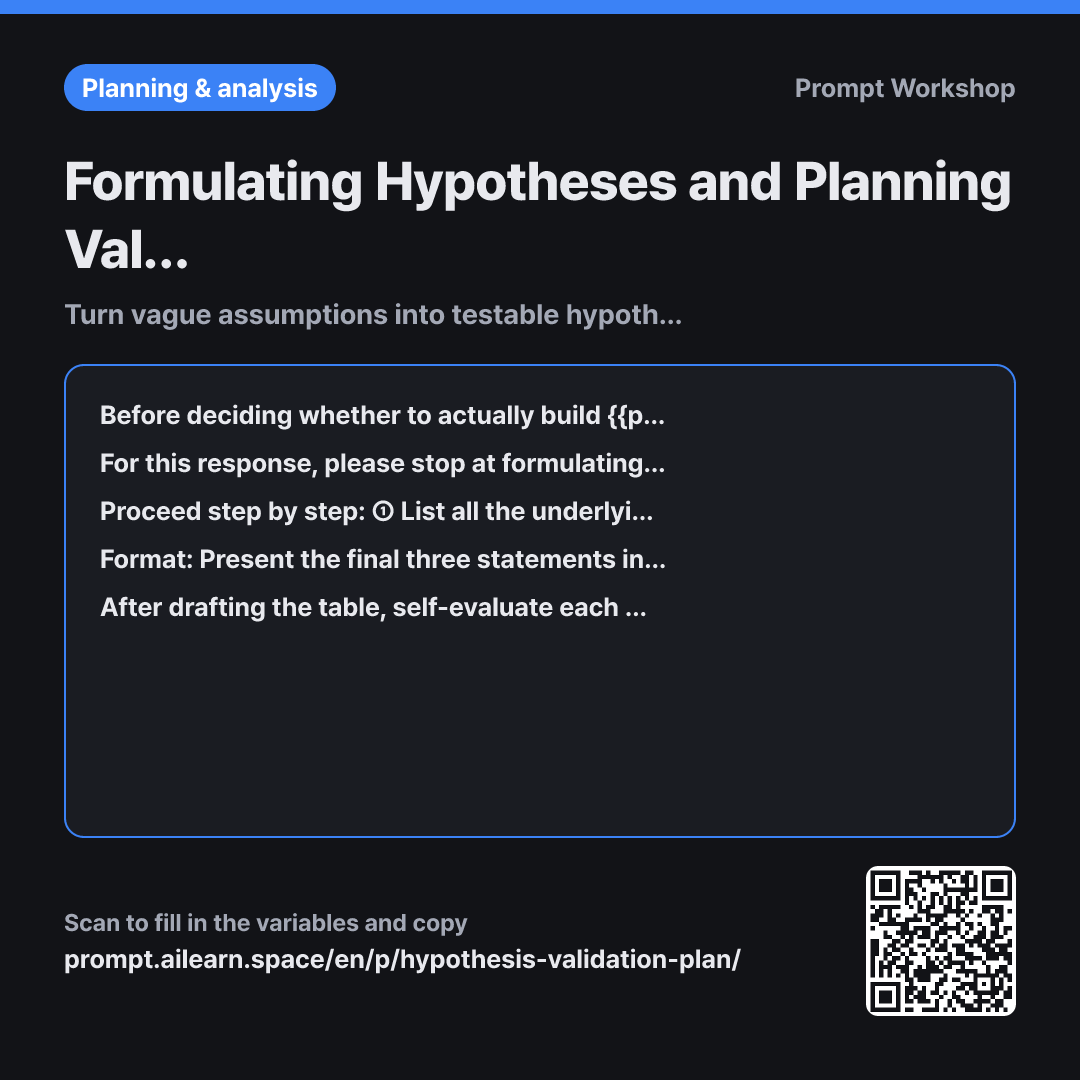
When asking for hypothesis validation all at once, AI typically defaults to generic advice like "run a survey." It leaves out crucial details such as what specific questions to ask or what response threshold determines whether you proceed. That happens because you asked for methods before locking down precise, testable statements.
This is why the second paragraph strictly limits the scope of the output to formulating hypotheses. Splitting hypothesis generation from experimental planning is the core design of this prompt. If asked simultaneously, the AI layers plausible-looking experiments on top of poorly defined assumptions, leaving no room for human review. Once you inspect the hypotheses and filter out weak ones, you can proceed to the validation plan using the follow-up variant.
The three steps in the third paragraph rely heavily on sequence. Asking to pick the most critical assumptions before brainstorming all underlying beliefs causes the AI to pick only from the first few obvious thoughts. Specifically, criterion ②—"if proven false, would break the entire project"—sets the validation priority. You should not test what is easy to test; you must test what is fatal to the project.
The "Criteria for Truth" column in the format connects this table directly to actionable experiments. Without quantitative metrics, teams interpret identical results differently. The final self-evaluation step prevents hypotheses from drifting back into subjective wishful thinking—the most common pitfall when formulating product hypotheses.
Unfamiliar terms? See Aha AI: chain-of-thought, self-consistency
Compared with a bad example
I want to make an app where tutors upload homework photos and parents get summaries. How can I validate if this will work?
This prompt will trigger generic suggestions: run surveys, conduct interviews, or launch a landing page test. Because it is a cookie-cutter checklist, it fails to pinpoint the biggest risk in your specific idea. In this case, the core risk is whether tutors will bother uploading daily photos, but generic tests miss that friction point and lack clear pass/fail thresholds.
Variations
Get a Validation Plan After Selecting a Hypothesis
Please create three ways to validate the single hypothesis I select from the previous table within this week. For each method, specify: "What to do / How many days it takes / How many participants needed / Result that proves it true / Result that invalidates it (kill criteria)". Include at least one method that does not require building an app, and exclude any tests not directly related to {{item to check}}.
This is the second step to use after choosing your key hypothesis. Demanding explicit "kill criteria" prevents confirmation bias and stops you from over-optimistically interpreting ambiguous test results.
Audit an Existing Hypothesis
Below is a hypothesis I drafted. Do not generate new hypotheses; audit this one based on the following criteria: ① Can it be proven true or false purely through observable behavior? ② Does it describe actual actions of {{target customer}}, or is it just wishful thinking? ③ What part of the project fails if this is wrong? Answer each item in one line, and provide a revised statement at the end.
Hypothesis: {{item to check}}
Hypotheses written by creators often carry hidden optimism. Auditing the statement before asking for a rewrite highlights the specific logical gaps in your framing.
Model notes
When asked to both generate a table and perform a self-audit in one prompt, some models may display only the audit commentary and omit the final table. If the table is missing, simply follow up with: "Please output the final revised table."
Related prompts
Last updated 2026-09-02 · Found a mistake? Let us know