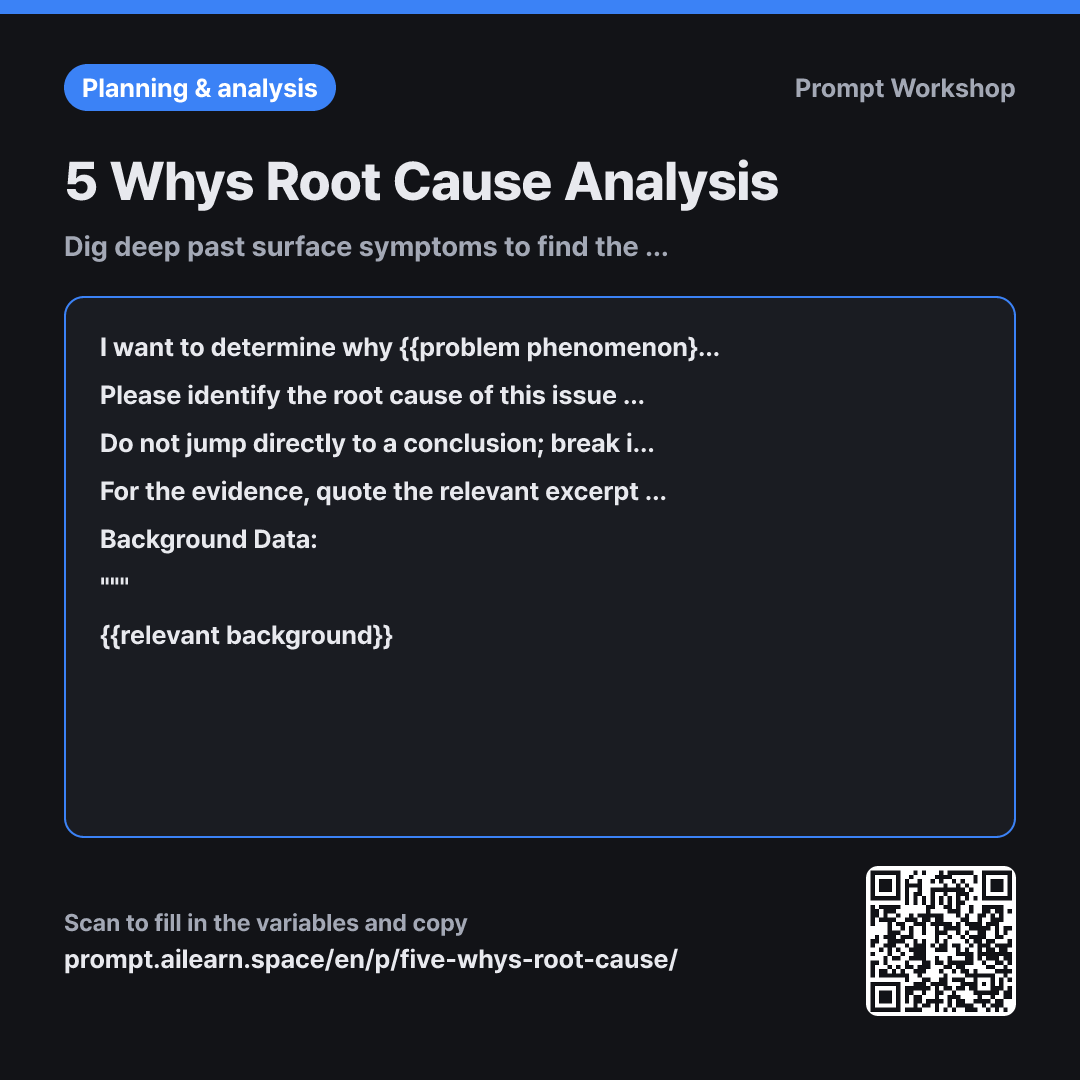
Why it is written this way
When asking ChatGPT to perform a 5 Whys analysis, it often stops at the first plausible answer. If you ask "Why were responses delayed?", it might output "Because the agent was busy," and the analysis wraps up right there. The next month, the exact same issue recurs because being busy is merely a symptom, not the root cause.
The third paragraph prevents this early stop. It explicitly locks the steps into five distinct levels and requires each step to build directly upon the preceding answer. If you simply say "Find the root cause," the AI skips the intermediate reasoning and provides a superficial final takeaway. Documenting the intermediate steps allows humans to verify where any logical leaps occur.
Framing the task with the explicit objective "to prevent it from happening again" is equally critical. Without a clear goal, root cause analysis turns into passive retrospective reporting. Structuring each step into three lines ("Why / Answer / Evidence") ensures the chain does not drift into pure speculation. If an evidence line is marked as an assumption, it acts as a signal that the team needs to gather more empirical data.
The final two constraints define the rigor of this prompt. Marking missing data as "Assumption" filters out fabricated root causes, and prohibiting individual fault forces the analysis to inspect underlying systemic flaws. When a root cause prompt ends with "Who made the mistake?", nothing actionable is fixed. Enclosing the background data in """ ensures that the text inside is treated as reference data rather than active instructions.
Unfamiliar terms? See Aha AI: chain-of-thought, hallucination
Compared with a bad example
Why are customer inquiry responses delayed? Analyze it using 5 whys.
While this generates five lines, the lack of background data causes the AI to fill the gaps with generic assumptions without knowing staffing levels or return-handling duties. It reaches generic conclusions like "Staff shortage → Need to hire" regardless of your actual constraints, leaving no evidence to review or validate in a meeting. Specific operational clues, such as untracked manager interventions, are completely overlooked.
Variations
When multiple root causes are suspected
The issue {{problem phenomenon}} might stem from multiple branches. Review the background data below and generate two separate 5 Whys chains from different starting points. Start one branch from people and organizational factors, and the other from processes and tools. If the two chains converge at any point, highlight that convergence at the end.
""" {{relevant background}} """
Many operational problems do not follow a single linear chain. Splitting the analysis into two distinct branches and identifying convergence points makes it much easier to pinpoint high-impact interventions.
Generating actionable countermeasures immediately
Please provide three concrete countermeasures to eliminate the root cause identified above. Format each countermeasure with four items: "What to change / Owner / Feasible this month? (Yes/No) / Verification method". Also, specify which countermeasure failed if {{problem phenomenon}} recurs in the future.
This step prevents meetings from ending with just identifying the cause. Setting the verification method upfront establishes clear review criteria for the following month.
Related prompts
Last updated 2026-09-02 · Found a mistake? Let us know