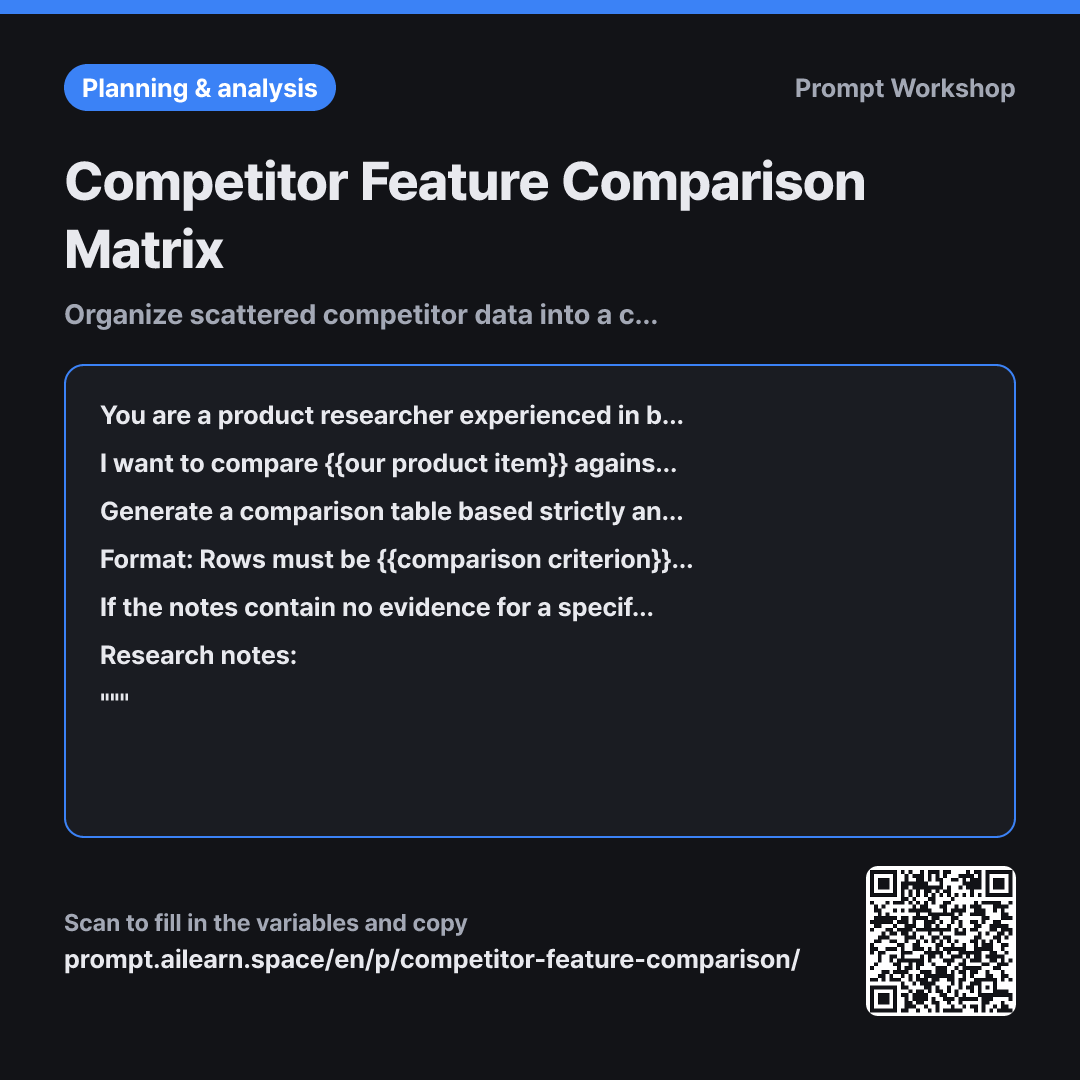
Why it is written this way
The biggest risk in a competitor analysis prompt is hallucinated gaps. When given a table structure, an AI naturally tends to fill every cell, often claiming a competitor "supports" a feature even when there is no supporting evidence. Presenting such unverified data in a strategy meeting can derail roadmaps based on phantom features.
That is why the constraint in the fifth paragraph forms the core of this prompt. Instead of merely telling the AI not to guess, it explicitly defines a fallback value: "No data". When given an explicit placeholder for unknowns, the AI reliably leaves gaps empty rather than fabricating answers. Flagging review-based data serves the same purpose, distinguishing subjective user impressions from official landing page specifications.
Setting the role to a researcher who "strictly states 'No data' when an answer is unknown" anchors this rigorous standard from the first sentence. In the format section, banning simple "Yes/No" checkmarks ensures each cell retains specific context for future review. The three takeaway sections underneath extract actionable strategic insights directly from the data.
Wrapping the research notes in """ delimiters isolates source text from prompt instructions. Landing pages often contain marketing slogans like "Sign up now!", which can confuse the AI or bleed into the analysis if not properly quarantined.
Unfamiliar terms? See Aha AI: hallucination, output-format
Compared with a bad example
Make a feature comparison table for our service vs Company A, Company B, and Company C.
Without raw reference data, the AI will invent features and guess pricing tiers based solely on brand names. Because there is no clear distinction between verified facts and assumptions, your team will have to manually re-verify every single cell from scratch.
Variations
Extracting Action Items Instead of a Table
Read the research notes below and extract only the immediate action items for {{our product item}}, omitting the comparison matrix. Group the findings into three lists: "Features most competitors have that we lack", "Features only we offer", and "Customer pain points under {{comparison criterion}} that no one solves yet". Include the supporting excerpt from the notes for each item.
""" {{research note memo}} """
Use this variant when you have already reviewed the matrix and need actionable product decisions. Requiring source quotes prevents back-and-forth verification later.
Pricing-Only Comparison
Extract and structure only the pricing details for {{competitor list}} into a table. Use the following columns: "Plan Name · Monthly Cost · Included Features · Overage/Add-on Triggers · Free Trial". If a price is missing from the notes, write "Unlisted". If a price includes conditions (such as annual billing discounts), include those conditions in parentheses.
""" {{research note memo}} """
Pricing often involves complex conditions, so condensing it into a single number can be misleading. Explicitly capturing conditions prevents inaccurate pricing benchmarks.
Model notes
Remove any sensitive internal company details from the research notes before pasting. For up-to-date pricing and features, manually verify public sources and paste the text into the notes rather than relying on the model's pre-trained memory.
Related prompts
Last updated 2026-09-02 · Found a mistake? Let us know