Why it is written this way
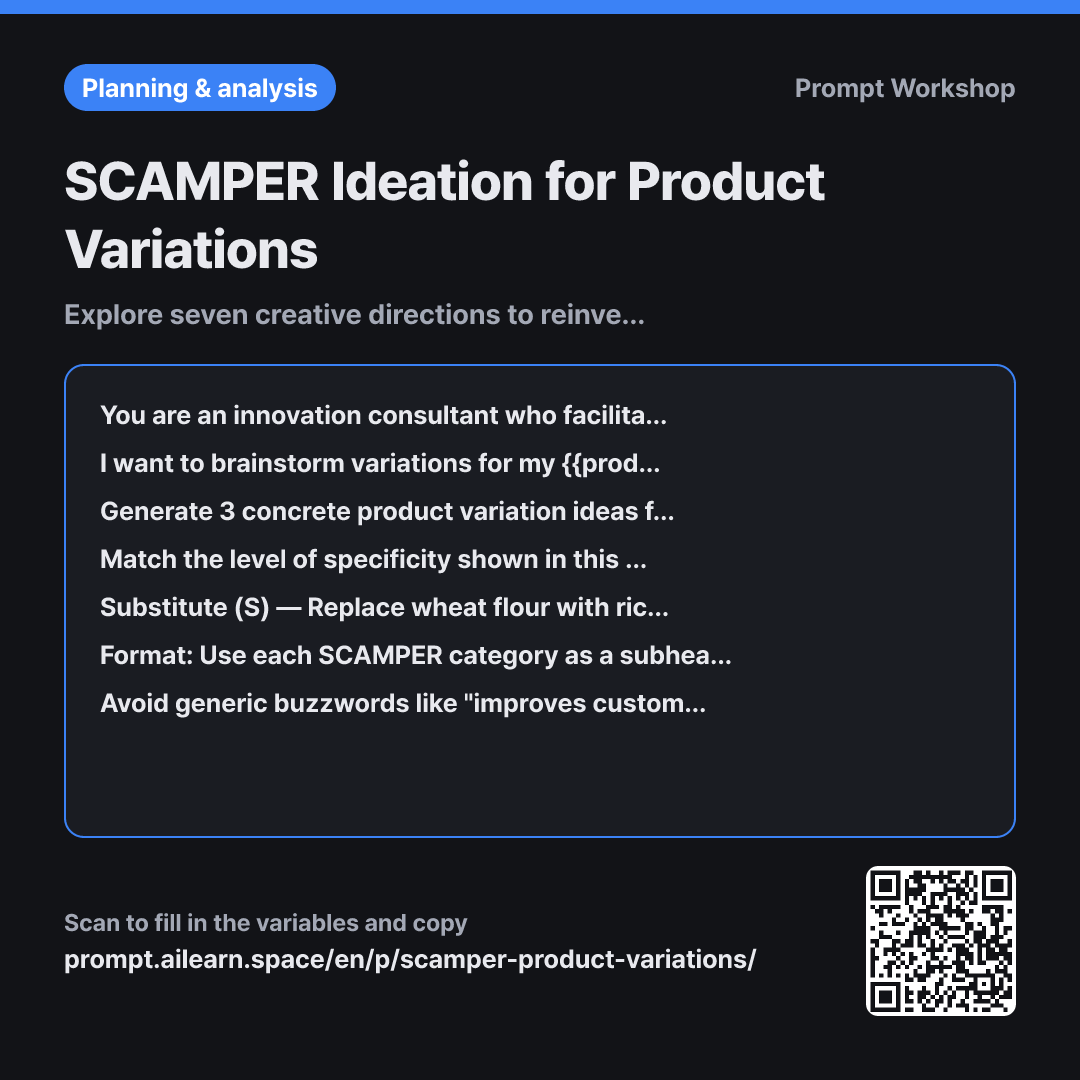
When asking ChatGPT to apply the SCAMPER method, the most common failure is receiving seven filled categories where not a single idea is practically usable. Sentences like "Combine — Bundle with another product" merely fulfill the framework's structure without deciding anything actionable. This prompt focuses on getting ideas you can actually build.
The most effective lever is the single example line in the fourth paragraph. Providing a concrete baseline example works far better than describing quality in abstract terms, guiding the remaining twenty outputs to match that level of depth. A vague instruction like "be specific" means different things to different models.
Setting the role to a workshop facilitator ensures the AI acts as a creative partner generating raw material rather than claiming definitive answers. The current customer feedback in the second paragraph sets the vector. Without clear feedback, the seven techniques merely restate product features; with it, every variation takes aim at solving that frustration. Adding a target customer naturally separates retention ideas from growth ideas.
The format split ("What changes / Who benefits and why") makes each concept immediately evaluable for feasibility. Finally, the constraint allowing "Not applicable" provides a necessary exit valve. Forcing all seven boxes invites weak filler that degrades trust in the entire output.
Unfamiliar terms? See Aha AI: few-shot, role-prompting
Compared with a bad example
Use the SCAMPER method to give me new ideas for our bakery's sandwich bread.
You get one generic line per category, such as "Rearrange — Change where items are displayed on the shelf." Without specific user complaints or a defined target audience, ideas scatter disconnected from real problems, and forced categories yield unusable filler.
Variations
For workflows and service processes
You are an operations improvement consultant. I want to redesign the workflow for {{product or service}} using the 7 SCAMPER techniques. The core bottleneck is: "{{current user complaint}}".
Provide 2 ideas per category using this structure: "Current state → Proposed change → Who saves time/effort". Exclude any solution that relies merely on hiring more staff.
When optimizing a process rather than a physical item, explicitly detailing "Current state" makes the operational shift immediately clear.
Structuring selected ideas into a 1-pager
Please summarize the selected variation idea into a one-page concept memo. Structure it with these sections: "What changes · Key benefit for {{target customer}} · Required resources to build · Top 2 potential failure risks". Do not invent new ideas beyond the chosen concept.
Separates divergence from convergence. Requesting both at once often leads the model to quietly alter the core idea while formatting.
Related prompts
Last updated 2026-09-02 · Found a mistake? Let us know