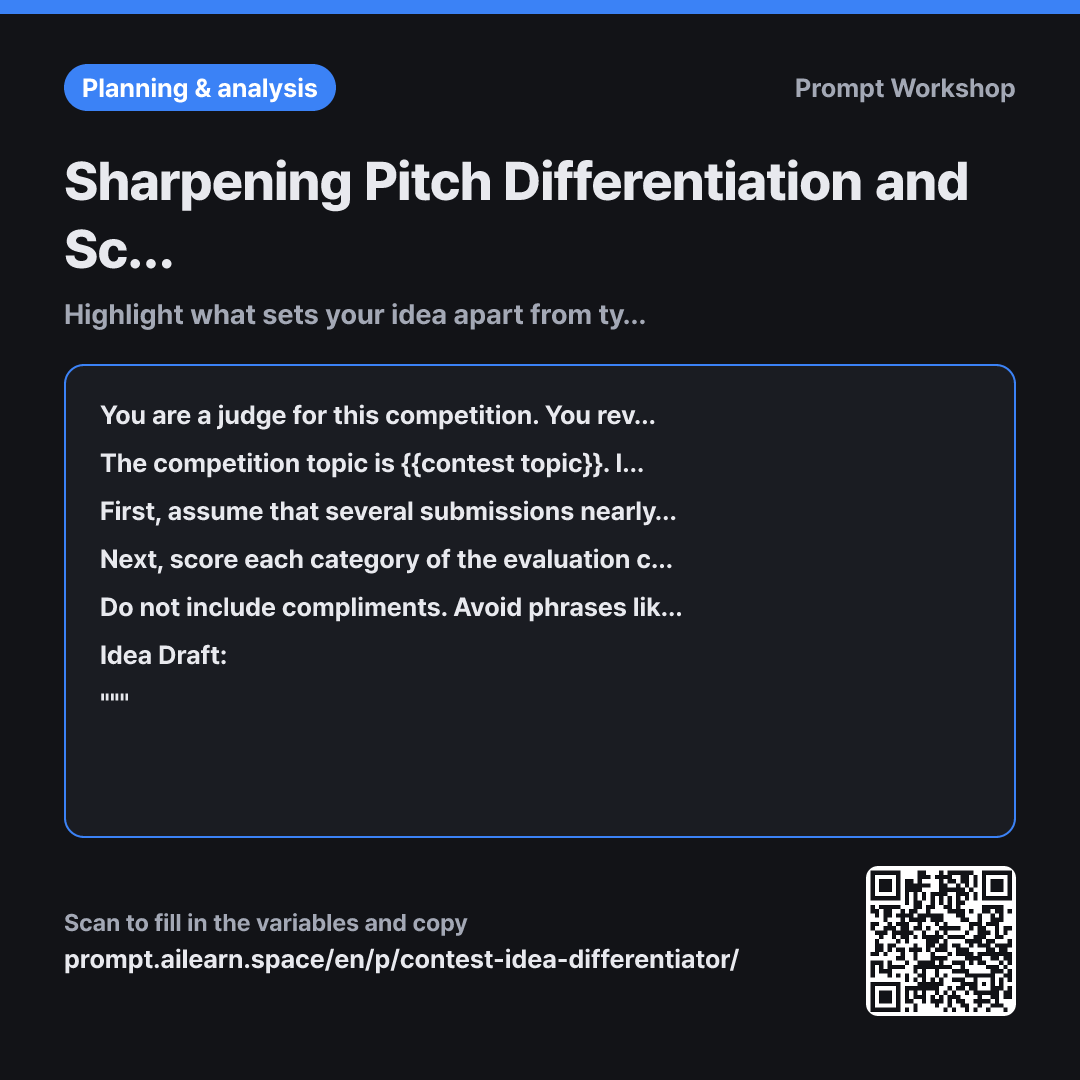
Why it is written this way
When you ask ChatGPT to review a competition proposal, it usually defaults to polite praise. It often starts with flattering remarks like "This is an innovative approach that effectively leverages local context" and adds a few soft suggestions at the end. The problem is that in an actual judging room, ten nearly identical proposals sit on the same desk. An idea that looks fine in isolation becomes completely unmemorable when placed side by side with competitors.
This is why the first paragraph sets the role as a strict judge—specifically one who "does not offer words of encouragement." Assigning an advisory role makes the model lean toward cheering you on, whereas a judging role forces it to look for deduction points. Having it write out the generic baseline version in the third paragraph serves the same purpose. Without a concrete point of comparison, asking for "differentiation" usually just yields a restatement of your draft.
Paragraph four guides a rigorous check using the official rubric. Requesting specific scores by category highlights weak points numerically, clarifying what needs immediate fixing. Asking for the projected post-revision score ensures the proposed fixes are meaningful adjustments rather than superficial edits.
The fifth paragraph sets strict constraints that forbid compliments and block the model from hallucinating non-existent partnerships or features. A common pitfall in pitch optimization is when the AI suggests "partnering with local government and top universities"—it sounds great on paper, but falls apart immediately under feasibility scrutiny. Use this prompt iteratively: revise the lowest-scoring sections, rerun the prompt, and continuously refine your pitch.
Unfamiliar terms? See Aha AI: role-prompting, self-consistency
Compared with a bad example
How is this competition idea? Let me know how to improve it.
(Paste idea draft)
The output will be a generic list of three pros and three cons. The suggestions will be overly vague (e.g., "Strengthen the execution plan"), offering little actionable guidance. Without evaluation criteria, high-weight and low-weight categories are treated identically, and words like "creative" will be handed out without testing whether the idea actually stands out from the competition.
Variations
Crafting One-Line Pitch Hooks
Generate five distinct one-line hooks for the proposal below targeting {{contest topic}}. Each hook must take a different angle (problem-first, methodology-first, audience-first, metric-first, and outcome-first). Below each sentence, write the single first question a judge would ask after reading only that line.
""" {{idea draft}} """
First impressions often hinge on a single line. Specifying five distinct angles prevents the model from generating near-duplicate variations.
Surfacing Vulnerabilities Before Team Reviews
Review the idea below against {{evaluation criteria}} and list seven critical questions a judge is likely to ask during the Q&A session. Rank them from hardest to easiest to answer. Next to each question, label whether our current draft can answer it using: "Ready to Answer · Needs Data · No Answer Available". Do not write the answers yet.
""" {{idea draft}} """
Ideal for presentation and Q&A prep. Prioritizing questions marked "No Answer Available" as immediate team meeting agenda items saves significant preparation time.
Related prompts
Last updated 2026-09-02 · Found a mistake? Let us know