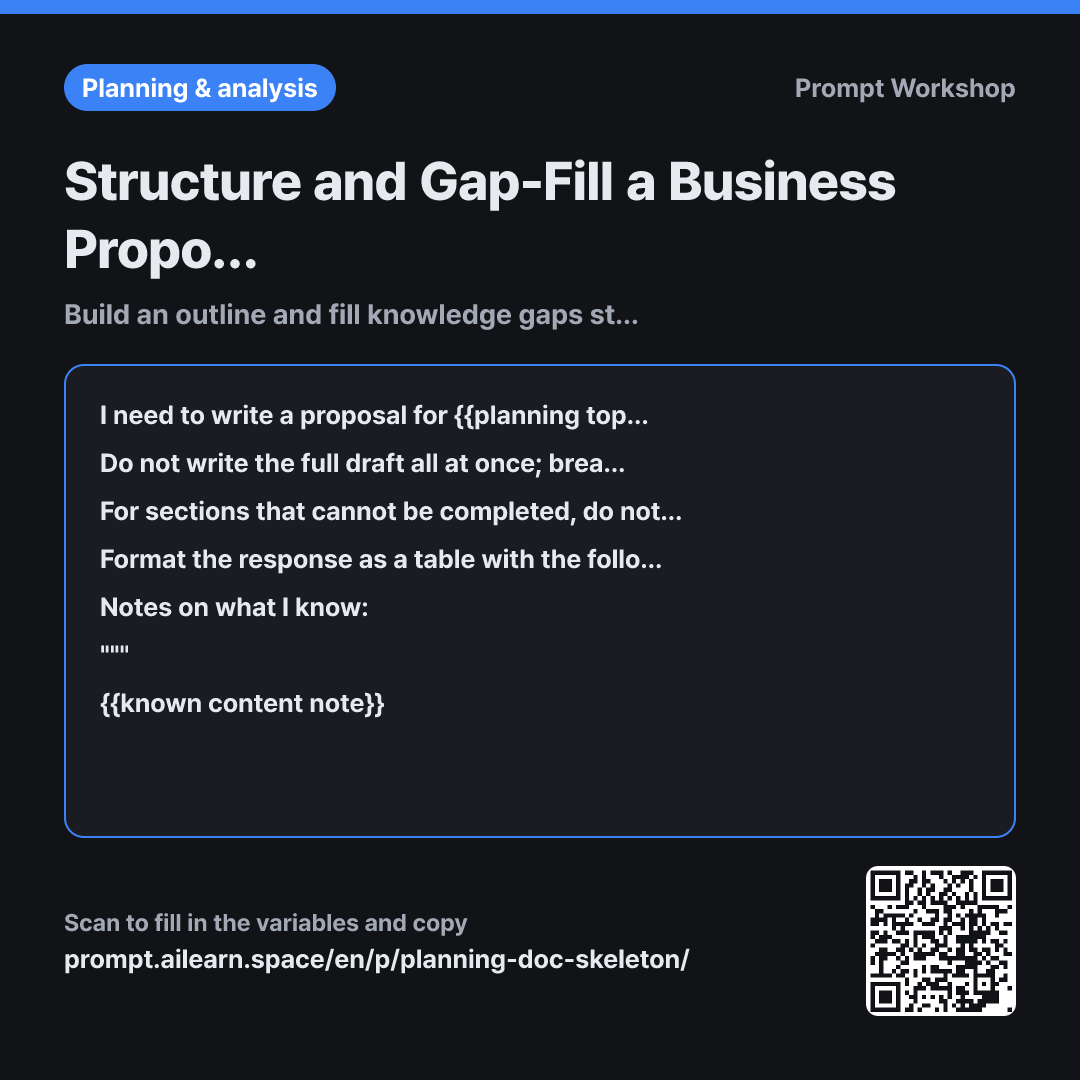
Why it is written this way
If you paste a generic proposal prompt and only swap the topic, an AI model will instantly generate a polished, complete draft. The problem is that half of the content inside will be fabricated details you never provided. The model invents plausible budgets, timelines, and rationale, blending them seamlessly so the hallucinations are hard to spot. Presenting that draft will quickly lead to disaster when a reviewer asks, "Where did this number come from?"
This is why the second paragraph strictly divides the workflow into two steps. This run only asks for the structural framework, delaying the full draft until the missing data is supplied. When you ask for the outline and draft simultaneously, the model papers over knowledge gaps with smooth prose. Postponing the writing phase ensures that unknowns remain clearly identified as unknowns.
Paragraph 3 instructs the model to ask clarifying questions. Limiting the questions to five prevents overwhelming you, while adding "who to ask" helps because missing proposal details often reside with other departments rather than in your head. Setting the decision-maker in the first paragraph's context customizes the necessary sections: a direct manager focuses on operational execution, whereas an executive or director requires budget justifications and cross-departmental impact.
The format requirement of the "Why approval will stall without this section" column strips away unnecessary boilerplate. Any section that cannot justify its presence here is merely mimicking generic proposal formats and can be deleted. Finally, enclosing the notes in """ prevents rough, unorganized sentences from being misread as direct instructions.
Unfamiliar terms? See Aha AI: chain-of-thought, hallucination
Compared with a bad example
Please write a proposal for introducing an employee book purchase stipend program.
The AI immediately generates a two-page proposal covering everything from background to expected benefits. However, numbers like "$200/year per employee" or a "3-month pilot test timeline" are entirely made up. It does not reflect existing education budgets because that wasn't mentioned, and real friction points like the finance team's reimbursement workload are completely omitted. You end up having to re-read and fix the entire draft from scratch.
Variations
Writing the Draft After Filling the Gaps
I have filled in the gaps identified in our previous outline. Please proceed with Stage 2 and write the main text of the proposal for {{planning topic}}. Keep the section order intact, and write each section strictly using only my input and the notes below. If newly discovered facts conflict with previous sections, do not smooth it over with prose; mark it explicitly as "[Conflict with Previous Section]". Keep the length suitable for a 3-minute read by {{approval target}}.
Notes on what I know: """ {{known content note}} """
A follow-up request moving to the full draft once the gaps from Stage 1 are filled. Firmly re-establishing the source boundaries prevents new hallucinated figures from creeping in.
Identifying Objections First
List five potential reasons why {{approval target}} might reject or object to {{planning topic}}. For each objection, categorize whether it can be rebutted using the notes below or cannot be rebutted due to lack of data. For objections that cannot currently be rebutted, indicate which section of the proposal should address them proactively.
""" {{known content note}} """
Anticipating potential objections early is much faster than revising a rejected proposal. Building your outline around these counterarguments shortens the review and approval cycle.
Model notes
Keep Stage 1 and Stage 2 within the same conversation thread. Requesting Stage 2 in a fresh chat will cause slight variations in the section names and structure established earlier.
Related prompts
Last updated 2026-09-02 · Found a mistake? Let us know