Why it is written this way
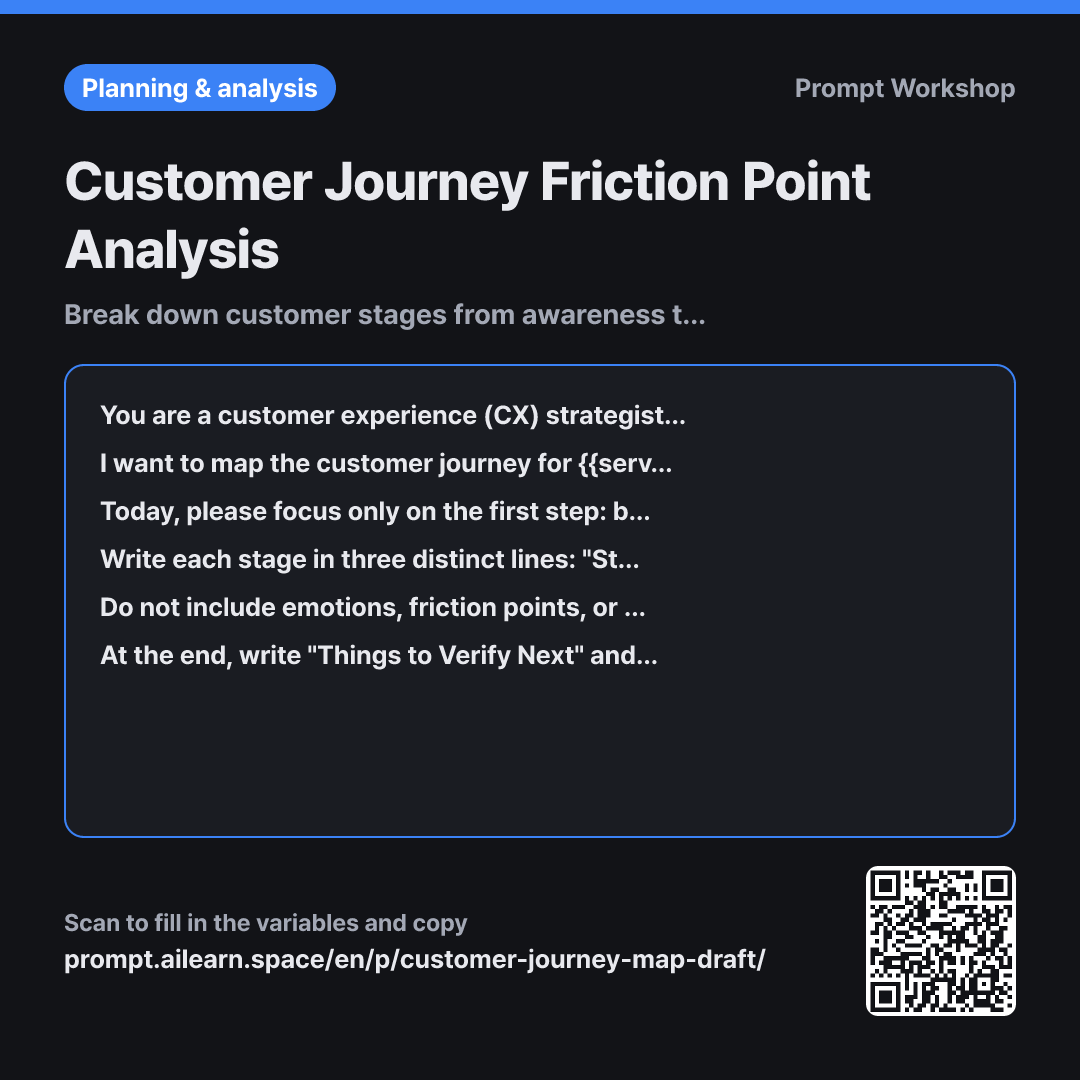
If you ask an AI to generate a complete customer journey map all at once, the output becomes shallow. Prompting "Create a customer journey map for our service" usually yields a generic table with standard stages like Awareness, Consideration, Purchase, and Retention, filled with single-sentence descriptions. Because it could apply to literally any business, it fails to reveal where your actual customers are dropping off.
This prompt intentionally breaks down the task. The initial request focuses solely on establishing realistic stage names, leaving emotions and churn points for the follow-up step. This multi-turn chaining approach provides two major benefits: first, you can catch and correct inaccurate stage definitions immediately; second, subsequent analysis runs on a grounded framework, resulting in much deeper insights.
Setting the Role constraint with "respond only up to what I specifically request and then pause" holds this entire structure together. Without it, the AI tends to fill in emotions and solutions automatically in one go. In the Format, requiring "the clear signal indicating they moved past this stage" is equally vital. A stage where you cannot define a clear transition signal is usually a phantom stage or two separate stages mashed together.
Finally, the concluding section forces a pause before advancing to the next Step. The biggest risk in AI-assisted journey analysis is building plausible-sounding insights on top of a flawed sequence. Getting three practical validation checkpoints up front allows you to interview a few recent customers and verify your journey's backbone right away.
Unfamiliar terms? See Aha AI: chain-of-thought, role-prompting
Compared with a bad example
Create a customer journey map for a meal prep delivery service. Include customer emotions and improvement points for each stage.
You will get a standard table, but the stage names will be generic textbook terms, and emotion columns will be filled with superficial words like "excited" or "disappointed." The recommendations will also default to cookie-cutter advice like "send a notification email" or "run a review contest," none of which are actionable in a team meeting. Most importantly, the true drop-off window—such as the week right after the first delivery—will be completely missing.
Variations
Follow-up Prompt 1 — Mapping Emotions and Friction Points per Stage
We will stick with the confirmed stage list for {{service name}}. The target remains {{customer type}}.
Now, generate a one-row table per stage with the following columns: "Stage | What the customer feels | If someone drops off here, why? | Basis for this assessment". For the "Basis" column, specify whether it is directly based on the context I provided or a general assumption.
Do not add new stages or rename existing ones. Do not propose improvement ideas yet.
Separating the evidence basis is crucial. If assumptions and confirmed facts blend together, the entire map loses credibility.
Follow-up Prompt 2 — Brainstorming Actionable Fixes for One Critical Stage
Let's focus strictly on the single stage where customers coming via {{purchase channel}} drop off the most in the journey of {{service name}}.
Please propose 3 actionable initiatives we can test specifically for that stage. Format each as: "What to change / Can this be done within this week? / How to measure if it worked". Exclude ideas that require purchasing new software or hiring additional staff.
Narrowing the scope to a single bottleneck while imposing feasibility constraints ensures proposals can be immediately decided on in a meeting.
Model notes
When continuing multi-step conversations, keep everything in the same chat thread so the model retains the confirmed stage names. If you start a new chat, paste the finalized stage list first before continuing.
Related prompts
Last updated 2026-09-02 · Found a mistake? Let us know