Why it is written this way
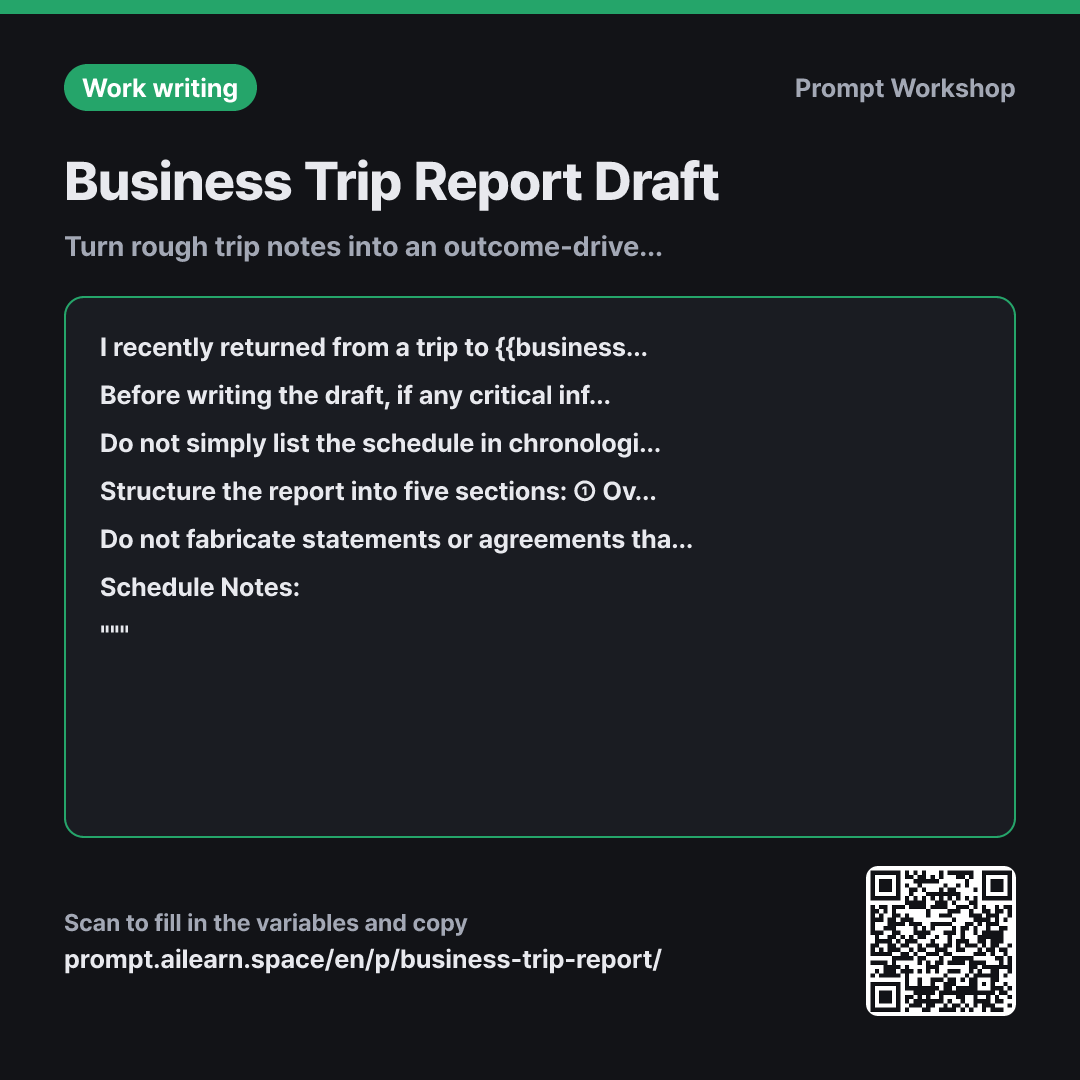
If you feed raw notes into a generic trip report prompt, nine times out of ten the AI simply regurgitates an itinerary: arrived on the 9th, met in the afternoon, toured the plant on the 10th. While factually accurate, that is a travel log, not an executive report. Readers need to know: "What did the company gain from this, and what are our next steps?" When the bottom line is buried in a timeline, the report gets sent back for revisions.
The context in the opening paragraph sets this benchmark. By framing the report for leaders deciding next steps, the AI prioritizes decision-relevant facts over personal observations. Explicitly forbidding a chronological summary in the third paragraph prevents the model's natural tendency to follow sequential notes.
The second paragraph utilizes clarifying questions. Trip notes often omit vital details like exact dates, traveling companions, or specific approval targets. Instead of letting the AI hallucinate these gaps, prompting it to ask first ensures high draft accuracy.
The format locks the results near the top and structures follow-ups into an actionable table. Finally, the constraint to avoid mistaking tentative statements for firm agreements prevents costly business errors—such as turning polite pleasantries into committed pipeline projections.
Unfamiliar terms? See Aha AI: output-format, hallucination
Compared with a bad example
I just got back from a business trip. Please write a report.
(Paste schedule notes)
Generates a basic chronological summary written in full sentences. Because no core purpose was specified, there is no framework to evaluate success, leading to generic fluff like "It was a productive visit." It lacks clear action items and often misinterprets casual remarks as formal commitments.
Variations
Short Single-Day Trip
Please summarize my single-day business trip to {{business trip destination}} for {{business trip purpose}} into a concise half-page report. Keep the overview to a single line, and cover only three sections: "Objective · Key Results · Next Steps" (with owners and deadlines for next steps). Do not invent details; mark missing items as "N/A".
Schedule Notes: """ {{schedule note memo}} """
Omits the clarifying questions and extra sections. Single-day trips carry fewer variables, making extra back-and-forth unnecessary.
Trade Show & Conference Debrief
Please draft a recap report for my visit to the trade show / exhibition in {{business trip destination}}. Instead of listing the booths visited, group the findings into three sections: "Competitor Trends Overlapping Our Products · Newly Identified Tech & Materials · Immediate Internal Recommendations". For each item, note where it was observed (booth name or vendor category). If an observation is an unverified assumption, explicitly tag it as "[Assumption]".
Schedule Notes: """ {{schedule note memo}} """ Key Outcomes: """ {{performance result}} """
Unlike meeting-focused trips, conferences rarely involve formal deals. Categorizing observations by competitor moves, technology, and internal action items transforms observations into business intelligence.
Model notes
Because clarifying questions are built into the prompt, the model will ask questions first. If it generates the full draft immediately without asking, reply with: "Please ask the clarifying questions first."
When answering the model's clarifying questions, continue in the same chat thread rather than opening a new one. Starting a new session wipes out the original notes and context, causing the draft generation to fail.
Related prompts
Last updated 2026-09-02 · Found a mistake? Let us know