Why it is written this way
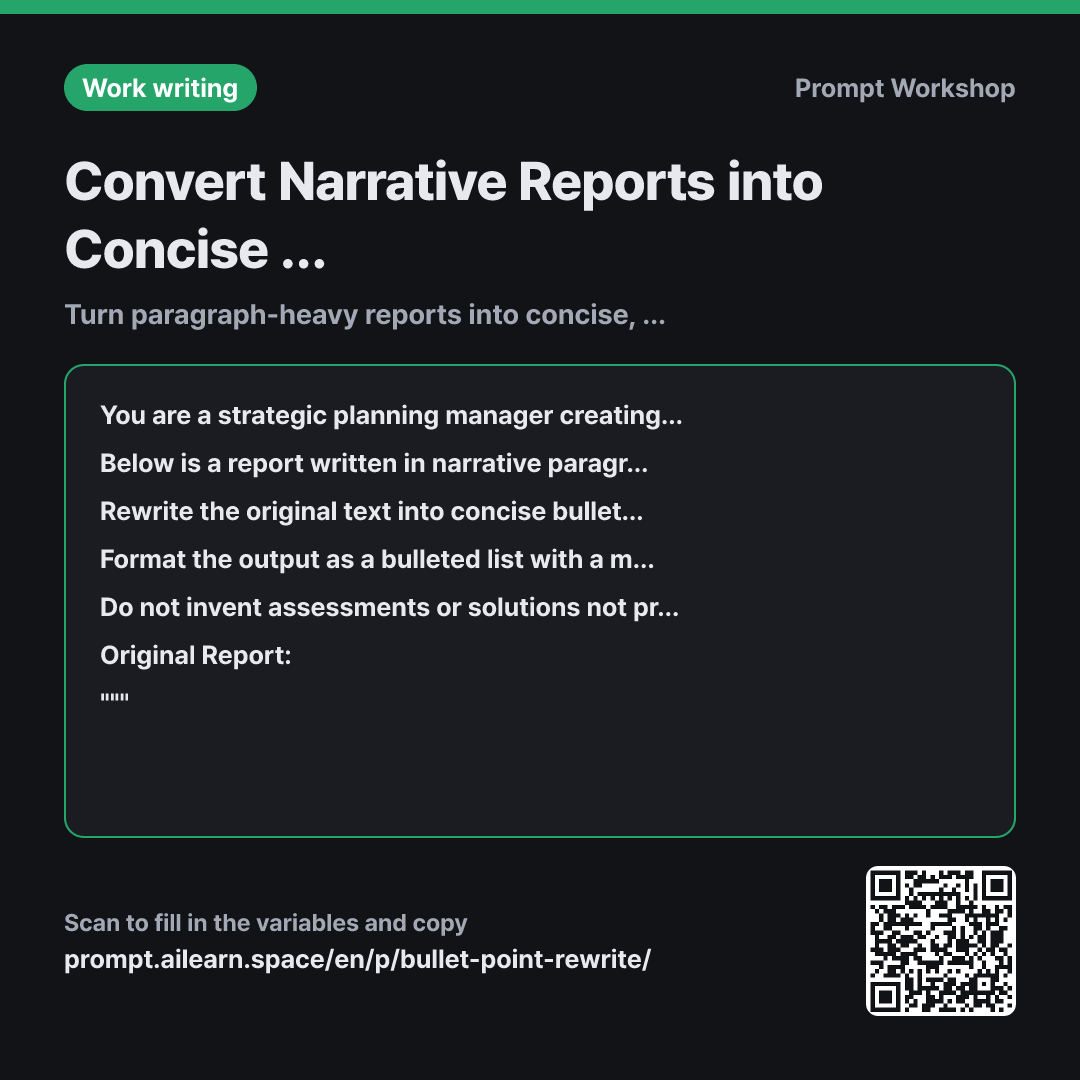
When converting narrative reports into a one-page format, simply prompting "make this bullet points" often yields a list where bullet markers are just placed in front of original sentences. The sentence count stays identical while only the endings are trimmed, making it even harder to read. Writing in bullet points is an exercise in discarding less critical details, not just shortening text—and the AI needs clear instructions to make those editorial cuts.
In the task paragraph, the instruction to "merge sentences discussing the same topic and arrange the bullets in order of importance" delegates this judgment to the AI. Explicitly asking to merge helps the AI reorganize by theme rather than following the original sentence order, which otherwise leaves the main conclusion buried at the bottom.
In the format paragraph, three constraints are defined together: item count, single-line length, and noun-phrase endings. Demonstrating the ending style with concrete examples prevents the AI from slipping back into full, polite sentences after a few items—a common pitfall in bullet generation.
In the constraints paragraph, asking for "omitted key details" works hand-in-hand with the item limit. Without this escape hatch, the AI might silently delete vital information or awkwardly cram multiple ideas into one line just to hit the target count. Wrapping the source text in """ ensures subheadings inside the report aren't misinterpreted as system commands.
Unfamiliar terms? See Aha AI: output-format, context-window
Compared with a bad example
Make this into bullet points
Last month's new user acquisition campaign reached 118% of its target...
The output will simply mirror the original sentence count as a bulleted list. Sentence lengths remain unchanged, stretching over multiple lines without saving reading time. Without prioritization, a key milestone like 118% goal attainment carries the same visual weight as an operational detail like 12 returned packages.
Variations
Executive Decision Brief (Bottom-Line First)
Summarize the report below into bullet points, ensuring the first item clearly states the main conclusion or requested action. Follow with supporting rationale in subsequent bullets. Maximum {{maximum item count}} items, each under 15 words, ending in concise phrases. Prefix items requiring immediate approval with "[Decision Required]".
""" {{original report}} """
When the reader is a key decision-maker, leading with conclusions and explicitly tagging decision items saves meeting time.
Weekly Status Report Format
Organize the following content into three distinct bulleted sections: "Accomplished This Week · Planned Next Week · Blockers / Need Help". Limit each section to a maximum of {{maximum item count}} items, under 15 words per bullet, using concise phrases. If a section has no relevant updates, write "None" instead of leaving it empty.
""" {{original report}} """
When a standard template exists, explicitly providing the section names speeds up formatting. Requiring "None" for empty sections makes it clear whether an item was omitted or simply nonexistent.
Model notes
If the bullet points revert to full narrative sentences, following up with "Rewrite this ending every bullet with a concise noun phrase" is faster than regenerating from scratch.
Language models follow total item limits well, but may occasionally exceed single-line or character constraints. If precise length is critical, simply follow up with: "Shorten only the bullets that exceed the length limit."
Related prompts
Last updated 2026-09-02 · Found a mistake? Let us know