Why it is written this way
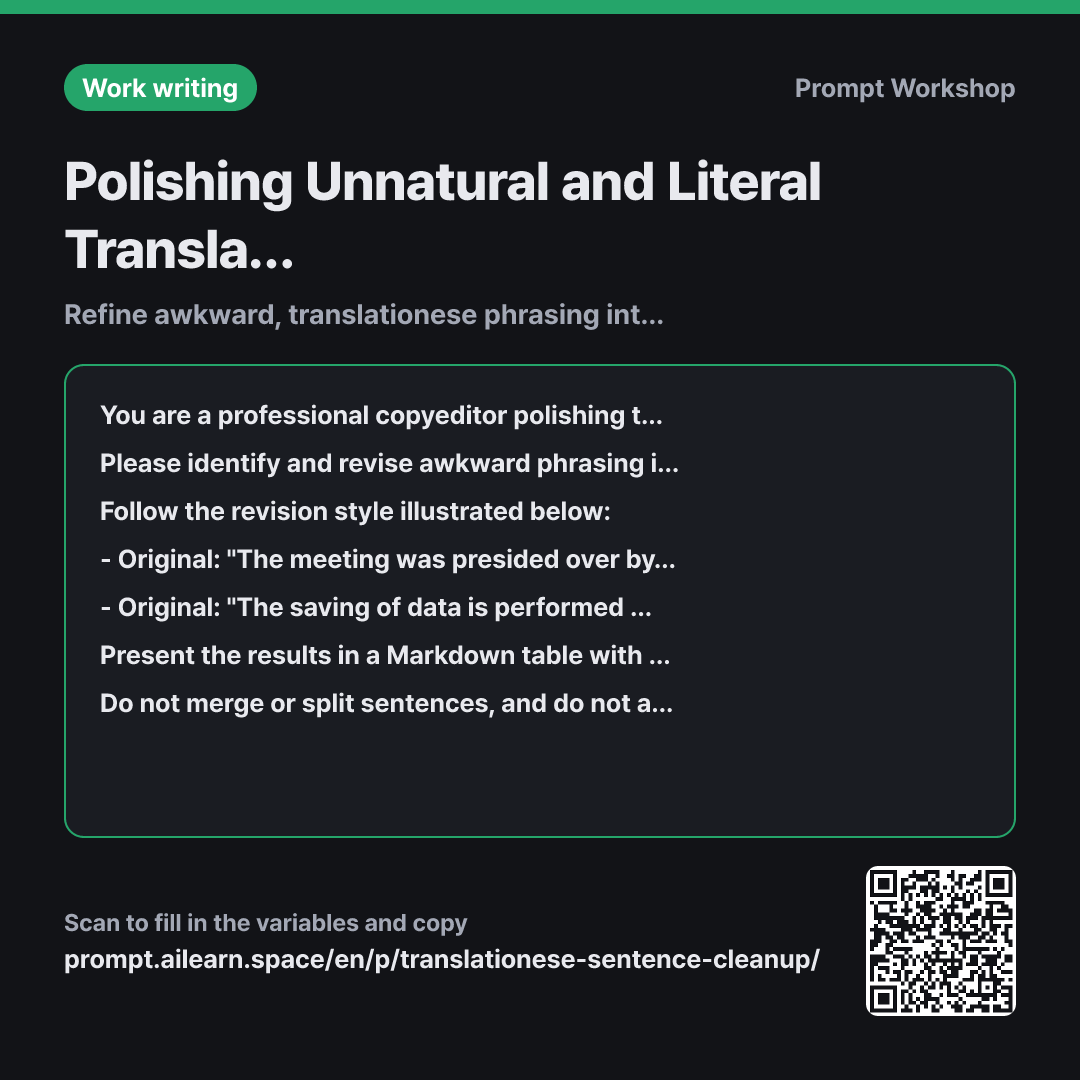
Machine-translated text is often semantically correct but stiff and awkward to read. A common mistake in translation-editing prompts is simply asking to "make it sound natural." When given such broad instructions, the AI tends to rewrite paragraphs from scratch, merge multiple sentences, or inject unrequested explanations—subtly distorting the original meaning. Reviewers then have to cross-reference every word against the source text to verify accuracy.
To prevent this, the Task explicitly targets three specific stylistic pitfalls: passive voice, nominalization, and stacked modifiers. Because most translationese stems from these three habits, naming them explicitly ensures the AI surgically edits only the problematic phrasing rather than overhauling the entire text. Giving clear negative constraints ("what not to touch") yields far more stable results than vague requests for fluency.
The Examples in the third paragraph clearly define the permissible scope of edits. They demonstrate that minor reordering and verb conversions are expected, but structural rewrites are not.
The Format specifies a side-by-side comparison table to streamline human review. Instead of forcing you to re-read the entire output to spot changes, the table allows for quick skimming. The Constraint requiring "Needs Verification" for ambiguous phrasing provides a safe fallback so the AI does not make risky assumptions. Wrapping the input in """ delimiters ensures the draft content is strictly treated as data rather than additional instructions.
Unfamiliar terms? See Aha AI: few-shot, hallucination
Compared with a bad example
Make these sentences sound more natural.
This feature can be activated by the user...
The output might read smoothly, but it often alters sentence counts and paraphrases expressions entirely. Without a side-by-side comparison, verifying whether the technical meaning was preserved becomes difficult—making it risky for manuals, documentation, or legal contracts. It also leaves no audit trail of what was changed and why.
Variations
Quick Sentence-by-Sentence Check
Please revise only the passive voice constructions and nominalized verbs in the sentences below. Output each sentence on a new line in the format "Original → Revised" without additional explanations. If a sentence requires no changes, write "No change needed."
""" {{draft translation}} """
Omits the detailed table and explanations for quick, high-volume sentence-level checks.
Editing Against the Source Text
Below is a translated draft alongside the source text. First, verify whether any meaning from the source has been omitted or incorrectly added. Then, revise any awkward translationese phrasing. Format the output as a table with the columns: "Draft | Revised | Meaning Discrepancies", and flag any sentence where unwarranted additions or omissions occurred.
""" {{draft translation}} """
Prioritizes accuracy over stylistic flow. Setting this sequence prevents the AI from smoothing over translation errors at the expense of accuracy.
Model notes
For texts with heavy industry terminology, providing a "Do Not Translate / Do Not Modify Terms" glossary beforehand prevents the AI from needlessly rephrasing standardized vocabulary.
While LLMs easily catch obvious unnatural passives, they sometimes overlook subtle filler phrasing or repetitive connective words. If your domain has specific recurring translation quirks, add them directly to the target list.
Related prompts
Last updated 2026-09-02 · Found a mistake? Let us know