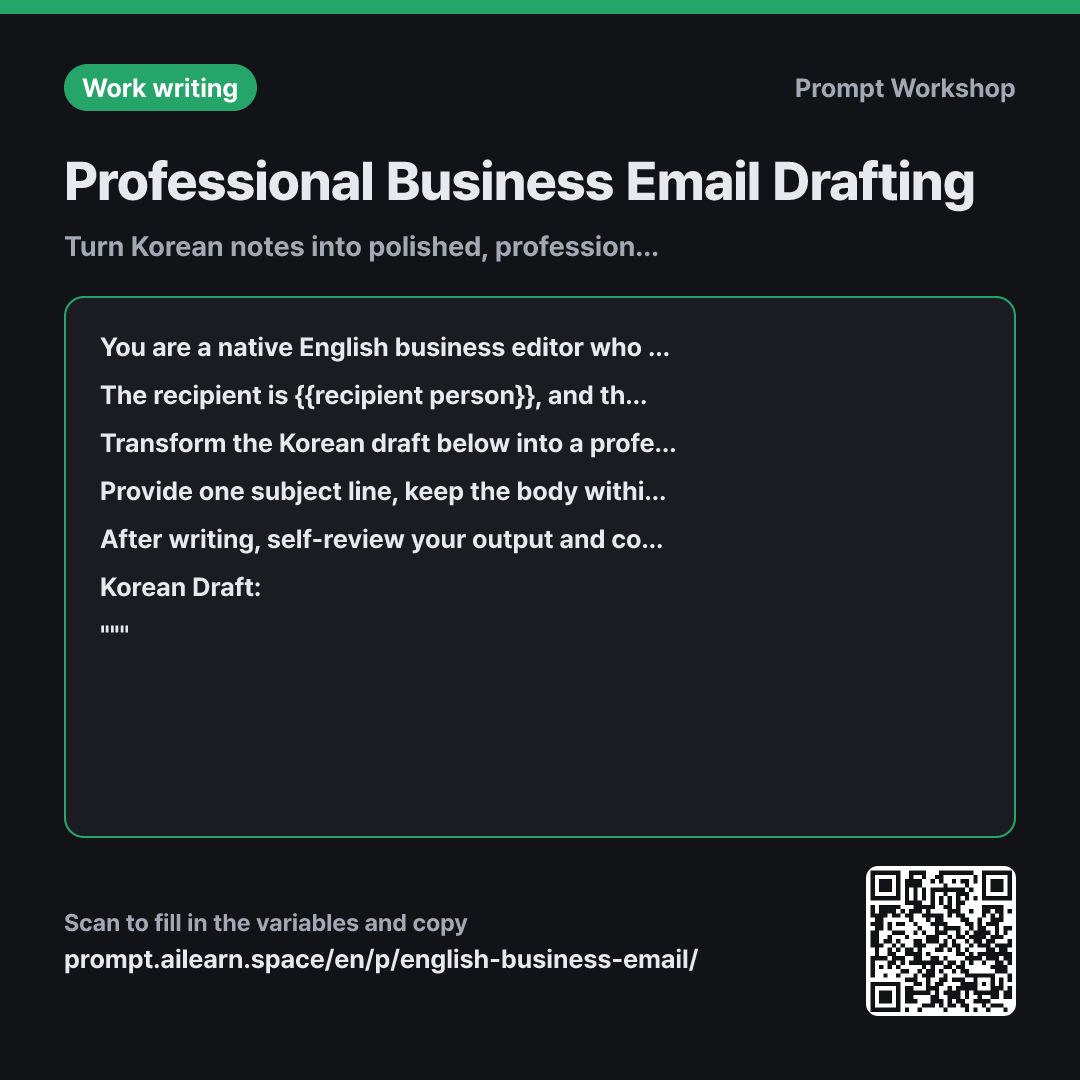
Why it is written this way
When asking AI to "translate" a Korean draft, it usually produces a word-for-word translation in English. Korean business communication often puts context first and the actual request at the very end. However, English-speaking professionals often postpone reading emails if the core ask is not clear in the first paragraph. In addition, polite phrases like "Sorry for the inconvenience" sound like an admission of fault when translated literally.
This is why the Role in the first paragraph specifies an editor rather than a translator. An editor is empowered to restructure paragraphs and trim unnecessary phrasing. Without this instruction, the model tries too hard to stay faithful to the original text and preserves awkward expressions. The Context in the second paragraph defines the recipient and formality level for the same reason: the phrasing needed for a first-time outreach differs greatly from a routine message to a weekly collaborator.
The fifth paragraph sets up Self-Review. The biggest risk with AI-generated business emails is the subtle hallucination of unmentioned deadlines or quantities. By narrowing the verification criteria down to three points and requesting only the final result, the AI fixes any internal errors before returning the response.
Wrapping the Korean draft in """ ensures that internal requests like "please check" are treated as source material rather than instructions for the model. Asking for three bullet points explaining what changed allows anyone to verify why the email was rewritten that way before hitting send.
Unfamiliar terms? See Aha AI: role-prompting, prompt-injection, output-format
Compared with a bad example
Translate this into English:
Thank you for sending the quote last time. But the installation fee seems missing so please check it...
Following the original sentence order buries the main deadline ("revised quote by Wednesday") at the very bottom. Apologies are also carried over directly, making a simple inquiry look like an apology letter and delaying the recipient's response due to lack of clarity.
Variations
Reviewing an English Draft You Already Wrote
You are a native English business editor. Below is an English email I wrote to {{recipient person}}. The purpose of this email is {{main business}}.
Do not rewrite the entire email right away. Instead, point out issues first: ① Grammar or article errors, ② Phrasing that sounds awkward or unintentionally blunt to native speakers, and ③ Sentences where the core message gets diluted. Provide two examples for each category. Then, present a revised version addressing only the most critical areas.
""" {{korean draft text}} """
If you ask for an immediate rewrite, the entire text changes, making it harder to learn from your mistakes. Having the AI diagnose issues first helps improve your business writing skills over time.
Short Reply or Polite Decline
Write a short English reply to {{recipient person}}. The main purpose is {{main business}}, and the tone should be {{formality level}}.
Keep it under five sentences and output the body only without a subject line. Even if declining or reporting a delay, limit apologies to one brief sentence and offer an alternative or updated timeline instead.
""" {{korean draft text}} """
A standard three-paragraph structure is excessive for quick replies. This variant limits apologies to a single sentence and focuses the rest of the message on actionable next steps.
Model notes
The formality of English outputs varies between models. If the tone feels too stiff, follow up with "Make it sound more natural and conversational." If it feels overly casual, prompt it with "Adjust the tone for a first-time external business partner."
Related prompts
Last updated 2026-09-02 · Found a mistake? Let us know