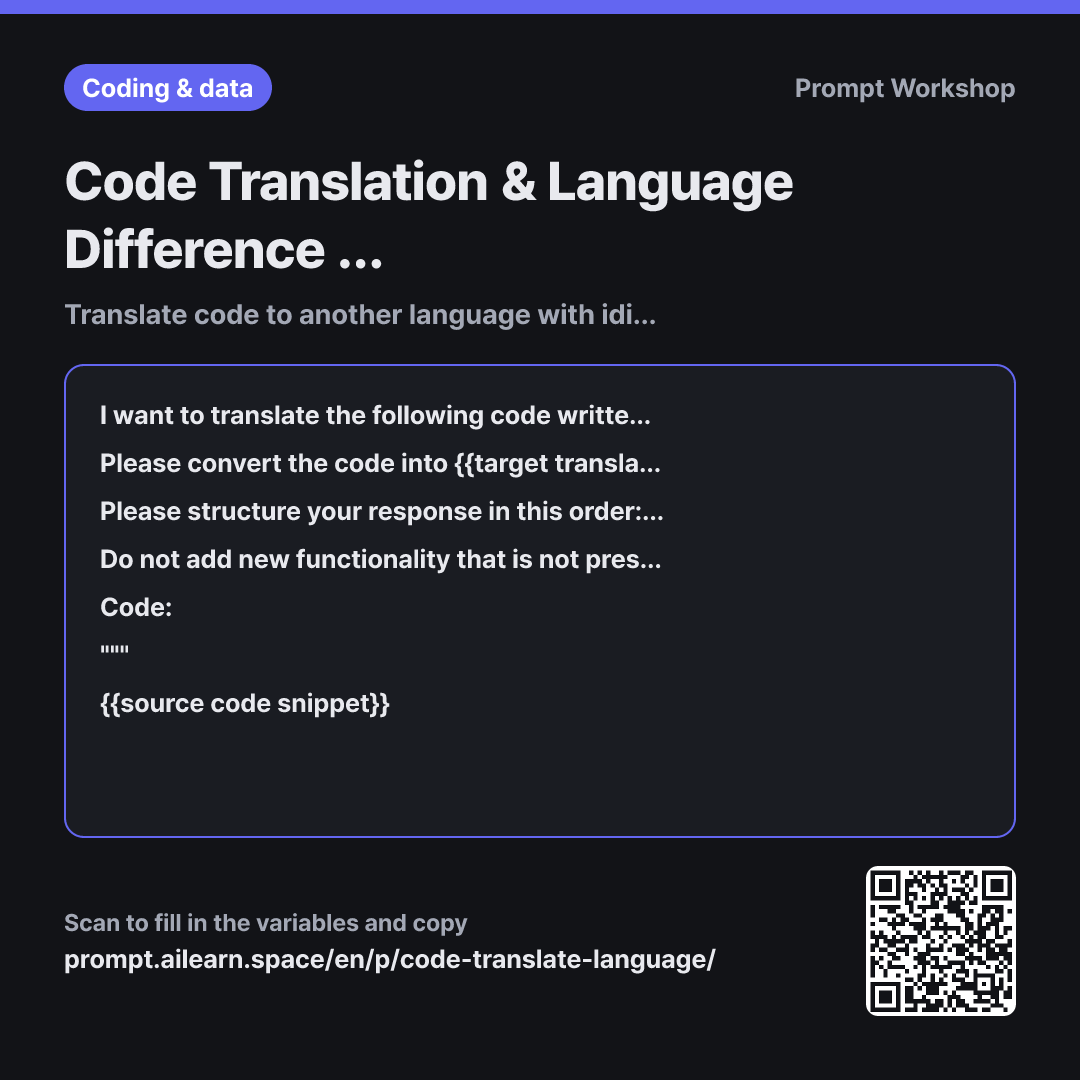
Why it is written this way
Code translation is something AI appears to do exceptionally well at a glance, making it tempting to copy-paste the output directly. The problem is that syntactically valid code is not necessarily safe code in the target language. An expression used casually in Python might lead to value truncation or runtime exceptions in Java, yet still pass compilation—causing bugs that surface much later.
This is why the Task explicitly states: "Do not just perform a literal syntax-by-syntax translation." Without this constraint, you get a direct line-by-line translation that runs, but is unidiomatic and difficult to maintain. Asking to highlight risky idioms from the original code serves the same purpose.
The core of the output Format lies in parts ② and ③. Receiving only the translated code offers no learning value because you cannot tell what changed or why. The diff table provides an at-a-glance comparison, and the "Behavioral edge cases" section surfaces typical translation traps upfront—such as integer division quirks, encoding issues, or null handling.
The "Needs Verification" rule in the Constraints prevents the model from hallucinating plausible-sounding library functions. When it admits uncertainty, you know exactly what to look up. Wrapping the code in """ prevents comments or strings inside the code from being interpreted as prompt instructions.
Unfamiliar terms? See Aha AI: hallucination, output-format
Compared with a bad example
Convert this to Java def parse_orders(rows): ... (paste code)
This will produce working code, but it will be a literal line-by-line translation retaining structures rarely used in Java. Without explanations of what changed, subtle divergence points like integer division are easily missed, and incorrect library names won't be caught until runtime. In the end, you spend just as much time verifying every line as you would translating it manually.
Variations
When you want to identify risks before porting
I plan to port the following {{source language}} code into {{target translation language}}. Do not translate the code yet; instead, identify potential risk areas and pain points in the migration. Provide a list ordered by risk severity, specifying for each item: the relevant source section · why it is problematic · potential candidate solutions. Do not mention sections that require no special attention.
""" {{source code snippet}} """
Use this before porting large or complex codebases. Identifying risk points beforehand gives you a clear checklist when reviewing the converted code.
When validating an already translated snippet
Below is code that I have translated from {{source language}} to {{target translation language}}. Please identify edge case inputs where the output might diverge between the original and translated versions. Organize your findings in a table showing: Input Example · Original Result · Translated Result · Why they differ. For any sections where you determine behavior is identical, provide a one-line justification.
""" {{source code snippet}} """
Use this for code review after you have manually ported a snippet. Getting concrete test input values upfront allows you to run direct comparative tests immediately.
Model notes
Always execute and test the translated code yourself. Models frequently hallucinate exact method names or argument orders even when referencing the correct standard library.
Related prompts
Last updated 2026-09-02 · Found a mistake? Let us know