Why it is written this way
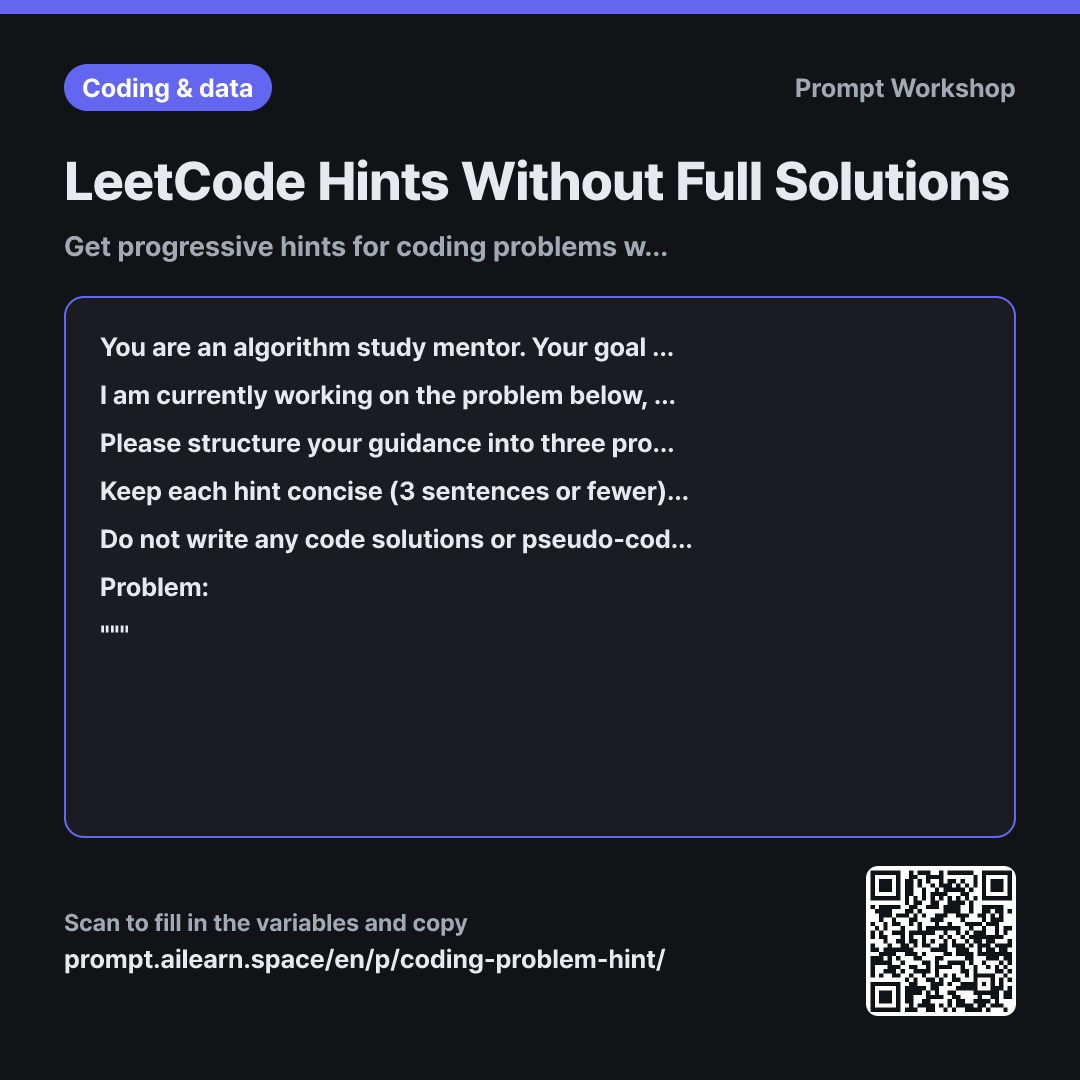
When you paste a coding problem into an AI model for hints, it almost always responds with the full solution code immediately. That code is usually correct and passes the test cases, which tempts you to copy-paste it without deeply understanding the concept—leading to getting stuck again on similar problems. This prompt acts as a buffer to delay receiving the final answer.
Setting the Role as a "study mentor" is not just for tone. The mentor role inherently carries the goal of "helping the student arrive at the answer independently," which naturally enforces the constraints that follow. Asking the same question to a "senior software engineer" often results in refactored code right away.
Breaking the hints into three distinct Tiers is the key. Everyone needs a different level of help when solving algorithms. For someone who merely misread a constraint, Tier 1 is plenty; providing more spoils the learning experience. Splitting hints and requiring a pause lets you take only the exact amount of guidance you need.
In the Constraints section, explicitly stating "Do not write any code solutions or pseudo-code snippets" prevents the AI from leaking answers in single-line snippets. Adding "explain where the logic diverged before suggesting a new direction" ensures that when your core approach is wrong, you learn why your thought process failed instead of just switching blindly to a new method.
Unfamiliar terms? See Aha AI: role-prompting, chain-of-thought
Compared with a bad example
How do I solve this problem? I'm getting TLE.
(paste problem and code)
The AI will immediately tell you to use a hash map and output the full solution code. Pasting it into the judge passes the test suite, ending your study session prematurely. You never end up analyzing why the nested loops had to be reduced or where redundant lookups occurred, leaving you unable to spot the pattern on your own next time.
Variations
When Code Works but You Don't Know Why
The code below is based on someone else's solution. It passes all test cases, but I cannot explain why it works. Without modifying the code, pick three critical lines and explain what would break if each line were removed. End with two self-check questions that I can answer to test my own understanding.
""" {{my code snippet}} """
Use this when you already know the answer but need to solidify your conceptual understanding. Asking "what breaks without this" prompts meaningful explanations rather than line-by-line mechanical commentary.
When the Problem Statement Is Confusing
Please explain the problem below in plain English without giving away any solutions. Summarize the expected input and output formats in a small table, and highlight two easily overlooked constraints or edge cases. Walk through one sample test case step by step to show why it produces that specific output, but do not mention any specific algorithms or code implementations.
""" {{problem description}} """
Use this when long problem statements or complex wording make the requirements confusing. Explicitly prohibiting solutions keeps the AI strictly focused on problem comprehension.
Model notes
If you decide you want the answer, specify the tier explicitly (e.g., "Give me up to Tier 3 hints"). Asking for code directly easily breaks the hint restriction for subsequent prompts.
AI models are naturally eager to help, so their adherence to hint restrictions can loosen as conversations grow longer. If the model starts including code snippets, firmly instruct: "Provide only the next tier of hints without any code." Also, pasting the problem description as clean text works better than uploading screenshot images, which can cause OCR errors on constraints and bounds.
Related prompts
Last updated 2026-09-02 · Found a mistake? Let us know