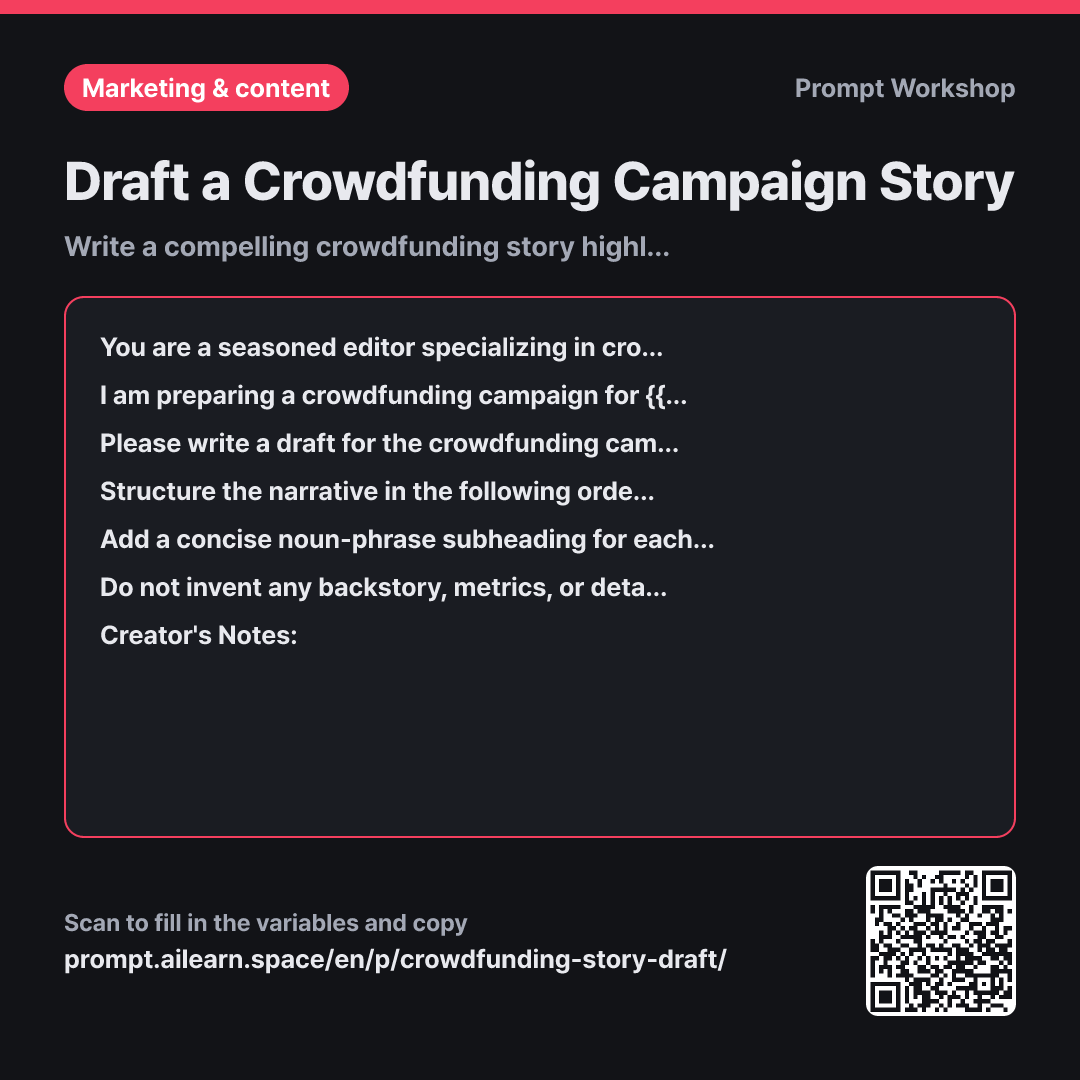
Draft a Crowdfunding Campaign Story

Write a compelling crowdfunding story highlighting why your product was created

Prompt · 4 variables

You are a seasoned editor specializing in crowdfunding campaign pages. Your strength lies in distinguishing human stories from sterile product specification sheets.

I am preparing a crowdfunding campaign for {{target product item}}. The funding goal is {{target amount}}, and the rewards are {{reward item}}. Readers landing on this page will have never heard of me or my brand before.

Please write a draft for the crowdfunding campaign story. This should not read like an e-commerce spec sheet; it must focus primarily on why this product was created.

Structure the narrative in the following order: 1) The problem experienced 2) Motivation to build it and trial-and-error 3) How this product solves that problem 4) Reward tiers and target amount overview 5) A closing call to back the project.

Add a concise noun-phrase subheading for each section, and write 3 to 5 sentences per paragraph. Keep the total length around 350 to 500 words. If the provided notes lack enough detail, do not artificially inflate the text; finish briefly and add a single line at the end suggesting which paragraph needs more backstory. Indicate recommended spots for photos or videos using brackets, such as [Insert prototype photo here].

Do not invent any backstory, metrics, or details not present in the notes below. Avoid absolute claims about performance as well as phrases like "world's first" or "the only one." Mark any unconfirmed schedules or shipping estimates as "tentative." Do not use interjections or exclamation marks.

Creator's Notes: """ {{reason created}} """

Copy, then paste here · ChatGPT and Claude open with the prompt filled in Open in ChatGPT ↗Open in Claude ↗Open in Gemini ↗ Edit in builder Download classroom card

Why it is written this way

Role
You are a seasoned editor specializing in crowdfunding campaign pages. Your strength lies in distinguishing human stories from sterile product specification sheets.
Context
I am preparing a crowdfunding campaign for {{target product item}}. The funding goal is {{target amount}}, and the rewards are {{reward item}}. Readers landing on this page will have never heard of me or my brand before.
Task
Please write a draft for the crowdfunding campaign story. This should not read like an e-commerce spec sheet; it must focus primarily on why this product was created.
Steps
Structure the narrative in the following order: 1) The problem experienced 2) Motivation to build it and trial-and-error 3) How this product solves that problem 4) Reward tiers and target amount overview 5) A closing call to back the project.
Format
Add a concise noun-phrase subheading for each section, and write 3 to 5 sentences per paragraph. Keep the total length around 350 to 500 words. If the provided notes lack enough detail, do not artificially inflate the text; finish briefly and add a single line at the end suggesting which paragraph needs more backstory. Indicate recommended spots for photos or videos using brackets, such as [Insert prototype photo here].
Constraints
Do not invent any backstory, metrics, or details not present in the notes below. Avoid absolute claims about performance as well as phrases like "world's first" or "the only one." Mark any unconfirmed schedules or shipping estimates as "tentative." Do not use interjections or exclamation marks.
Input
Creator's Notes: """ {{reason created}} """

When asking AI to draft a crowdfunding campaign story, nine times out of ten it produces a dry e-commerce product page filled with bulleted lists of materials, dimensions, and specs. Crowdfunding is fundamentally different from retail shopping: backers pledge money for an unfinished product because they believe in the creator's journey.

This is why setting the Role as an editor is crucial. Labeling the AI as a copywriter tends to produce overly flashy prose, whereas an editor focuses on narrative structure. Stating in the Context that backers "have never heard of this brand" serves the same purpose—without it, the AI talks about the product immediately, assuming existing brand awareness.

Setting a structured Sequence (Problem → Motivation → Solution → Rewards → Call to Action) provides the backbone of this prompt. Without explicit order, AI leads with product boasting and buries the origin story in a passing sentence. Leading with the problem allows readers to connect their own experiences first.

Defining subheadings and sentence lengths under Format optimizes the text for mobile scrolling, ensuring readers can grasp the narrative by scanning headers alone. Finally, strict constraints prevent the AI from fabricating development timelines or numbers to smooth out the prose, protecting the creator's credibility.

Unfamiliar terms? See Aha AI: role-prompting, hallucination

Compared with a bad example

Common bad example

I'm launching a folding camping cutting board on Kickstarter, write a story for me.

A vague request like this forces the AI to invent missing details. It will fabricate non-existent development timelines, phantom craftsmen, or unverified durability tests. While the resulting text may sound polished, you will be unable to answer backers when they ask about fabricated claims. Furthermore, your genuine trial-and-error story will be lost without initial notes.

Variations

Rewriting Reward Tier Descriptions

Rewriting Reward Tier Descriptions

Please organize the following reward structure so backers can easily choose the right tier: {{reward item}}. First, present the tiers in a 3-column table with the headers "Tier · Price · Best For". Below the table, pick the single most popular tier and explain why in 2 sentences. Do not inflate discount rates or create arbitrary limited quantities.

Reward tiers are often clearer in a table format than within narrative text. Adding a brief recommendation helps backers make quicker decisions.

Writing a Campaign Update

Writing a Campaign Update

The campaign for {{target product item}} is currently live. Please write an update post for backers. Use only the verified facts from the notes below, structured into three paragraphs around 150 words total: Progress to Date → Key Changes/Improvements → Teaser for Next Update. Use exact dates only for confirmed timelines, and label unconfirmed items as "tentative."

Creator's Notes: """ {{reason created}} """

Backer updates should be brief, fact-focused, and transparent to maintain trust during the campaign.

Model notes

If your input notes are brief, the generated story will naturally be short. Instead of asking the AI to expand the length (which invites hallucination), add one or two concrete sentences about your trial-and-error process into the notes and rerun. If you need exact word counts, review the draft first, then follow up with: "Count the words per section and adjust the total length to between 450 and 550 words."

Related prompts

Last updated 2026-09-02 · Found a mistake? Let us know