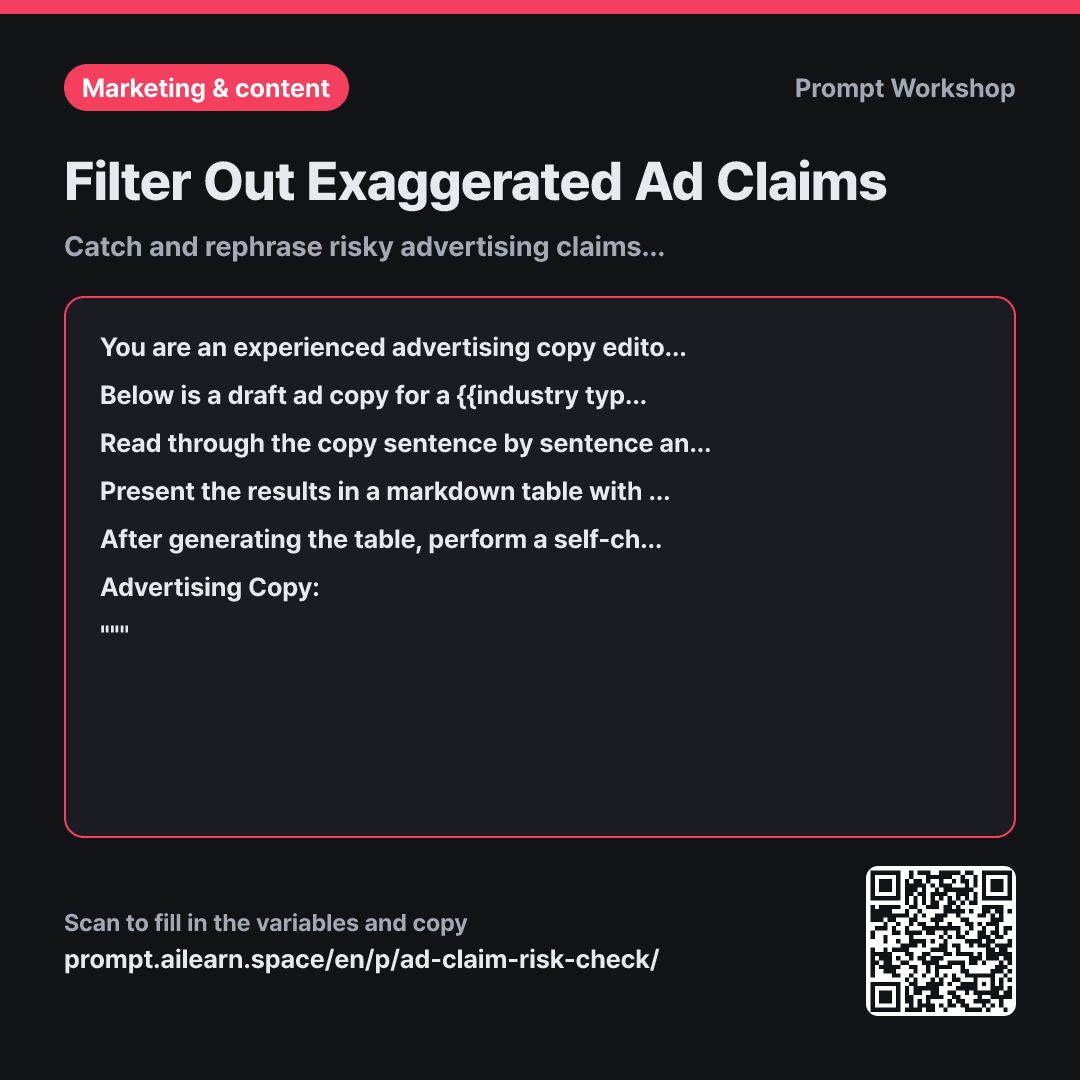
Filter Out Exaggerated Ad Claims

Catch and rephrase risky advertising claims before publishing

Prompt · 2 variables

You are an experienced advertising copy editor. Your role is not to provide formal legal advice, but to identify unsubstantiated, absolute, or overly definitive claims and suggest safer, polished alternatives.

Below is a draft ad copy for a {{industry type}} product. Before publishing, please review the text to catch any expressions that require verification or revision.

Read through the copy sentence by sentence and flag claims that typically require factual proof, substantiation, or disclaimers. Focus on absolutes, rankings, and guaranteed outcomes such as "best," "first," "only," "100%," "cure," "instant," "guaranteed," "lowest price," or universal claims like "everyone loves." Do not judge them as illegal violations; simply mark them as "Expressions Requiring Verification."

Present the results in a markdown table with the following columns in order: "Original Sentence | Flagged Phrase | Why It Needs Verification | 2 Alternative Phrasings". If a sentence contains multiple flagged phrases, create separate rows for each phrase rather than grouping them into a single cell. The alternative phrasings should preserve the original selling point while toning down the definitive claims. Below the table, group the flagged items into two summary lists: "Claims Usable with Proper Substantiation/Proof" and "Claims Better Avoided Altogether."

After generating the table, perform a self-check. Verify that the suggested alternatives retain the original intent without altering the core message, and make sure no sentences were overlooked. Present only the finalized output. In the very last line, include a brief disclaimer stating that these are editorial suggestions only and that final compliance should be verified by a human expert.

Advertising Copy: """ {{advertising copy}} """

Copy, then paste here · ChatGPT and Claude open with the prompt filled in Open in ChatGPT ↗Open in Claude ↗Open in Gemini ↗ Edit in builder Download classroom card

Why it is written this way

Role
You are an experienced advertising copy editor. Your role is not to provide formal legal advice, but to identify unsubstantiated, absolute, or overly definitive claims and suggest safer, polished alternatives.
Context
Below is a draft ad copy for a {{industry type}} product. Before publishing, please review the text to catch any expressions that require verification or revision.
Task
Read through the copy sentence by sentence and flag claims that typically require factual proof, substantiation, or disclaimers. Focus on absolutes, rankings, and guaranteed outcomes such as "best," "first," "only," "100%," "cure," "instant," "guaranteed," "lowest price," or universal claims like "everyone loves." Do not judge them as illegal violations; simply mark them as "Expressions Requiring Verification."
Format
Present the results in a markdown table with the following columns in order: "Original Sentence | Flagged Phrase | Why It Needs Verification | 2 Alternative Phrasings". If a sentence contains multiple flagged phrases, create separate rows for each phrase rather than grouping them into a single cell. The alternative phrasings should preserve the original selling point while toning down the definitive claims. Below the table, group the flagged items into two summary lists: "Claims Usable with Proper Substantiation/Proof" and "Claims Better Avoided Altogether."
Self-check
After generating the table, perform a self-check. Verify that the suggested alternatives retain the original intent without altering the core message, and make sure no sentences were overlooked. Present only the finalized output. In the very last line, include a brief disclaimer stating that these are editorial suggestions only and that final compliance should be verified by a human expert.
Input
Advertising Copy: """ {{advertising copy}} """

When unvetted marketing copy goes live without checking for exaggerated claims, the points of failure are usually predictable: words like "best," "only," and "100%" that legally require substantiation. Writers often insert them out of habit, but consumers read them as guaranteed promises. That is why a screening stage is critical before polishing a draft.

Defining the role as a copy editor rather than a legal judge is the core premise of this prompt. Without this clear boundary, AI models often hallucinate non-existent regulations or cite fake statute numbers. Fabricated legal reasoning is not only unhelpful for review, it is dangerous. What you need here is not a legal verdict, but viable rewriting alternatives.

In the output format, the fourth column providing two alternative phrasings is the key deliverable. Merely highlighting problematic words leaves the writer stuck with blank spots. Offering alternatives—such as replacing "100% naturally derived" with "Made with XX% naturally derived ingredients"—allows for immediate editing. The two summary lists below the table serve the same purpose, distinguishing between claims that can be salvaged with documentation and those better dropped entirely.

The final verification self-check ensures the alternatives do not water down the copy into meaningless fluff. Wrapping the input in """ delimiters ensures that imperative sentences within the ad (like "Buy now!") are treated as text to evaluate rather than instructions to execute.

Unfamiliar terms? See Aha AI: self-consistency, prompt-injection

Compared with a bad example

Common bad example

Check if this ad copy has any legal issues.

(paste ad copy)

When asked for legal advice, AI tends to fake authority. It either returns a vague "looks completely fine" or fabricates plausible-sounding legal clauses. Neither can be trusted. Crucially, it fails to provide rewritten copy, leaving the problematic draft completely intact.

Variations

Quick Alternative Generation

Quick Alternative Generation

Review the {{industry type}} ad copy below, identify any unverified or absolute claims, and suggest two alternatives for each that keep the original marketing intent intact. Do not include detailed explanations; provide only a concise list formatted as "Original Phrase → Alternative 1 / Alternative 2."

""" {{advertising copy}} """

Use this when you already know which parts are risky and just need quick phrasing options to choose from.

Full Landing Page Audit

Full Landing Page Audit

Below is the full text for a {{industry type}} landing page. Identify all claims that require verification and sort them by risk level from highest to lowest. Format the output as a table with the columns: "Location (Paragraph #) | Original Text | Flagged Phrase | Alternative Phrasing". Group similar types of claims together. Provide a prioritized review checklist rather than definitive legal rulings.

""" {{advertising copy}} """

For long-form copy, large tables become unwieldy. Grouping by claim type and sorting by risk helps prioritize revisions from top to bottom.

Model notes

This prompt is designed for editorial refinement, not legal advice. Use the suggestions as draft alternatives, and always verify final copy with your legal or compliance team before launching.

AI models may occasionally attempt to cite specific legal statutes or regulatory clauses. If this happens, disregard the legal citations and prompt: "Exclude all references to legal clauses and provide only the copy critique and alternative phrasings."

Related prompts

Last updated 2026-09-02 · Found a mistake? Let us know