Why it is written this way
It is notoriously difficult to spot flaws in your own writing because your brain automatically fills in the gaps from your memory. That is why an effective review prompt should never merely ask to "take a look"—it must first establish structured evaluation criteria. Without explicit criteria, AI typically returns generic compliments and minor typo fixes.
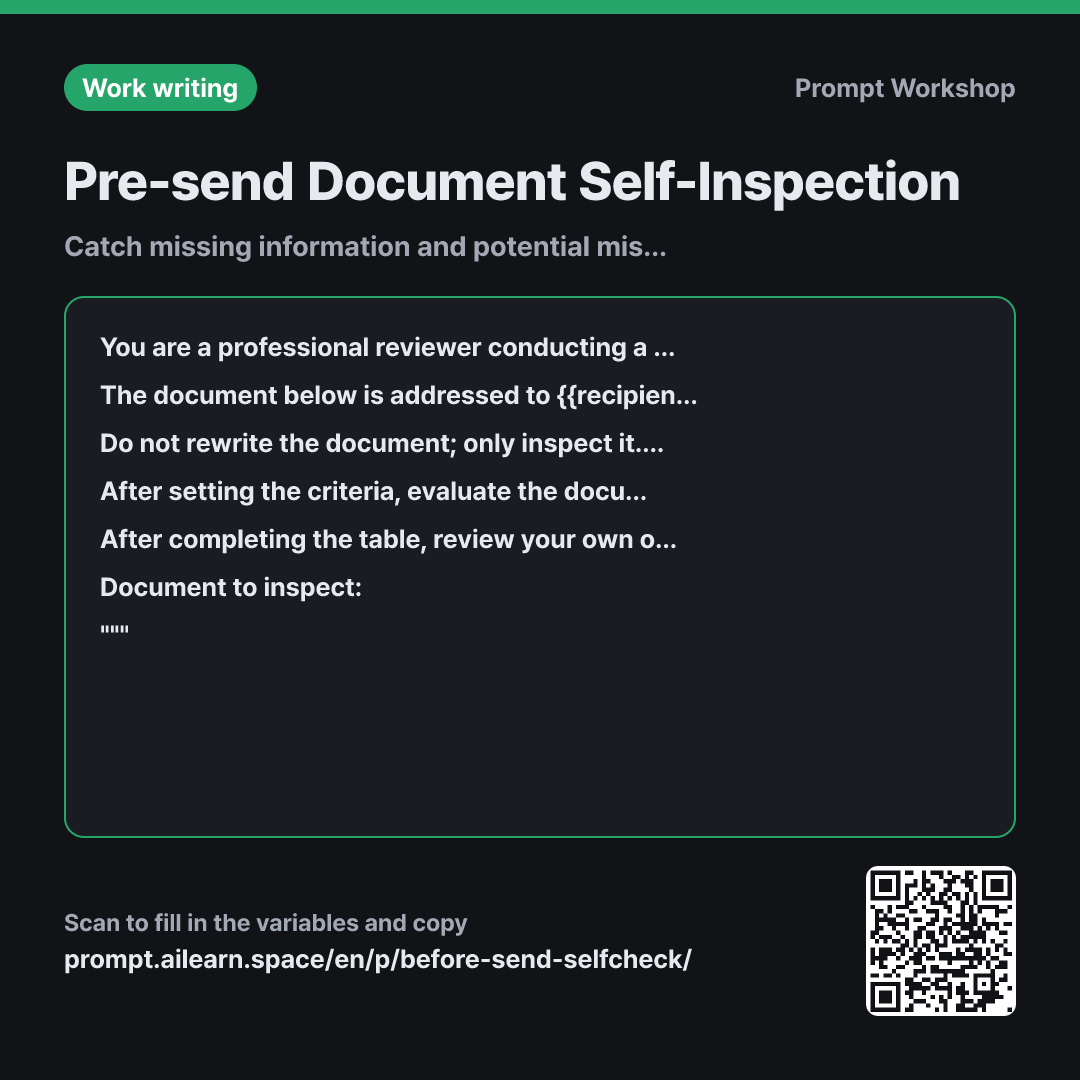
The first line establishes the Role strictly as an inspector who finds issues rather than a ghostwriter. Without this boundary, the AI tends to output a fully rewritten draft immediately, obscuring where the original weaknesses were. The Context provided by the recipient and purpose completely alters the evaluation criteria—a sentence acceptable to a direct report might be problematic when addressed to an executive or an external client.
The Task section requires drafting 6 specific criteria beforehand to prevent superficial, unstructured commentary. The three-tier rating and verbatim quotation in the Format eliminate hallucinated critiques; if the AI cannot cite an exact sentence, the critique is discarded as unfounded.
The fifth paragraph adds a self-verification loop where the AI double-checks its own table before finalizing. The concluding line on "What might happen if sent as is" gives the writer an immediate risk assessment to decide whether a rewrite is mandatory. Wrapping the input in """ ensures that meta-phrases inside the draft (such as "Please review immediately") are not mistaken for prompt instructions.
Unfamiliar terms? See Aha AI: output-format, prompt-injection
Compared with a bad example
Can you check if this looks good to send?
(paste draft here)
Asking like this usually produces a couple of polite lines like "Looks great!" followed by basic grammar corrections. Because no evaluation criteria are specified, critical omissions (such as missing attachments or vague deadlines) that would prompt follow-up questions from the recipient get overlooked. Often, the AI provides an unsolicited full rewrite, leaving you unclear on what specifically was wrong with the original text.
Variations
30-Second Pre-Flight Check (Quick)
Please inspect the draft below before I send it to {{recipient person}}. Focus only on these 3 points (maximum 2 items each): ① Clarifications the recipient will likely have to ask for, ② Missing details (deadlines, owners, attachments), and ③ Sentences that could be misunderstood. Do not provide a rewritten draft.
""" {{document to inspect}} """
Reduces the criteria to three key areas and drops the table format. Best suited for short emails when you need immediate, scannable feedback.
Anticipating Pushback Before Submission
Below is a document addressed to {{recipient person}} for the purpose of {{document purpose}}. Predict 3 likely reasons the approver might reject this request or ask for revisions. For each reason, quote the exact sentence from the draft that serves as evidence. Then, list specific items needed to address those 3 concerns. Do not rewrite the document.
""" {{document to inspect}} """
Narrows the evaluation criteria specifically to "reasons for rejection." Highly effective for approval requests, proposals, or formal sign-offs.
Model notes
If the document is very short, generating 6 inspection criteria may be excessive. For drafts under ten lines, replace it with "4 criteria are sufficient."
Some models may slightly paraphrase the original text in the "Supporting Quote" column. If the citations are not verbatim, instruct the model: "Re-quote the exact sentences from the draft word-for-word without altering a single character."
Related prompts
Last updated 2026-09-02 · Found a mistake? Let us know